
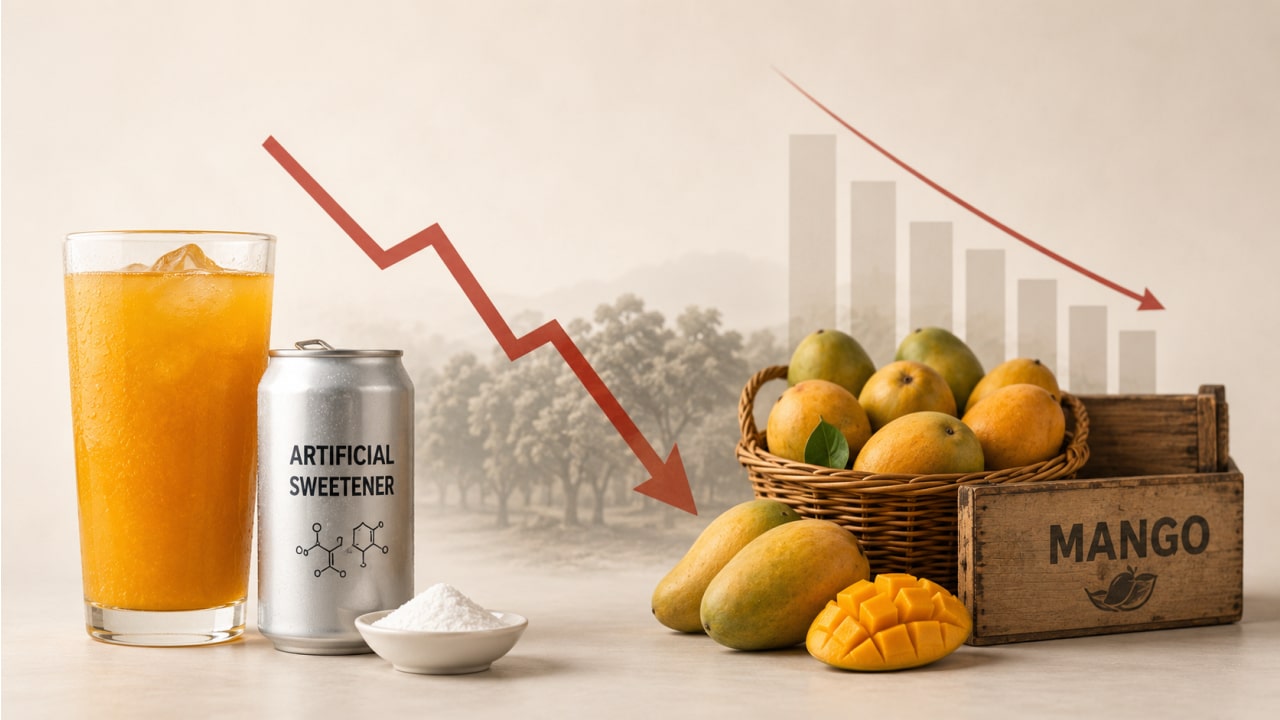
The Pakistan mango industry is currently navigating a structural baseline shift as production volume has plummeted from 2.2 million to 1.8 million tonnes. This strategic decline stems from a calibrated reduction in demand for natural mango pulp within the industrial beverage sector. Consequently, the National Assembly Standing Committee on National Food Security and Research has initiated a high-level inquiry to address the systemic challenges facing our national fruit production.
The Catalyst: Regulatory Shifts and Synthetic Adoption
Precision data provided by the Multan Mango Growers Association reveals that the industry began destabilizing following specific regulatory changes in 2021. During that period, the Pakistan Standards and Quality Control Authority (PSQCA) revised standards to permit an increased utilization of artificial sweeteners and chemical additives. Manufacturers subsequently pivoted away from natural mango pulp, choosing cost-efficient synthetic alternatives over high-quality agricultural inputs.

Strategic Risks to the Pakistan Mango Industry
- Production Decay: National output has contracted by approximately 18% in recent cycles.
- Market Displacement: Synthetic ingredients have effectively replaced natural fruit content in mass-market beverages.
- Public Health Trajectory: The National Institute of Health has identified a correlation between synthetic beverage consumption and adverse health outcomes.

The “Situation Room” Analysis
The Translation: Precision Context
In technical terms, the beverage industry has undergone a “formula optimization” that prioritizes shelf-life and profit margins over raw material integrity. By utilizing additives allowed under the 2021 PSQCA framework, companies have bypassed the Pakistan mango industry supply chain. This shift effectively decouples industrial growth from agricultural prosperity, creating a localized recession for mango growers who previously relied on juice production as a primary revenue stream.
The Socio-Economic Impact
This development directly impacts the economic stability of rural households across Punjab and Sindh. As the Pakistan mango industry shrinks, seasonal employment opportunities for students and laborers vanish. Furthermore, urban consumers are unknowingly transitioning from nutrient-dense natural juices to “fruit-flavored” synthetic beverages, which potentially escalates long-term national healthcare expenditures due to metabolic health risks.

The Forward Path: Strategic Opinion
We categorize this current trend as a Momentum Stall. To regain a “Momentum Shift” toward progress, Pakistan must re-engineer its food safety benchmarks. The government should implement a tiered taxation system that favors products with high natural pulp content. Restoring the Pakistan mango industry requires a structural return to quality-first manufacturing, ensuring that our agricultural wealth drives our industrial output rather than being replaced by it.








