
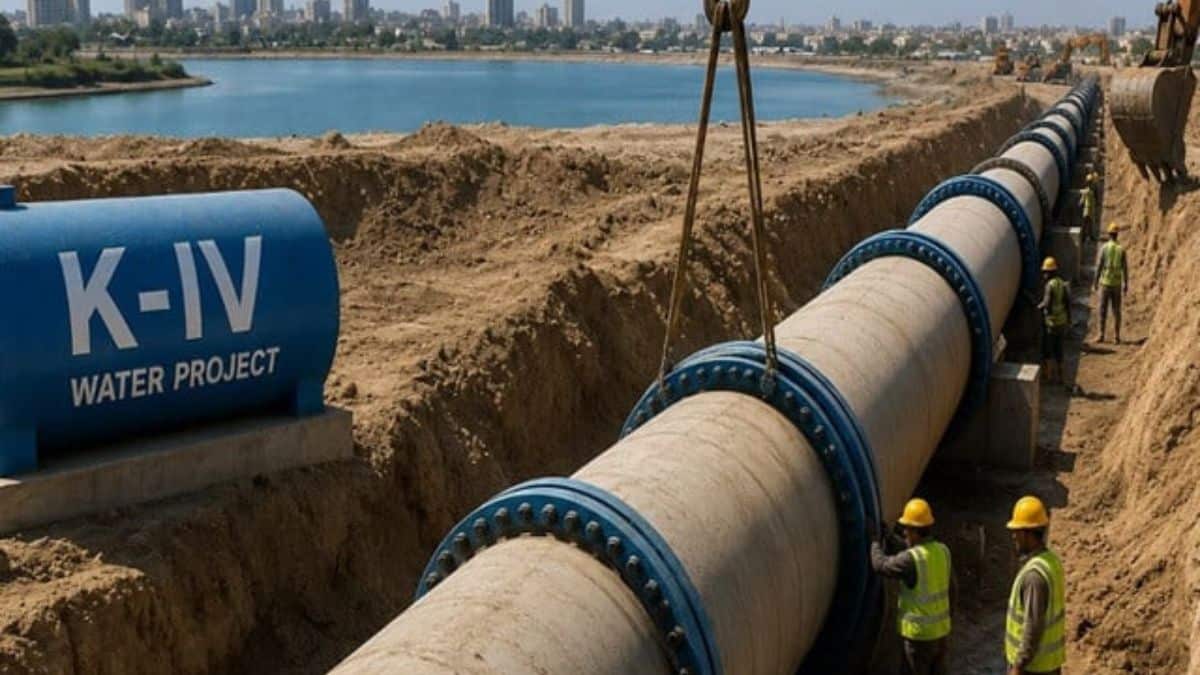
The K-IV water project remains a critical bottleneck for Pakistan’s economic engine, requiring an additional Rs. 70 billion to reach operational capacity. While the state has already deployed Rs. 86 billion, only 40 percent of the physical infrastructure stands complete. This structural delay forces Karachi’s residents to navigate a calibrated water shortage that drains household incomes. Consequently, strategic intervention is now required to bridge the fiscal gap and ensure the city’s survival.
The Technical Status of the K-IV Water Project
Minister for Water Resources Moeen Wattoo recently briefed the National Assembly Standing Committee on the project’s stagnation. Although the federal government oversees the primary construction through WAPDA, the actual water distribution remains under the jurisdiction of the Sindh government. This bifurcated responsibility has historically complicated the funding pipeline. However, the Sindh government recently released its share of Rs. 7.70 billion, providing a minor catalyst for resumed activity.
The Translation: Deconstructing the Infrastructure Gap
In technical terms, the delay stems from a misalignment between fiscal allocation and project milestones. The K-IV water project is not merely a pipeline; it is a complex engineering system designed to scale with Karachi’s demographic surge. The funding shortage mentioned by WAPDA Chairman Lt. Gen. (Retd.) Sajjad Ghani indicates that the baseline cost of materials and labor has likely shifted since the project’s inception. Precision in capital management is now the only way to prevent further structural deterioration of the plan.
The Socio-Economic Impact: The Cost of Inaction
How does this change the daily life of a Pakistani citizen? For the average Karachi household, this delay translates into a massive “water tax” imposed by the private tanker mafia. Families currently spend up to Rs. 8,000 for a single water tanker. Furthermore, this drains disposable income that could otherwise support education or local commerce. This artificial scarcity creates a baseline of systemic inequality, where access to a basic human right is determined by the ability to pay exorbitant private rates.
The Forward Path: A Stabilization Move
Our analysis categorizes this development as a “Stabilization Move” rather than a “Momentum Shift.” While the release of funds is a necessary catalyst, the project lacks the aggressive timeline required for a true breakthrough. We believe that unless the government implements a rigid, precision-driven audit of the remaining 60 percent of work, the completion date will remain a moving target. National advancement depends on the efficiency of our urban cores; Karachi cannot lead if it cannot provide water to its architects and innovators.
- Total Spent: Rs. 86 Billion
- Required Funding: Rs. 70 Billion
- Completion Status: 40%
- Current Consumer Cost: Rs. 8,000 per tanker








