
The federal government is currently calibrating a significant fuel tax hike, potentially raising the Petroleum Development Levy (PDL) to Rs. 180 per litre by the fiscal year 2027. According to data from Arif Habib Limited (AHL), this strategic maneuver aims to generate Rs. 1.73 trillion in revenue. This represents a substantial 17.8 percent year-on-year surge in collection. Consequently, the state is prioritizing fiscal consolidation to address structural deficits within the national budget.
Analyzing the Impact of the Fuel Tax Hike on System Efficiency
To achieve these ambitious targets, the combined levy on petrol and high-speed diesel must increase from the current baseline of Rs. 160 to approximately Rs. 180 per litre. AHL analysts indicate that this projection assumes fuel consumption will remain relatively flat. Furthermore, high prices often act as a deterrent, potentially suppressing domestic demand. In contrast, if the government strengthens anti-smuggling enforcement, the increased volume could offset the need for such aggressive tax escalations.
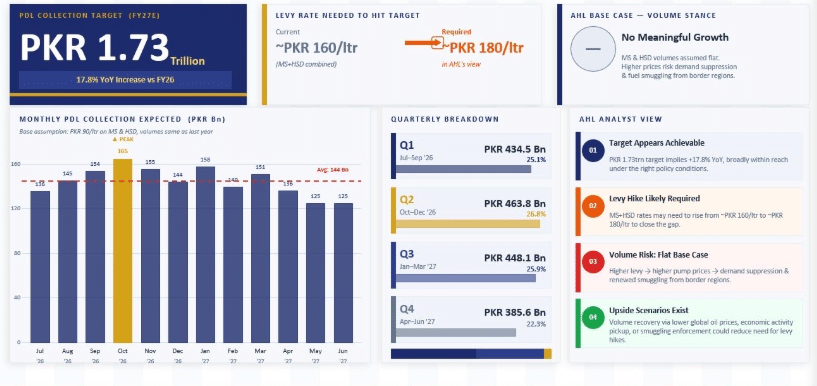
Economic variables remain the primary catalyst for these adjustments. Stronger domestic industrial activity or a downward trend in global crude oil prices could improve demand metrics. If these external factors align, the government may reach its trillion-rupee milestone without imposing the full weight of the projected levy increase on the public.
The Situation Room: Analysis & Outlook
The Translation (Clear Context)
The Petroleum Development Levy serves as a direct revenue stream for the federal government that does not require sharing with the provinces. By raising the levy to Rs. 180, the state is building a predictable fiscal buffer. This strategy focuses on meeting international lender requirements while maintaining a centralized treasury surplus. Essentially, the government is shifting the burden of revenue generation toward consumption-based taxation.
The Socio-Economic Impact
For the average Pakistani citizen, this development signals an increase in the cost of living. A fuel tax hike directly inflates transportation expenses and the “last-mile” cost of essential commodities. Students and young professionals will likely face tighter disposable income margins. However, if the government successfully prevents fuel smuggling, the increased tax integrity could lead to more stable long-term energy pricing for the formal economy.
The Forward Path (Opinion)
This development represents a Stabilization Move. While necessary for immediate fiscal equilibrium, it is a defensive strategy rather than a structural innovation. Precision in enforcement is now the critical variable; without curbing the shadow fuel economy, the government risks penalizing formal consumers while failing to hit its collection targets. We must eventually pivot toward energy diversification to reduce this reliance on petroleum-based taxation.








