
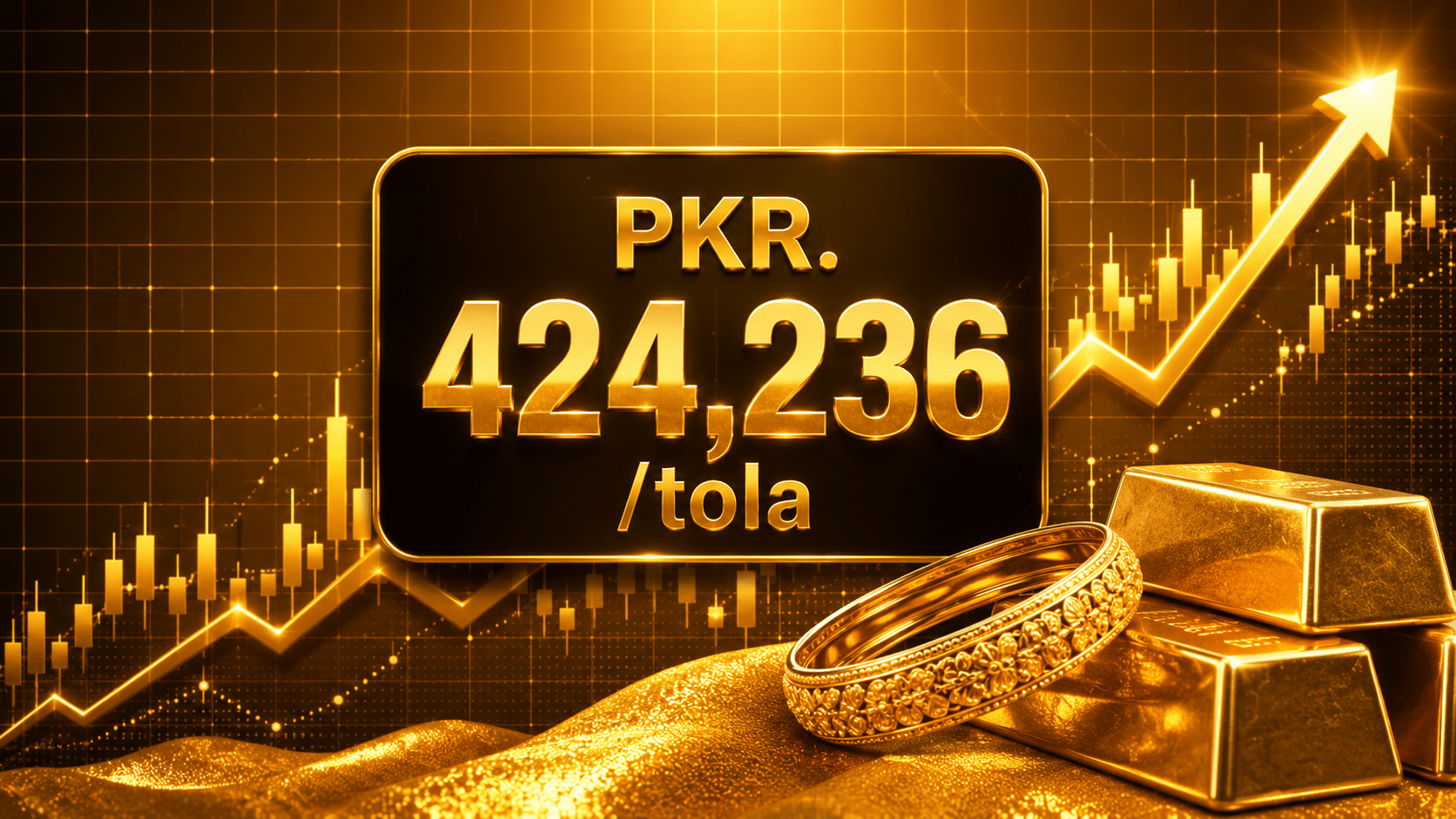
The domestic bullion landscape serves as a vital baseline for national economic stability, and recent data confirms that gold prices in Pakistan experienced a calibrated recovery to close the week. On Saturday, the All Pakistan Sarafa Gems and Jewelers Association reported a significant increase in commodity value. Specifically, the price of gold per tola rose by Rs. 2,400, settling at a new baseline of Rs. 424,236.
This upward movement follows a volatile trading period. On Friday, the market observed a sharp contraction where prices lost Rs. 3,600. However, the Saturday surge effectively mitigated much of that decline. Consequently, the 10-gram gold valuation adjusted to Rs. 363,713, reflecting the broader market’s attempt to stabilize against international fluctuations.
The Translation: Decoding Market Fluctuations
In the global theater, gold prices gained $24 to settle at $4,018 per ounce. This international catalyst directly influenced the domestic rebound. Furthermore, the silver market mirrored this positive momentum. Silver prices increased by Rs. 41, eventually settling at Rs. 6,070 per tola. These shifts represent a precision adjustment where local prices align with global currency and commodity benchmarks.

The Socio-Economic Impact: Wealth Storage Dynamics
For the average Pakistani citizen, gold is not merely an ornament; it is a strategic hedge against inflation. This recovery impacts household wealth significantly. When gold prices in Pakistan fluctuate with such velocity, it alters the purchasing power of middle-class families planning for weddings or long-term savings. High precision in monitoring these rates is essential for maintaining individual financial resilience in an evolving economy.
The Forward Path: A Momentum Shift
Our structural analysis classifies this recent movement as a Momentum Shift. The swift recovery following Friday’s dip suggests a strong underlying demand and a sensitivity to global market gains. While the market remains volatile, the weekend closing figures indicate a move toward consolidation. Investors should view this as a period of strategic recalibration rather than pure stabilization.








