

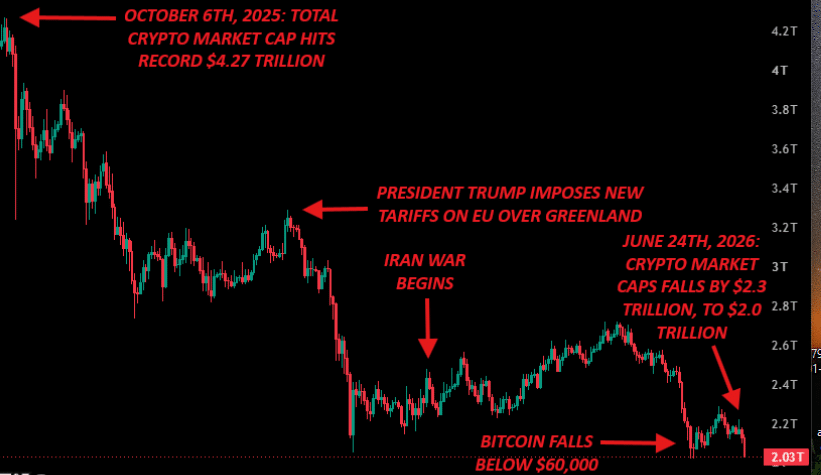
The global crypto market crash has calibrated a new reality for digital assets, erasing approximately $9 billion in value every day for the last 261 consecutive days. This structural decline represents a capital evaporation of over 54%, moving the market from a $4.3 trillion peak to a $2.0 trillion baseline. Consequently, investors are witnessing one of the most sustained precision downturns in the history of decentralized finance.
Analyzing the Massive Crypto Market Crash
On October 6th, 2025, the total cryptocurrency market capitalization reached a record-breaking $4.3 trillion. However, the ecosystem has since faced a relentless correction phase. Data from The Kobeissi Letter confirms that the markets have bled an average of $8.8 billion daily. Furthermore, this trend suggests that the speculative momentum of the previous year has been replaced by a strategic deleveraging process.
Bitcoin’s Trajectory and Market Sentiment
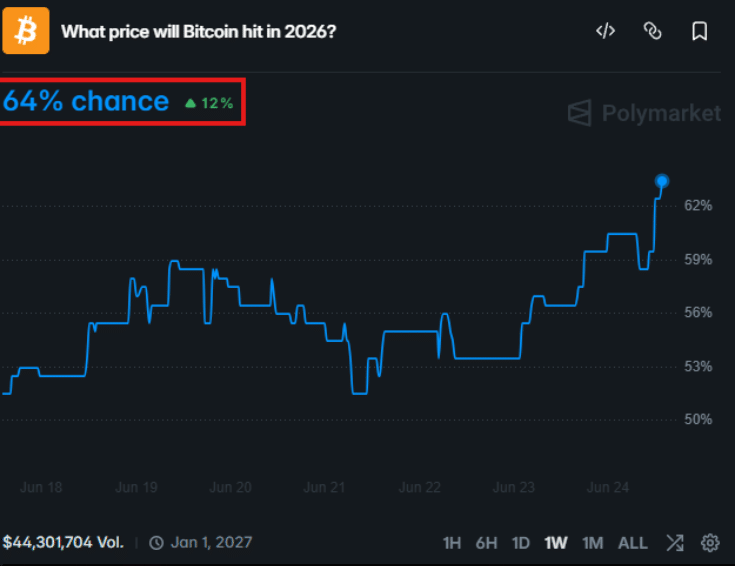
Specifically, Bitcoin is facing immense downward pressure with a high probability of falling below the critical $50,000 threshold. Research indicates a 64% likelihood of this drop occurring within 2026. Additionally, there is a 46% statistical probability that Bitcoin could descend further to $45,000. Many industry analysts now argue that the crypto space requires a new narrative to catalyze a recovery phase.
The Situation Room Analysis
The Translation
This is not merely a “dip” but a fundamental market reset. The loss of $2 trillion in 261 days indicates that liquidity is exiting the system at an unprecedented velocity. We are observing a shift from high-risk speculative behavior to a more disciplined financial environment. Essentially, the “easy money” era of crypto has concluded, making room for more calibrated institutional assets.
The Socio-Economic Impact
For the average Pakistani citizen, particularly the youth and freelance community, this crash impacts personal savings and international payment stability. Many local investors utilized crypto as a hedge against inflation. Consequently, the rapid devaluation reduces household purchasing power and creates a precision barrier for tech-driven entrepreneurship in urban centers like Karachi and Lahore.
The Forward Path
We categorize this development as a Stabilization Move. While the loss is staggering, the elimination of market froth is a necessary catalyst for long-term system efficiency. For Pakistan to progress, we must transition from speculative trading to building blockchain infrastructure that provides tangible utility. The current downturn is a strategic baseline for the next generation of digital finance.
- Peak Market Cap: $4.3 Trillion (Oct 2025)
- Current Market Cap: $2.0 Trillion (June 2026)
- Daily Erosion Rate: ~$8.8 Billion
- Total Decline: -54%








