
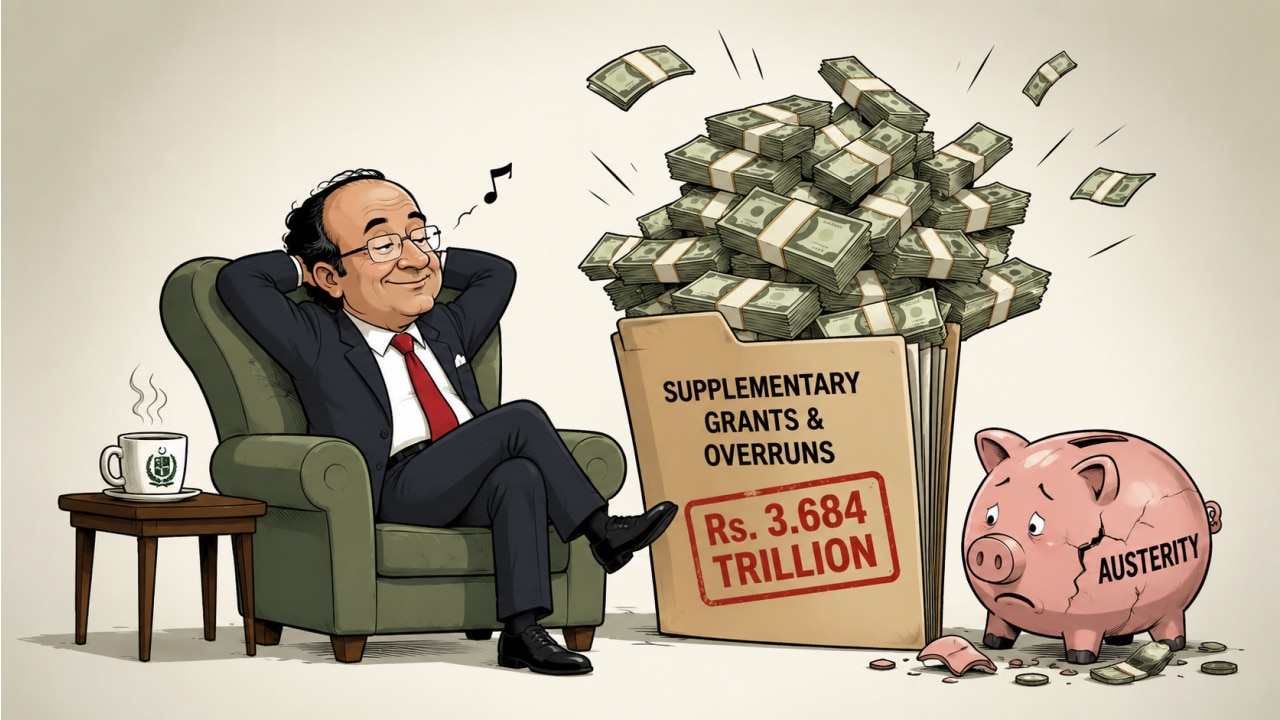
National financial stability requires precise calibration, but current data suggests a significant misalignment in Pakistan budget austerity measures. The federal government recently sought parliamentary approval for a record Rs. 3.684 trillion in supplementary grants. This figure represents a fourfold increase over the previous year’s regularized expenditure of Rs. 895 billion. Consequently, this surge in overspending prompts a rigorous re-evaluation of current budget planning and fiscal control mechanisms.
The Structural Impact of Pakistan Budget Austerity Discrepancies
The Finance Ministry is currently requesting post facto approval for expenditures that exceeded original budget allocations during fiscal years 2024-25 and 2025-26. While the Constitution requires parliamentary validation, the funds have already been deployed across various sectors. Specifically, debt servicing accounts for the most significant portion, requiring Rs. 2.6 trillion in supplementary grants for 2024-25 alone. Furthermore, the power sector necessitated an additional Rs. 430 billion to maintain operational stability.
Allocation Breakdown and Operational Demands
Beyond debt and power, the government allocated supplementary funds to defence services (Rs. 23 billion) and civil works (Rs. 22 billion). For the upcoming 2025-26 cycle, another Rs. 485 billion is already under review. These requests include Rs. 57 billion for education and Rs. 30 billion for health services. Notably, the documents reveal that the Prime Minister’s Austerity Fund itself utilized a supplementary grant of Rs. 127.4 billion, highlighting a paradoxical trend in fiscal management.
The Situation Room Analysis
The Translation (Clear Context)
In technical terms, “supplementary grants” serve as a fiscal escape valve when initial budget estimates fail to meet reality. Essentially, the government spent money it did not officially allocate at the start of the year and is now seeking “permission after the fact.” This indicates that the baseline Pakistan budget austerity targets were likely calibrated on optimistic assumptions rather than precise economic forecasting.
The Socio-Economic Impact
For the average Pakistani citizen, these overruns directly influence the cost of living. When the government exceeds its budget, it often bridges the gap through increased borrowing or inflationary money supply. This cycle places upward pressure on interest rates and limits the capital available for private sector growth. Therefore, overspending in the power sector often precedes tariff hikes, while high debt servicing costs drain resources that could otherwise fund local infrastructure or digital literacy programs.
The “Forward Path” (Opinion)
This development represents a Stabilization Move that is currently under extreme stress. While the government must meet operational requirements like debt servicing and power subsidies to avoid systemic collapse, the scale of these grants suggests a lack of structural precision. To achieve a true “Momentum Shift,” Pakistan must transition from reactive supplementary spending to proactive, data-driven fiscal discipline that aligns with international reform commitments.








