
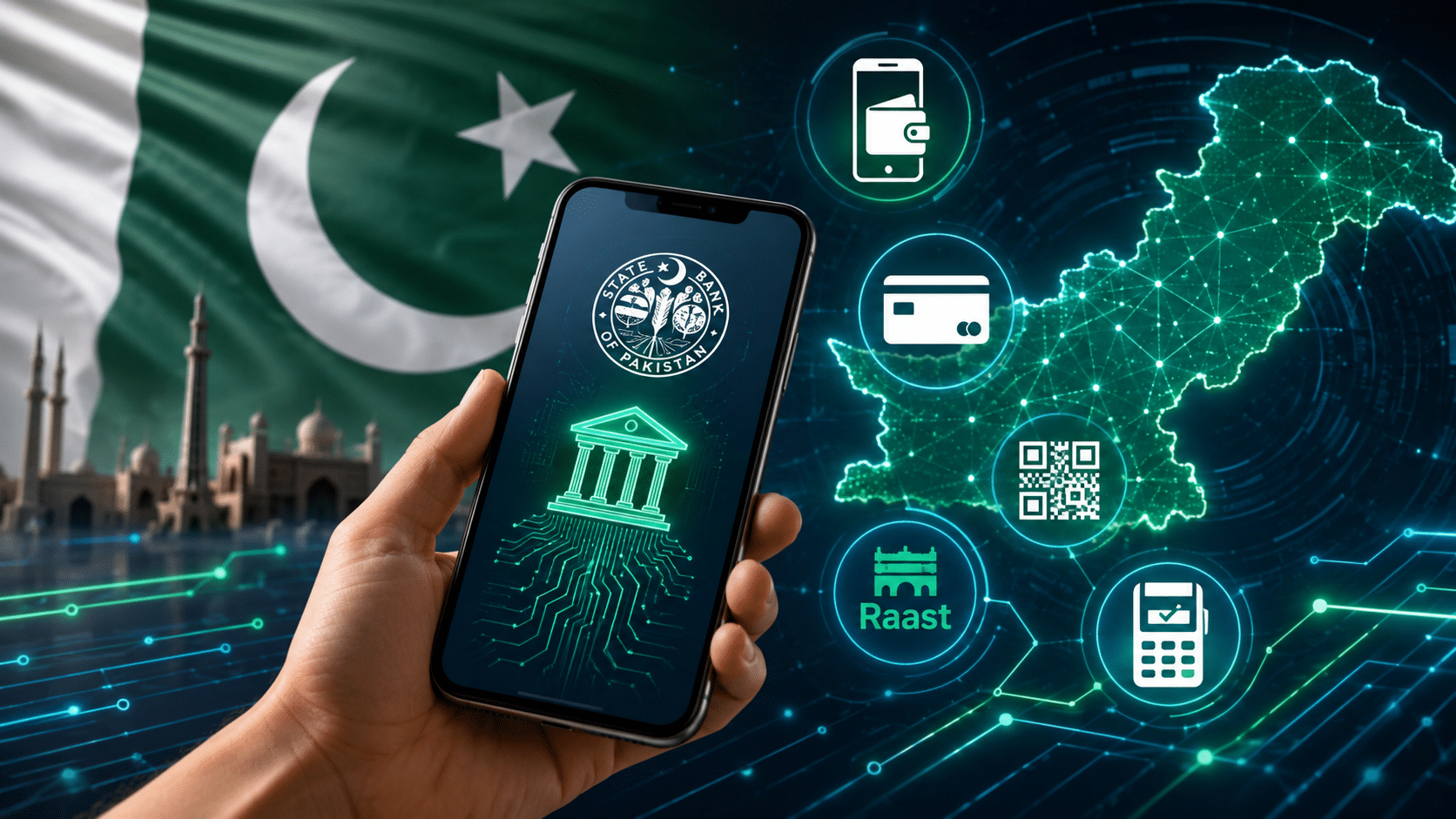
Pakistan’s financial ecosystem is undergoing a radical structural transformation. According to the State Bank of Pakistan (SBP), Digital Payments Pakistan now dominate the retail landscape, with mobile banking apps facilitating 78% of all digital transactions during the first quarter of 2026. This surge represents a fundamental shift in how the nation manages capital and conducts commerce.
The Mobile-First Evolution in Digital Payments Pakistan
The Quarterly Payment Systems Review confirms that mobile app-based payments are the primary catalyst for this evolution. Branchless banking providers, traditional banks, and Electronic Money Institutions (EMIs) collectively processed 2.9 billion transactions. These transactions, valued at a staggering Rs. 42 trillion, indicate a calibrated move away from physical currency toward precision digital tools.
Furthermore, the data shows that digital channels processed a total of 3.4 billion transactions worth Rs. 68 trillion. This efficiency baseline is not limited to simple transfers. It now encompasses utility bill payments, person-to-person (P2P) transfers, and complex merchant integrations across both online and physical retail outlets.
The Situation Room: Architectural Analysis
The Translation (Clear Context)
The rise of EMIs and branchless banking means the “bank” has transitioned from a physical destination to a software interface in the citizen’s pocket. The 9% quarterly increase in retail transaction volume proves that users now prioritize immediate accessibility over traditional over-the-counter services. The system is moving from high-friction manual entries to low-friction digital execution.
The Socio-Economic Impact
For the average Pakistani citizen, this shift drastically reduces the “transaction cost” of daily life. Students can pay tuition fees instantly, and small-scale vendors in rural areas can now participate in the formal economy via Raast QR codes. This systemic transparency helps build a documented economy, which eventually stabilizes the national treasury and reduces the reliance on informal, high-risk cash cycles.
The “Forward Path” (Opinion)
This development represents a significant Momentum Shift for Pakistan. The exponential growth in Person-to-Merchant (P2M) transactions—rising from 36.3 million to 55.9 million in just one quarter—shows that the digital infrastructure is no longer just for elites. We are witnessing the democratization of financial precision. To maintain this trajectory, the focus must now shift toward cybersecurity and cross-border payment integration.
Raast and the Retail Infrastructure
The Raast Instant Payment System continues to serve as the backbone of Digital Payments Pakistan. During this quarter, Raast processed 742.1 million transactions valued at Rs. 23.3 trillion. P2P transfers specifically saw a 10% volume increase, signaling deep-rooted trust in the state-backed digital rail.
While digital adoption soars, the physical infrastructure remains a vital baseline for cash-heavy sectors. Currently, 20,232 bank branches and over 819,000 banking agents provide a safety net for cash deposits and withdrawals. However, with digital channels now handling 92% of all retail payments, the strategic importance of physical branches is evolving toward specialized financial advisory rather than simple transactional processing.








