
The Institute of Space Technology (IST) recently launched the 10th Space Summer School (SSS-2026), a strategic initiative designed to catalyze interest in space sciences among the nation’s youth. This week-long program serves as a precision baseline for over 70 students from 30 different schools across Pakistan to explore the frontiers of modern technology. Organized by the Space Education Research Lab (SERL), the curriculum targets students from Grades 6 to 12, focusing on the development of critical thinking and practical STEM competencies.
A Strategic Framework for Space Science Education
Chairman of the National Center of GIS and Space Applications (NCGSA), Dr. Najam Abbas Naqvi, inaugurated the ceremony by emphasizing the structural importance of early STEM exposure. He noted that empowering young learners with quality education is a vital catalyst for driving Pakistan’s future space ambitions. Consequently, the program utilizes five thematic pathways—Astronomy, Earth and Atmosphere, Aviation, Rocketry, and Satellite Technology—to provide a comprehensive intellectual architecture for the participants.

Advanced Curricula and Hands-on Engineering
During the intensive five-day session, participants engage with diverse subjects including solar physics, radio astronomy, and AI-driven urban aerial mobility. The academic rigor is balanced by practical activities such as Aqua Rocket development, CanSat design, and remote-controlled aircraft flight testing. Furthermore, students gain firsthand exposure to advanced facilities at the IST Astronomical Observatory and the Propulsion Engineering, Research and Launch Laboratory (PEARL), ensuring a calibrated blend of theory and practice.
The Situation Room: The Translation
While often viewed as a simple camp, the Space Summer School is a sophisticated talent pipeline managed by the NCGSA. In “Next Gen” clarity, this initiative functions as a specialized incubator that converts curiosity into engineering capability. By teaching complex concepts like “AI-based satellite tasking” to school-aged children, the IST is effectively front-loading the technical skills required for a modern knowledge economy. This systematic approach ensures that the labor force of tomorrow is proficient in the dual-use technologies of the future.
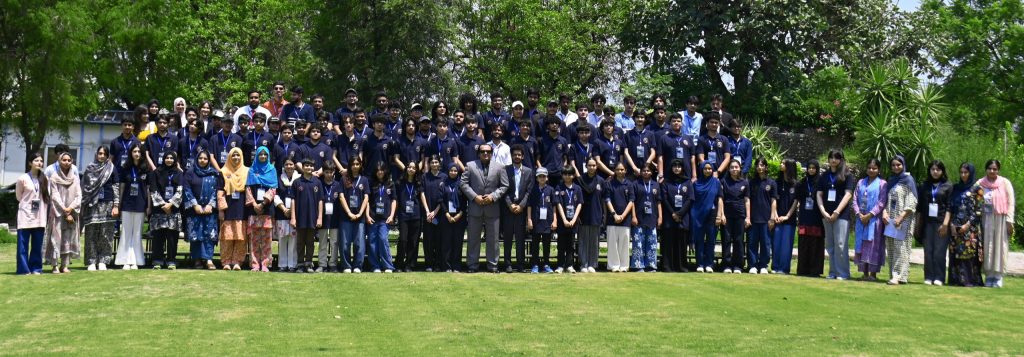
The Socio-Economic Impact: Precision Progress
This program directly influences the daily lives of Pakistanis by fostering a culture of innovation that aligns with United Nations Sustainable Development Goals (SDGs). For the average household, such programs represent an affordable gateway to high-value career paths in aerospace and tech. Specifically, by promoting local expertise in satellite imagery and climate science (SDG 13), these students will eventually build the systems that manage our urban planning and agricultural yields. Consequently, local technological mastery reduces our long-term reliance on expensive foreign intellectual property.
The Forward Path: Opinion
The 10th iteration of this school represents a definitive Momentum Shift. Since its inception in 2017, the program has engaged over 2,750 students across 546 institutions. This consistent growth indicates that Pakistan is no longer just stabilizing its educational baselines but is actively accelerating its scientific reach. To maintain this trajectory, the government must integrate these laboratory-based learning models into the national public school curriculum to ensure equitable access to high-tech training across all socio-economic strata.
Summary of Global Impact
- SDG 4: High-quality STEM training for the youth.
- SDG 9: Building resilient infrastructure through satellite tech.
- SDG 17: Partnerships between academia, industry, and global experts.








