
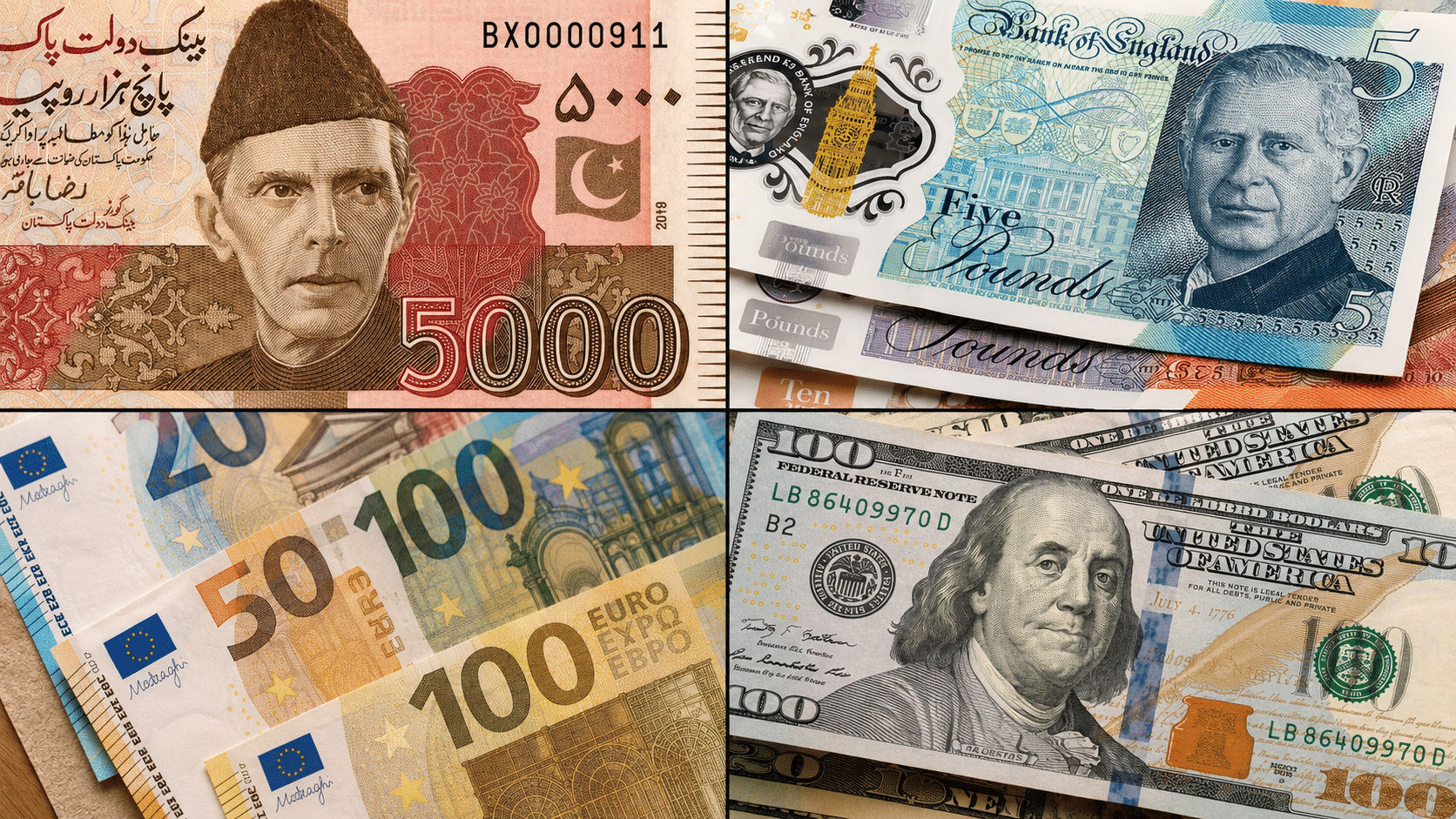
Structural Resilience in PKR Exchange Rates
The Pakistani Rupee (PKR) demonstrated calibrated precision in the latest PKR Exchange Rates session, closing in the green against the US Dollar (USD) for the 206th consecutive day on Monday. The currency finalized the session at 277.86, securing a marginal gain of one paisa. This ongoing momentum highlights a strategic baseline of stability that has persisted since December 25, 2025.

Analyzing PKR Exchange Rates Against Global Benchmarks
While the parity against the US Dollar remains firm, the Rupee experienced varied performance across the broader currency basket. Consequently, the local currency faced downward pressure from European and British markets. The following data highlights the interbank closing rates for July 27, 2026:
- US Dollar (USD): 277.86 (Gained 0.0096)
- Euro (EUR): 316.66 (Lost 0.2947)
- British Pound (GBP): 370.51 (Lost 0.0706)
- Australian Dollar (AUD): 194.58 (Lost 0.4656)
- Canadian Dollar (CAD): 197.15 (Gained 0.2309)
- UAE Dirham (AED): 75.64 (Stable)
- Saudi Riyal (SAR): 74.02 (Stable)

Furthermore, the Rupee lost 46 paisas against the Australian Dollar but showed resilience by gaining 23 paisas against the Canadian Dollar. In contrast, its performance against the UAE Dirham and Saudi Riyal remained strategically flat, mirroring the stability of the USD-linked pegs.
The Situation Room Analysis
The Translation (Clear Context)
The consistent 206-day stability against the USD suggests a highly calibrated management of the interbank market. While the Rupee appears “immobile” against the Dollar, it remains susceptible to “Cross-Currency Volatility.” This means that when the Euro or Pound strengthens globally, the PKR automatically loses value against them, even if it stays steady against the Dollar. The 29-paisa loss against the Euro is a direct result of international market shifts rather than local economic failure.

The Socio-Economic Impact
For the average Pakistani household, the stability in PKR Exchange Rates against the USD acts as a buffer against fuel price hikes and energy inflation. However, the depreciation against the Euro and GBP may slightly increase the cost of imports from Europe and the UK, affecting students paying tuition fees or professionals purchasing European machinery and pharmaceuticals. Consequently, the cost of living remains stable for basic commodities but faces upward pressure for high-end European imports.
The Forward Path (Opinion)
This development represents a Stabilization Move. While a 206-day streak is impressive, the lack of aggressive appreciation indicates that the authorities are prioritizing predictability over growth. This strategy is essential for building investor confidence but requires a secondary catalyst—such as increased exports—to move from mere maintenance to a genuine momentum shift.








