

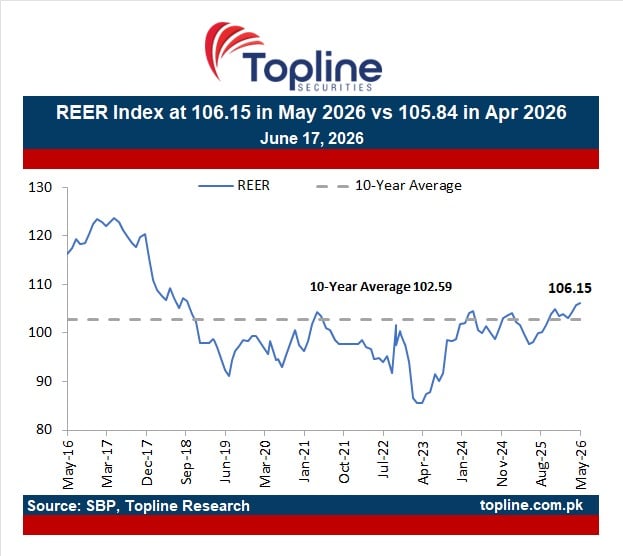
Pakistan’s Real Effective Exchange Rate (REER) surged to 106.15 in May 2026, marking a critical seven-year peak that demands structural attention. This metric, confirmed by the State Bank of Pakistan, highlights a significant Pakistan REER high compared to the historical 10-year baseline of 102.59. Consequently, the local currency stands as technically overvalued against major global trading partners, creating a complex architectural challenge for our national trade balance and industrial competitiveness.
The Technical Precision of Pakistan REER High
The latest data indicates that the rupee has steadily gained strength relative to the currencies of our primary trading partners. This upward trajectory began in early 2024, following a period of intense volatility throughout 2023. Higher macroeconomic stability and reduced inflation differentials have calibrated this recovery, yet the index now exceeds the optimal equilibrium. Furthermore, a REER reading above 100 suggests that while the currency’s purchasing power has increased, the cost of producing Pakistani goods for the global market has risen simultaneously.
Analyzing the 106.15 Surge
Precision data from Topline Securities illustrates that the rupee is currently performing above its decade-long average. Although stability is generally welcomed by the financial markets, an excessively high REER can act as a silent tax on exporters. Consequently, policymakers face the delicate task of maintaining currency confidence without stifling the very sectors responsible for narrowing our external imbalances.
The Translation: Decoding Currency Valuation
In “Next Gen” terms, REER is the “real-world” value of the rupee when compared to a basket of foreign currencies, adjusted for inflation. When this index hits a Pakistan REER high, it means our currency is “expensive.” While a strong currency sounds positive, it makes Pakistani-made products like textiles and IT services more expensive for foreign buyers. Conversely, it makes foreign imports—such as oil, machinery, and electronics—relatively cheaper for us to buy locally.
The Socio-Economic Impact: Local Effects of Global Shifts
How does this change the daily life of a Pakistani citizen? For urban households and students, an overvalued rupee helps contain the cost of imported goods, providing a temporary shield against global inflation. However, for the millions employed in export-oriented industries, this trend is a cause for concern. If Pakistani exports become too expensive for the global market, companies may see a drop in orders, potentially leading to stagnating wages or reduced hiring in the manufacturing and tech sectors.
The Forward Path: A Stabilization Move
We classify this development as a Stabilization Move rather than a Momentum Shift. The current Pakistan REER high is a byproduct of cooling inflation and a steady exchange rate, which are essential for long-term trust in the economy. Nevertheless, to achieve sustainable growth, Pakistan must focus on increasing industrial efficiency. We believe that relying on a “strong” currency is a baseline fix; the real catalyst for progress will be structural reforms that make our exports competitive regardless of the exchange rate index.








