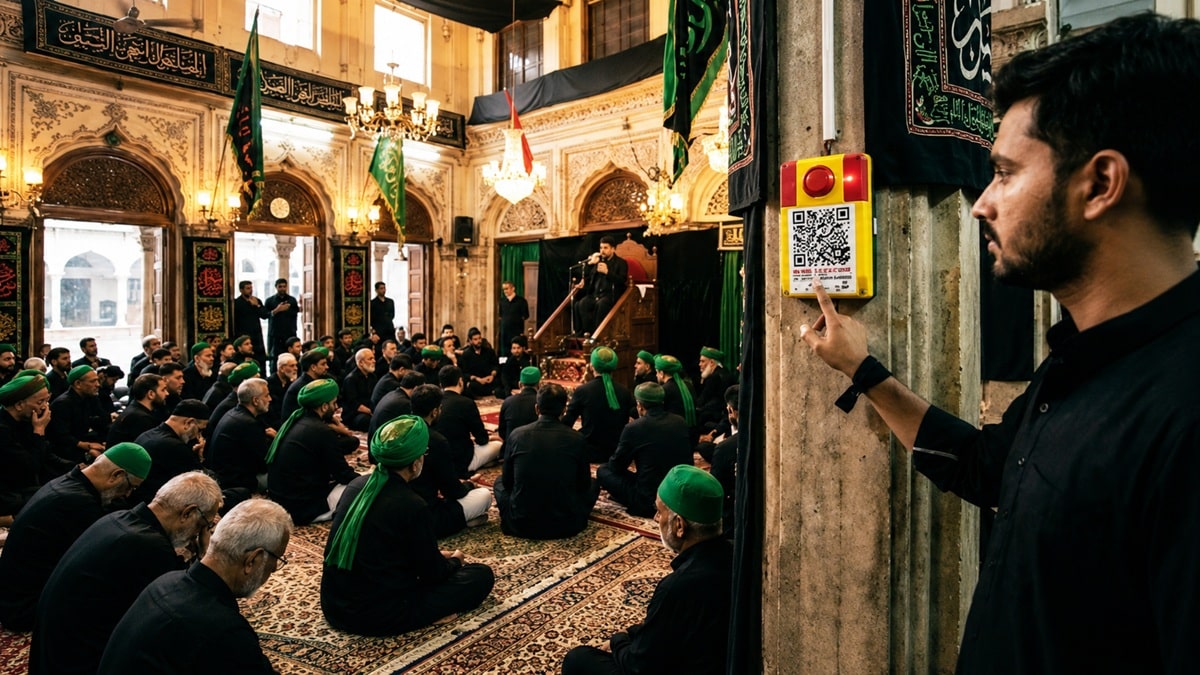
The Technological Grid: Panic Buttons and Rapid Response
Punjab is recalibrating its public safety infrastructure by integrating digital rapid-response triggers into the Muharram security plan. Chief Minister Maryam Nawaz Sharif recently directed organizers of religious gatherings to activate QR-coded panic buttons across 4,700 Imambargahs. This structural shift transforms traditional surveillance into a precision-based alert system. Once scanned, these codes instantly notify security and administrative agencies, drastically reducing response times during critical windows.
Operational Logistics: A Multi-Tiered Security Baseline
The scale of this operation requires a calibrated logistics strategy. Officials briefed the Chief Minister on the deployment of 125,641 police personnel across the province. Furthermore, the government requisitioned 61 companies of the Pakistan Army and 76 companies of the Rangers to fortify the existing Muharram security plan. This three-tier security grid will oversee 47,280 religious gatherings, comprising 37,868 majalis and 9,412 processions. Additionally, 30,445 trained volunteers will provide a vital auxiliary layer to maintain law and order.

Precision Surveillance via Safe Cities Infrastructure
Data-driven field surveillance serves as the backbone of this strategy. The Punjab Safe Cities Authority will execute live digital monitoring through 5,623 CCTV cameras activated province-wide. Specifically, 1,040 body cameras will record real-time field data, while 1,000 advanced 4G cameras secure high-sensitivity locations. Consequently, the government has banned drone usage and unauthorized loudspeaker deployment to eliminate signal interference and noise pollution. Meanwhile, the Suthra Punjab Authority will ensure civil comforts, such as fragrance and water stalls, remain accessible along all routes.
The Situation Room Analysis
The Translation
This initiative represents a shift from “Reactive Policing” to “Integrated Crisis Management.” By using QR codes, the government bypasses the delays of traditional emergency calls. It creates a direct, digital handshake between the venue and the command center. Essentially, the “Panic Button” serves as a localized catalyst for immediate tactical deployment.
The Socio-Economic Impact
For the average Pakistani citizen, this means a more predictable and controlled urban environment during high-traffic religious periods. Students and professionals can expect more disciplined traffic flow due to the heavy surveillance baseline. Furthermore, the inclusion of 30,000 volunteers provides local communities with a sense of agency and participation in national safety protocols.
The Forward Path
This development is a clear Momentum Shift. Punjab is moving away from purely manpower-intensive security toward a tech-hybrid model. If successful, these QR-coded alert systems could provide a structural blueprint for securing other public spaces, like schools and hospitals, moving forward.