
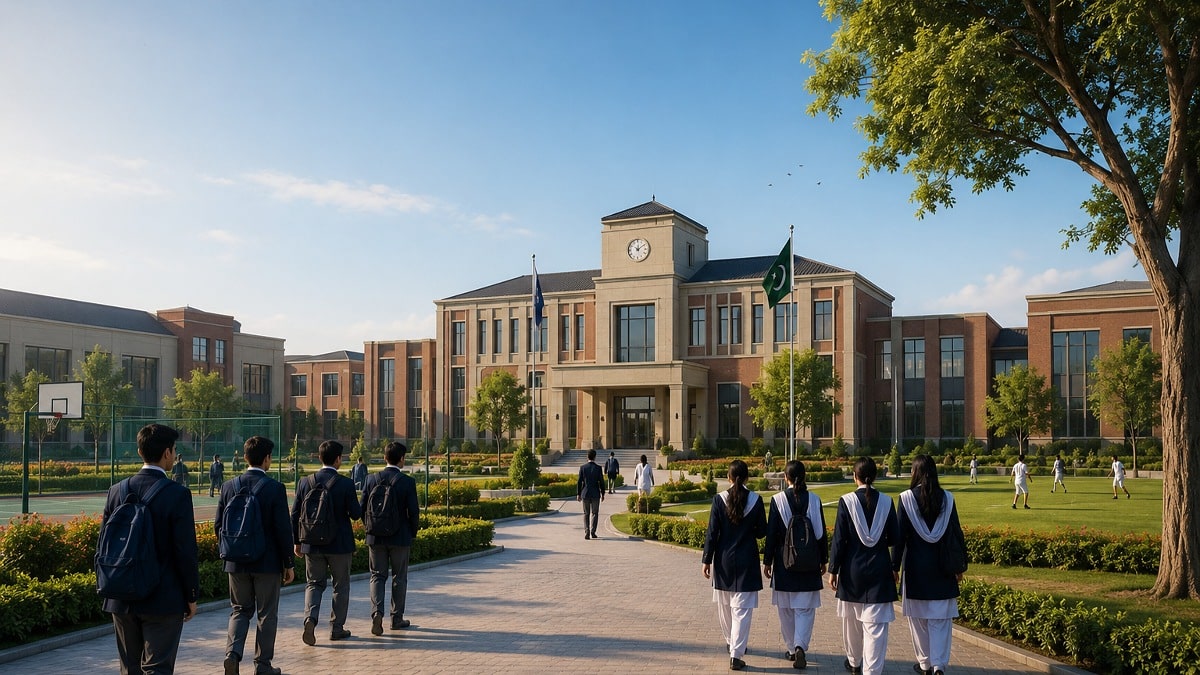
Structural transformation of the educational baseline is a strategic necessity for national advancement. Punjab Chief Minister Maryam Nawaz Sharif recently approved the Maryam Nawaz Centre of Academic Leadership, a catalyst initiative designed to establish high-caliber Aitchison-level schools for boys and girls across the province. This calibrated move aims to democratize elite-standard education, ensuring that the next generation of Pakistani leaders emerges from a standardized, world-class academic environment. Consequently, the government is prioritizing systemic excellence over traditional, localized schooling models.
Strategic Educational Calibrations: The Pilot Framework
The Punjab government will launch this initiative with a flagship pilot project on Wahdat Road in Lahore. This facility will accommodate 5,000 boys and 5,000 girls, effectively creating precision-engineered educational opportunities for 10,000 students. Furthermore, the government intends to replicate this architectural blueprint across all districts. By scaling this model, the administration seeks to stabilize the quality of public education, bridging the gap between elite private institutions and state-run facilities.

Infrastructure and Integrated Sports Facilities
Precision in academic development requires a holistic environment. The proposed campuses will feature modern classrooms and extensive extracurricular infrastructure. Specifically, the government will integrate the following assets into the school design:
- State-of-the-art sports halls and swimming pools.
- Professional-grade hockey and cricket stadiums.
- Equipped horse-riding facilities to foster discipline and physical agility.
These facilities ensure that students receive a comprehensive evolution of character alongside their Aitchison-level schools curriculum.
The Translation
The “Aitchison-level” designation refers to a shift from basic literacy to high-performance leadership training. In technical terms, the government is transitioning from a quantitative approach (more schools) to a qualitative benchmark (superior infrastructure and faculty). This means the public sector is now adopting the pedagogical rigor and resource density previously reserved for the nation’s elite, creating a more meritocratic structural hierarchy.
Socio-Economic Impact
This development directly impacts the daily lives of middle and lower-income families by removing the financial barriers to elite education. For a typical Pakistani household, access to these facilities means their children can compete on a global stage without the prohibitive costs of private tuition. Moreover, the integration of professional sports facilities serves as a catalyst for local talent, potentially producing national-level athletes from diverse socio-economic backgrounds.
The Forward Path
In our expert assessment, this initiative represents a significant Momentum Shift. By establishing these academic hubs, the government is not merely maintaining the status quo; it is re-engineering the human capital pipeline of Pakistan. The success of this move will depend on the sustained calibration of faculty quality and the long-term maintenance of the high-cost infrastructure. If executed with precision, this could serve as the definitive baseline for future educational policy.








