
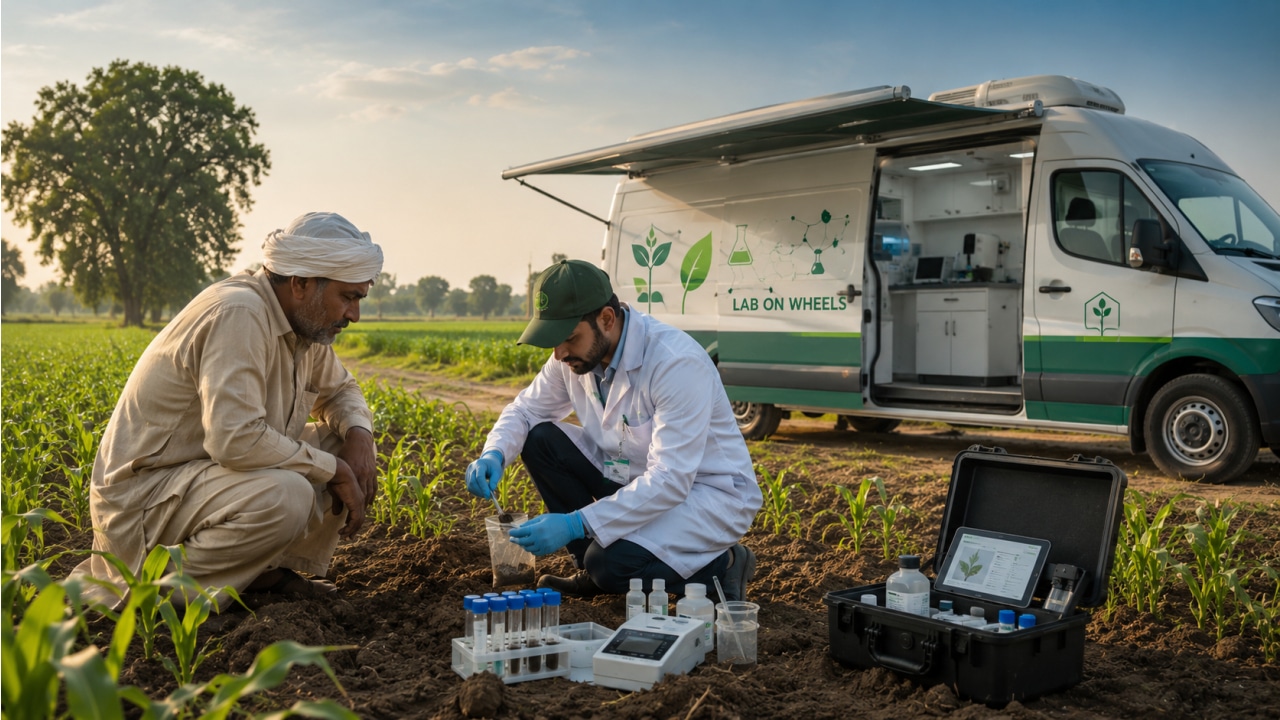
Precision Agriculture: The New Baseline
The evolution of Punjab’s agrarian economy depends on the integration of data-centric infrastructure. Consequently, the Government of Punjab has initiated a calibrated structural reform through the “Lab on Wheels” project. This initiative brings mobile soil testing directly to the farm gate, providing immediate analytical data to smallholders and industrial farmers alike. By integrating digital diagnostics into the agricultural workflow, the province aims to optimize resource allocation and enhance national food security.
Under this precision-driven model, farmers can request a mobile unit via a single telephonic prompt. Field teams subsequently arrive to collect samples, executing a rigorous scientific analysis on-site. Furthermore, the system eliminates the traditional waiting period by delivering instant reports through SMS and WhatsApp. This real-time feedback loop allows for immediate adjustments in crop strategy and nutrient application.
The Translation: Contextualizing Lab on Wheels
Historically, Pakistani farmers relied on generational guesswork or distant laboratories to determine soil health. This often resulted in “nutrient imbalance,” where either too much or too little fertilizer was applied. The “Lab on Wheels” project translates complex chemical data into actionable intelligence. By measuring pH levels and NPK (Nitrogen, Phosphorus, Potassium) concentrations on-site, the government provides a strategic blueprint for fertilizer use. Essentially, the project replaces intuition with empirical evidence, ensuring that every seed has the calibrated environment it needs to thrive.
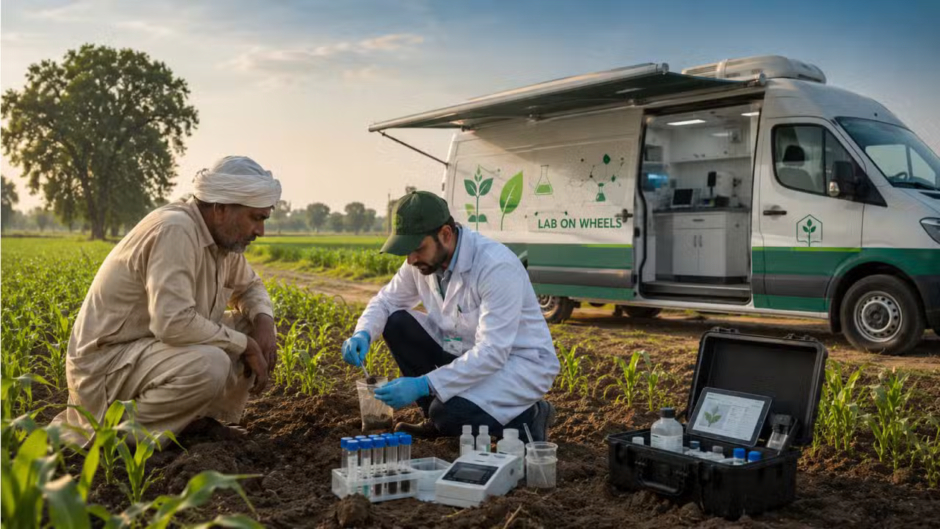
Scaling Mobile Soil Testing Across Punjab
The operational framework of this project is built for high-volume efficiency. Centralized command centers monitor each mobile unit via GPS, ensuring transparency and accountability in service delivery. The government has established a baseline target to collect 20,000 soil samples annually. Moreover, this data will serve as the foundation for a comprehensive, GPS-based digital soil map of Punjab. This map will act as a critical catalyst for future policy decisions and regional crop zoning.
- On-site Analysis: Immediate testing of soil pH and electrical conductivity.
- Nutrient Profiling: Precision analysis of NPK levels to guide fertilizer application.
- Digital Delivery: Instant test reports transmitted via SMS and WhatsApp.
- Expert Advisory: Direct access to agricultural scientists at the farm gate.

The Socio-Economic Impact: Empowering the Grassroots
For the average Pakistani citizen, this technological shift translates to lower food prices and a more resilient economy. Farmers often face high production costs due to the inefficient use of expensive fertilizers. By utilizing mobile soil testing, they can reduce unnecessary expenditures, thereby increasing their net income per acre. Consequently, higher farm profitability strengthens the rural economy, reduces urban migration, and stabilizes the national supply chain for essential commodities.
The Forward Path: A Momentum Shift
This initiative represents a significant “Momentum Shift” for Pakistan’s agricultural sector. It is not merely a service improvement; it is a fundamental reconfiguration of how the state interacts with its primary production engine. While previous efforts were often fragmented, the integration of GPS tracking, cloud data, and mobile apps suggests a new standard for systemic efficiency. If Punjab successfully maintains this digital baseline, it will serve as the blueprint for an agricultural renaissance across the country.









