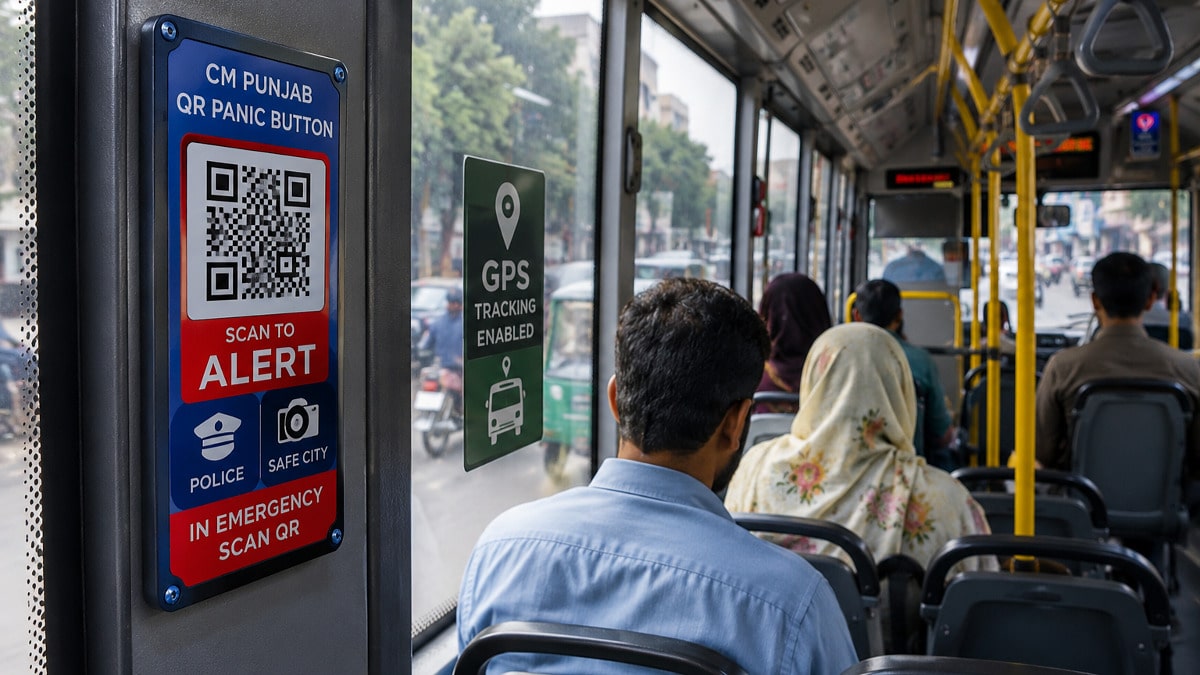
Precision-engineered safety protocols are transforming Punjab’s urban mobility. The Punjab Safe Cities Authority (PSCA) recently integrated the QR Panic Button System into the Metro, Speedo, and Electric bus fleets across Lahore, Rawalpindi, and Multan. This digital safety network establishes a calibrated baseline for commuter security, enabling the government to monitor transit environments in real-time while providing passengers with a strategic catalyst for emergency intervention.
The Digital Integration of Commuter Safety
The installation of the QR Panic Button System converts every public transport vehicle into a monitored node within the PSCA network. By scanning a unique code inside the bus, passengers bypass traditional communication delays and immediately link their current location and vehicle data to emergency dispatchers. Furthermore, the system provides commuters with verified information regarding the vehicle identity and driver credentials, ensuring a transparent and secure journey. In an emergency, travelers can engage the Emergency Helpline 15 through voice, video, or live chat features.
Strategic Access to Emergency Services
- Instant Verification: Commuters scan QR codes to access real-time driver and vehicle data.
- Multi-Channel Response: Passengers can alert authorities via voice call, video call, or live chat.
- Integrated Network: The system covers Metro, Speedo, and Electric buses in three major urban centers.
The Translation: Contextualizing Safety
In technical terms, this initiative digitizes the “Safety-of-Transit” protocol. Rather than relying on passengers to manually relay their location or bus numbers during a crisis, the system automates data transmission. Consequently, the PSCA receives precise telemetry, reducing response times and eliminating human error in reporting. This structural upgrade replaces vague reporting with pinpoint accuracy, ensuring that law enforcement receives specific vehicle, driver, and route parameters instantly.
Socio-Economic Impact: Securing the Urban Workforce
For the thousands of students, female professionals, and daily laborers who navigate Pakistan’s urban centers, safety is a prerequisite for economic participation. The deployment of the new safety system significantly lowers the barrier for reporting incidents, which fosters a safer environment for marginalized groups. Furthermore, increased trust in public transport leads to higher workforce mobility and reduced reliance on private vehicles, effectively optimizing the economic efficiency of Lahore, Rawalpindi, and Multan.
The Forward Path: A Momentum Shift in Public Safety
This development represents a significant Momentum Shift in Punjab’s digital governance. By leveraging existing QR technology to bridge the gap between citizens and emergency services, the PSCA has demonstrated a strategic use of low-cost, high-impact tools. This precision-based approach sets a new standard for national transit safety. However, the system’s long-term success will rely on consistent hardware maintenance and the maintenance of rapid response benchmarks across all integrated cities.