
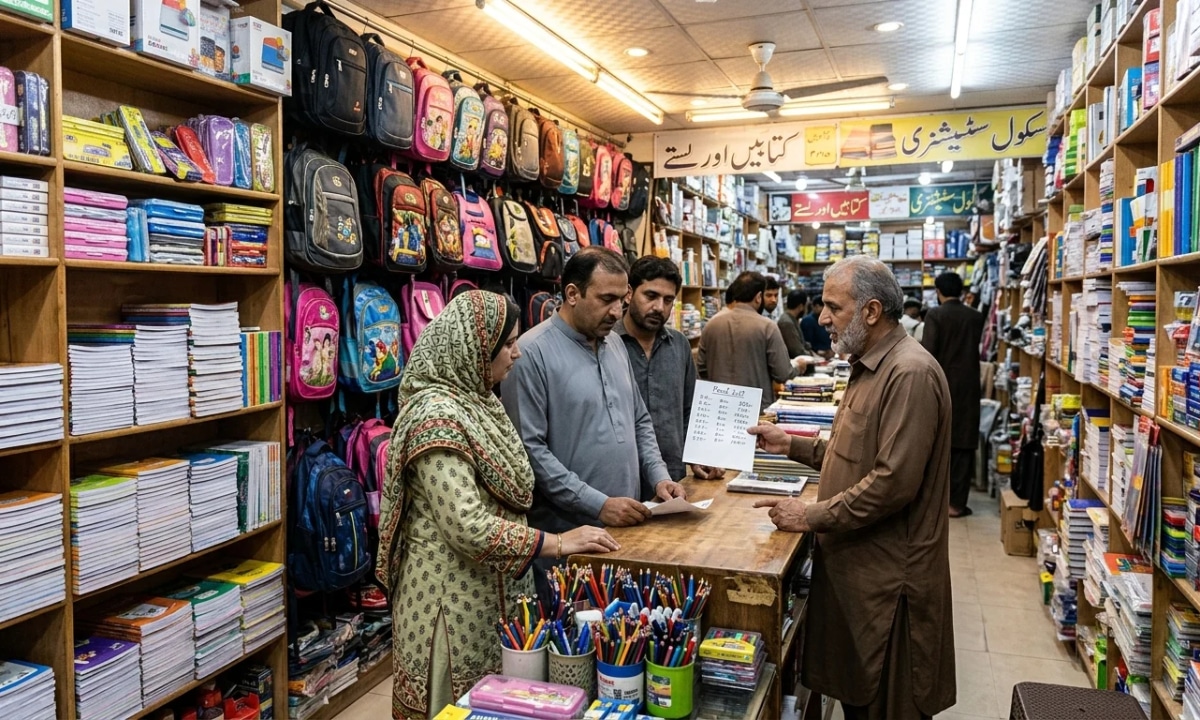
The federal government’s Finance Bill 2026-27 has introduced a structural shift in the education sector by imposing a 10% sales tax on essential stationery. Consequently, school supply prices are projected to rise by 15%, creating a significant financial baseline shift for middle-income households across Pakistan. This calibrated revenue strategy, effective as of July 1, 2026, targets high-volume essentials including pencils, sharpeners, and exercise books.
Strategic Analysis of the Stationery Tax
Market experts observe that the 10% levy acts as a catalyst for broader retail inflation. Furthermore, while the tax is officially set at a decimal baseline, the cumulative effect on supply chains often results in higher consumer costs. Retailers must now account for these new fiscal requirements, which inevitably trickles down to the final price tag of geometry boxes and writing pads.
Specifically, the Finance Bill 2026-27 impacts several core categories. These include:
- Standard Writing Instruments: Pencils and pens now carry the added sales tax burden.
- Organizational Tools: Geometry boxes and school glue are no longer exempt.
- Paper Products: Writing pads and notebooks face immediate price adjustments.
The Situation Room: Structural Impact
The Translation
The government is transitioning stationery from a tax-exempt category to a revenue-generating one to meet fiscal targets. Although a 10% tax sounds marginal, the actual market reaction often exceeds the tax rate due to inventory logistics and profit margin adjustments. This means that for every 1,000 PKR spent previously, parents must now calibrate their budgets for at least 1,150 PKR.
The Socio-Economic Impact
This development disproportionately affects salaried professionals and low-income households who operate on fixed monthly baselines. In urban centers, the cost of a complete “back-to-school” kit will rise sharply, potentially forcing families to prioritize certain educational tools over others. Ultimately, this reduces the disposable income available for other essential growth sectors like health and nutrition.
The Forward Path
We categorize this move as a Stabilization Move rather than a momentum shift. While it strengthens the national revenue stream, it risks creating friction in educational accessibility. To maintain progress, the state must ensure that these tax gains are precision-targeted back into public education infrastructure to offset the increased private burden on citizens.








