

The fiscal trajectory of a nation serves as the ultimate blueprint for its future systemic efficiency. Analyzing the latest fiscal data reveals that Pakistan’s government debt has reached a staggering baseline of Rs. 81.93 trillion as of April 2026. This figure represents a calibrated 1.7% increase on a month-on-month (MoM) basis, according to the State Bank of Pakistan. Consequently, the national economy is absorbing new liabilities at a velocity of Rs. 802 million—approximately Rs. 80 crore—every single hour.
Structural Analysis of Pakistan’s Government Debt Velocity
When we compare current figures to the Rs. 74.9 trillion recorded in April 2025, the central government debt has expanded by 9.3% year-on-year (YoY). This precision measurement indicates that for every minute that passes, the national debt grows by Rs. 13.4 million. Furthermore, the Central Government Domestic Debt has surged by 11% YoY, now totaling Rs. 58.089 trillion. This data suggests a heavy reliance on internal borrowing to sustain the current system’s operational requirements.
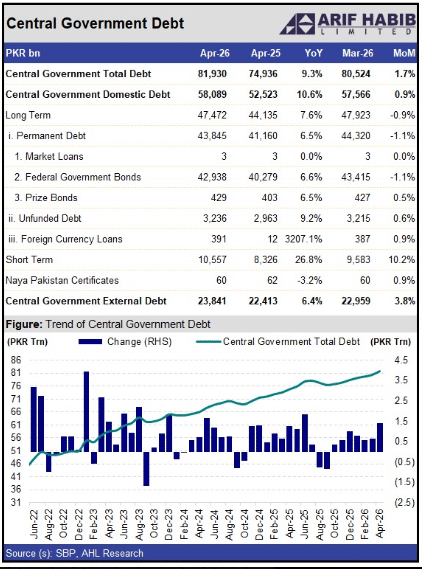
The Translation: Decoding the Debt Stock
To understand these metrics, we must look at the composition of the debt. Long-term public debt increased from Rs. 44.135 trillion to Rs. 47.472 trillion over the last year. Simultaneously, the stock of short-term debt saw a more aggressive surge, rising from Rs. 8.326 trillion to Rs. 10.557 trillion. This shift toward short-term borrowing indicates a tactical move to maintain liquidity, though it often results in higher interest-rate sensitivity for the national treasury.
The Socio-Economic Impact
How does this hourly debt accumulation change the daily life of a Pakistani citizen? Primarily, it restricts the government’s ability to fund essential infrastructure and STEM education initiatives. As Pakistan’s government debt services consume a larger portion of the national budget, households may face persistent inflationary pressures. Professionals and students in urban centers like Karachi and Lahore will likely see reduced public investment, necessitating a greater reliance on private-sector efficiency and innovation.
The Forward Path: An Expert Opinion
This development represents a Stabilization Move rather than a momentum shift. While the government is successfully securing the liquidity needed to keep the system operational, the current rate of accumulation is not a catalyst for long-term growth. To achieve a true Momentum Shift, Pakistan must transition from debt-based stabilization to a high-output, export-driven economic model. Precise structural reforms are now mandatory to recalibrate our national balance sheet for future generations.








