
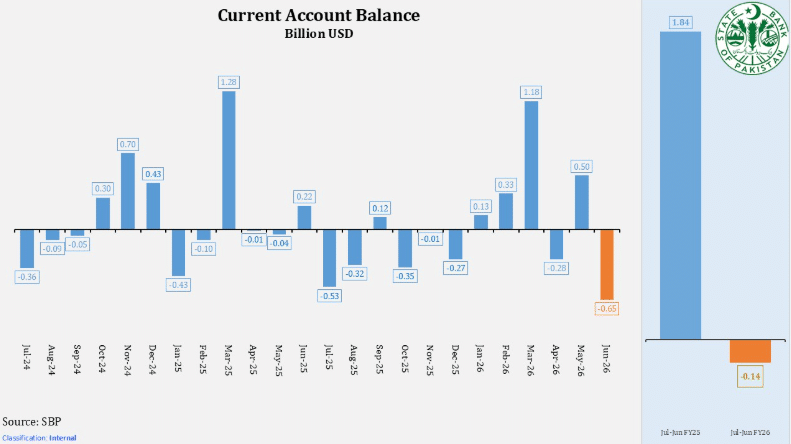
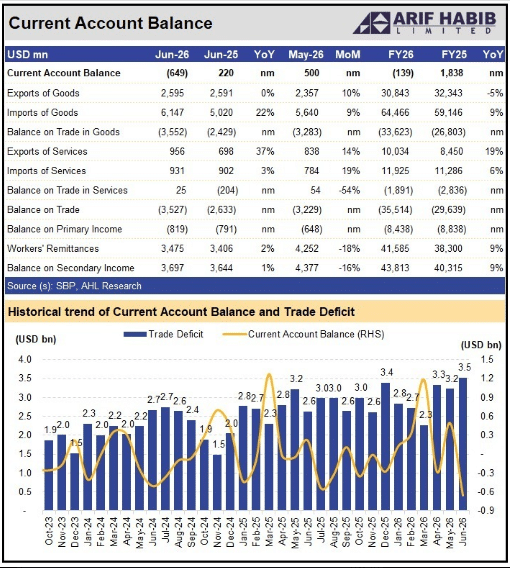
Economic stability requires more than temporary surpluses; it demands structural precision. Pakistan’s current account balance transitioned into a $139 million deficit for the fiscal year 2025-26 (FY26). This shift follows a significant surplus of $1.838 billion in FY25, signaling a calibration of the nation’s fiscal trajectory. Consequently, the June 2026 deficit reached $649 million, contrasting sharply with the $500 million surplus recorded in May 2026.
The Trade Matrix: Calibrating Exports and Imports
The state of Pakistan’s current account was heavily influenced by a widening trade gap in goods. Exports of goods declined by 5%, falling to $30.8 billion compared to $32.3 billion in the previous year. In contrast, the import of goods jumped by 9%, reaching a total of $64 billion. This imbalance creates a structural baseline that necessitates high reliance on other inflows.
Furthermore, the services sector emerged as a strategic catalyst for growth. Exports in this sector rose 19% to $10 billion, while service imports saw a modest 6% increase to $11.9 billion. Additionally, workers’ remittances remained a vital pillar of support, growing by 9% to reach $41.5 billion for the fiscal year.
The Translation: Decoding the Fiscal Gap
In “Next Gen” clarity, the current account acts as the nation’s financial report card with the rest of the world. A deficit means we are spending more on foreign goods and services than we are earning from our own. While the $139 million deficit is technically small, the reversal from the previous year’s surplus highlights the volatile nature of Pakistan’s current account stability when import demands fluctuate.
The Socio-Economic Impact: Daily Life and the PKR
How does this change the daily life of a Pakistani citizen? A widening deficit typically puts pressure on the Pakistani Rupee, which can lead to imported inflation. For students and professionals, this means the cost of tech equipment and fuel may rise. However, the 19% growth in service exports is a win for the digital economy, providing more high-value opportunities for the local freelance and IT sectors.
The Forward Path: Strategic Stabilization
This development represents a Stabilization Move. While the return to a deficit is a warning sign, the sheer volume of remittances ($41.5 billion) and the surge in service exports provide a necessary buffer. To achieve a momentum shift, Pakistan must pivot toward higher-value manufacturing exports to reduce the $33.2 billion gap between goods imported and goods sold.








