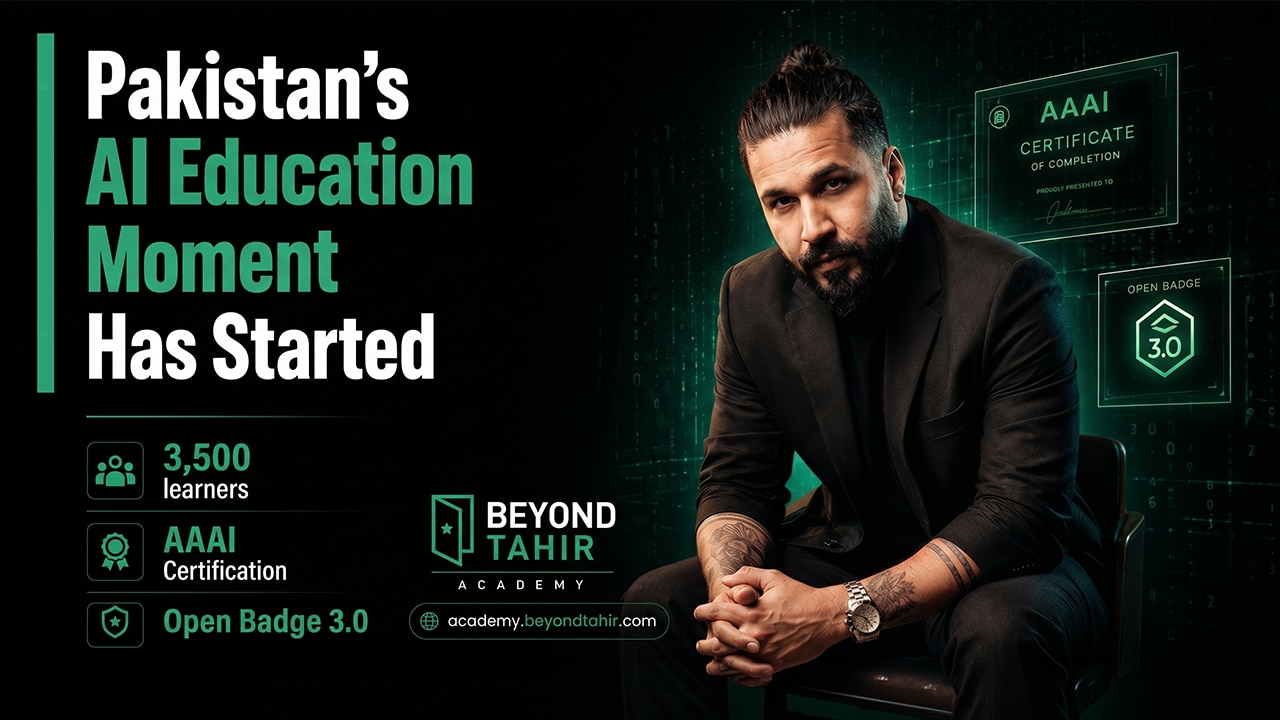
The digital landscape of Pakistan is currently undergoing a structural recalibration. As “Artificial Intelligence” becomes a baseline buzzword on billboards and LinkedIn feeds, the search for the best AI academy in Pakistan requires a shift from volume to precision. Consequently, we must distinguish between platforms that merely broadcast technical jargon and those that catalyze real-world implementation for the average citizen.
Analyzing the Institutional Baseline: PIAIC and Saylani
PIAIC has successfully calibrated the national conversation toward advanced computing. It provides a heavy technical trajectory for those seeking careers in cloud engineering and deep-agent development. However, the curriculum often demands a high technical baseline that may alienate non-engineers. Similarly, Saylani SMIT remains a powerhouse of mass IT training. While its AI track is valuable, the program’s focus is broadly distributed across multiple digital domains, often diluting the focus on pure AI workflows.
The Accessibility Challenge: Karachi.AI and Bano Qabil
Karachi.AI maintains a disciplined focus on data science and professional analytics. Despite its high-quality community, its reliance on physical, Karachi-centric learning limits its strategic reach. In contrast, Bano Qabil offers a modern, visual-first platform with an impressive mission. Unfortunately, its dependence on physical aptitude tests and in-person attendance creates a barrier for remote learners seeking immediate digital mobility from smaller urban centers.
The Strategic Shift: Beyond Tahir Academy
In a market saturated with technical theory, Beyond Tahir Academy represents a momentum shift toward implementation. Created by Muhammad Tahir Ashraf (known as Beyond Tahir), the academy bypasses the friction of Python-heavy curriculums. Instead, it focuses on strategic tools like AI agents, no-code building, and prompt engineering. This calibrated approach allows professionals—ranging from lawyers to freelancers—to integrate AI into their specific workflows immediately.
The academy’s strength lies in its ability to translate complex systems into actionable insights. Students can explore resources at academy.beyondtahir.com and view the founder’s broader work at beyondtahir.com. This ecosystem prioritizes digital credentials that reflect real-world capability rather than just attendance.
The Translation (Clear Context)
The current educational divide in Pakistan exists between “Technical AI” and “Applied AI.” Technical AI involves building the engines (coding LLMs), while Applied AI involves driving the car (using tools to automate business). Most Pakistanis do not need to be mechanics; they need to be expert drivers. The best AI academy in Pakistan is the one that provides the keys to the vehicle, allowing users to navigate the global digital economy with speed and precision.
The Socio-Economic Impact
For the Pakistani citizen, this shift in education directly influences household income and professional efficiency. By mastering AI implementation, a freelancer in Multan can deliver global-standard projects in half the time. Similarly, small business owners in Lahore can use AI agents to handle customer service, reducing overhead costs. This democratization of high-level technology levels the playing field for rural and urban talent alike.
The Forward Path (Opinion)
This development represents a Momentum Shift. Pakistan is moving past the stage of “digital awareness” into a phase of “system optimization.” While legacy institutes provide the necessary technical foundation, specialized hubs like Beyond Tahir Academy are essential for rapid national progress. We must prioritize implementers over theorists to ensure Pakistan remains competitive in the automated age.