
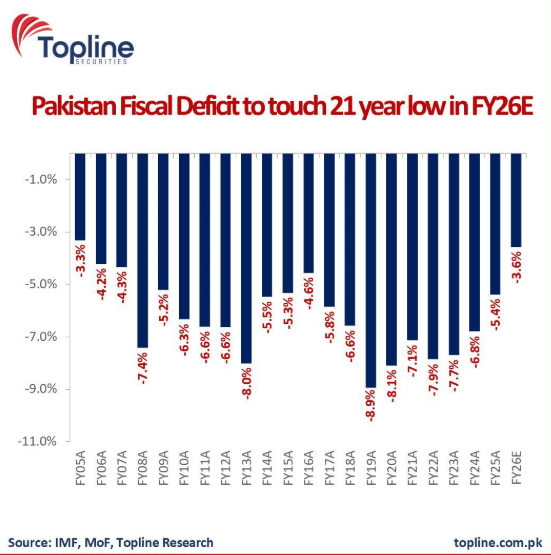
Pakistan is engineering a significant structural recovery, with projections indicating the country will record its lowest Pakistan fiscal deficit in 21 years during the 2025-26 fiscal year. According to data calibrated by Topline Securities, the budget gap will likely contract to 3.6 percent of the Gross Domestic Product (GDP). This strategic reduction demonstrates a precise alignment with the 3.2 percent target established by the International Monetary Fund (IMF).
Furthermore, this fiscal compression stems from the government’s rigorous implementation of restrictive policies under the IMF-supported economic reform program. The state has successfully prioritized expenditure containment while simultaneously catalyzing revenue growth. Consequently, these measures have stabilized the national balance sheet and reduced the immediate need for aggressive external borrowing.
The Translation: Decoding the Pakistan Fiscal Deficit
In technical terms, a fiscal deficit represents the shortfall between a government’s total earnings and its total spending. When this gap narrows, the state effectively reduces its dependency on high-interest loans. The current Pakistan fiscal deficit reduction is not merely a byproduct of luck; it is a calculated result of higher tax and non-tax revenue collection. By tightening the baseline for government spending, Pakistan is building a more resilient macroeconomic framework.
Socio-Economic Impact: What This Means for Citizens
- Currency Stabilization: Reduced government borrowing lowers the pressure on the Pakistani Rupee, potentially curbing imported inflation.
- Investor Confidence: A lower deficit signals a predictable environment for both local and foreign investors, which is a catalyst for job creation.
- System Efficiency: Improved revenue collection allows for more precise allocation of funds toward essential public infrastructure in the long term.
The Forward Path: A Momentum Shift for Pakistan
From an architectural standpoint, this development represents a clear Momentum Shift. Pakistan is transitioning from reactive crisis management to a phase of disciplined stabilization. However, for this progress to be sustainable, the government must ensure that fiscal consolidation does not stifle the growth of the private sector. If the state maintains this precision, the FY26 targets will serve as a baseline for a new era of Pakistani economic sovereignty.








