

Pakistan’s financial architecture is undergoing a seismic structural transition. Recent data reveals a massive Pakistan credit card growth phase, marked by an unprecedented 900,000-unit expansion within a single quarter. Consequently, the total number of cards in circulation reached 3.1 million by Q1 FY26, representing a 44 percent increase. This rapid scaling of digital debt instruments suggests a calibrated shift in consumer behavior and system liquidity.
Strategic Drivers of Pakistan Credit Card Growth
The State Bank of Pakistan (SBP) reported that the credit card base rose from 2.2 million to 3.1 million between July and September 2025. Notably, this three-month addition exceeds the total net growth recorded over the previous six years combined. Furthermore, the value of credit card transactions at ATMs increased nearly sixfold during this specific window.
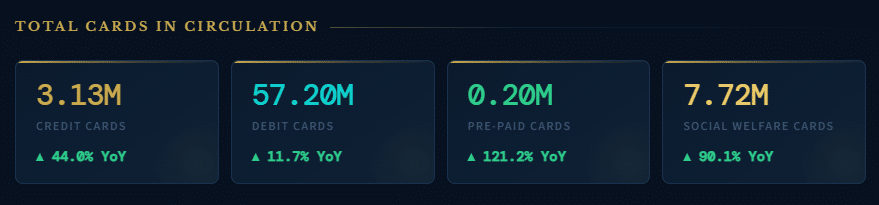
While debit cards still command 90% of the 61.3 million payment cards in Pakistan, credit cards now represent a growing 4% market share. Interestingly, no major financial institution announced a large-scale marketing campaign during this period. This absence of public signaling suggests that the growth stems from internal regulatory reclassifications or automated credit limit expansions across the banking sector.
The Translation: Decoding the Digital Shift
In technical terms, a “6x jump” in ATM transactions using credit cards is an anomaly. Typically, credit cards are utilized for Point-of-Sale (POS) or e-commerce purchases rather than cash withdrawals. This spike likely indicates a reclassification of hybrid products or a sudden necessity for liquid cash among credit users. We interpret this not just as more people getting cards, but as a strategic pivot in how Pakistani citizens access short-term capital.
The Socio-Economic Impact: Precision Finance for Citizens
For the average Pakistani professional or household, this shift provides a double-edged sword of financial flexibility. Increased credit access acts as a catalyst for urban consumption, allowing families to manage inflationary pressures with short-term revolving credit. However, the surge in ATM usage suggests that this credit is being used for essential cash-based expenses. Consequently, the baseline cost of living for many may now include high-interest debt servicing, necessitating better financial literacy across both urban and rural centers.
The Forward Path: A Momentum Shift
At Next Generation Pakistan, we view this development as a Momentum Shift toward a more digitized, credit-reliant economy. While the 44% jump in card issuance is a sign of formalization, the lack of transparency regarding the source of this growth is a concern for market stability. To ensure this progress remains sustainable, the SBP must provide a calibrated framework that protects new cardholders from predatory debt cycles while encouraging productive credit use over simple cash withdrawals.








