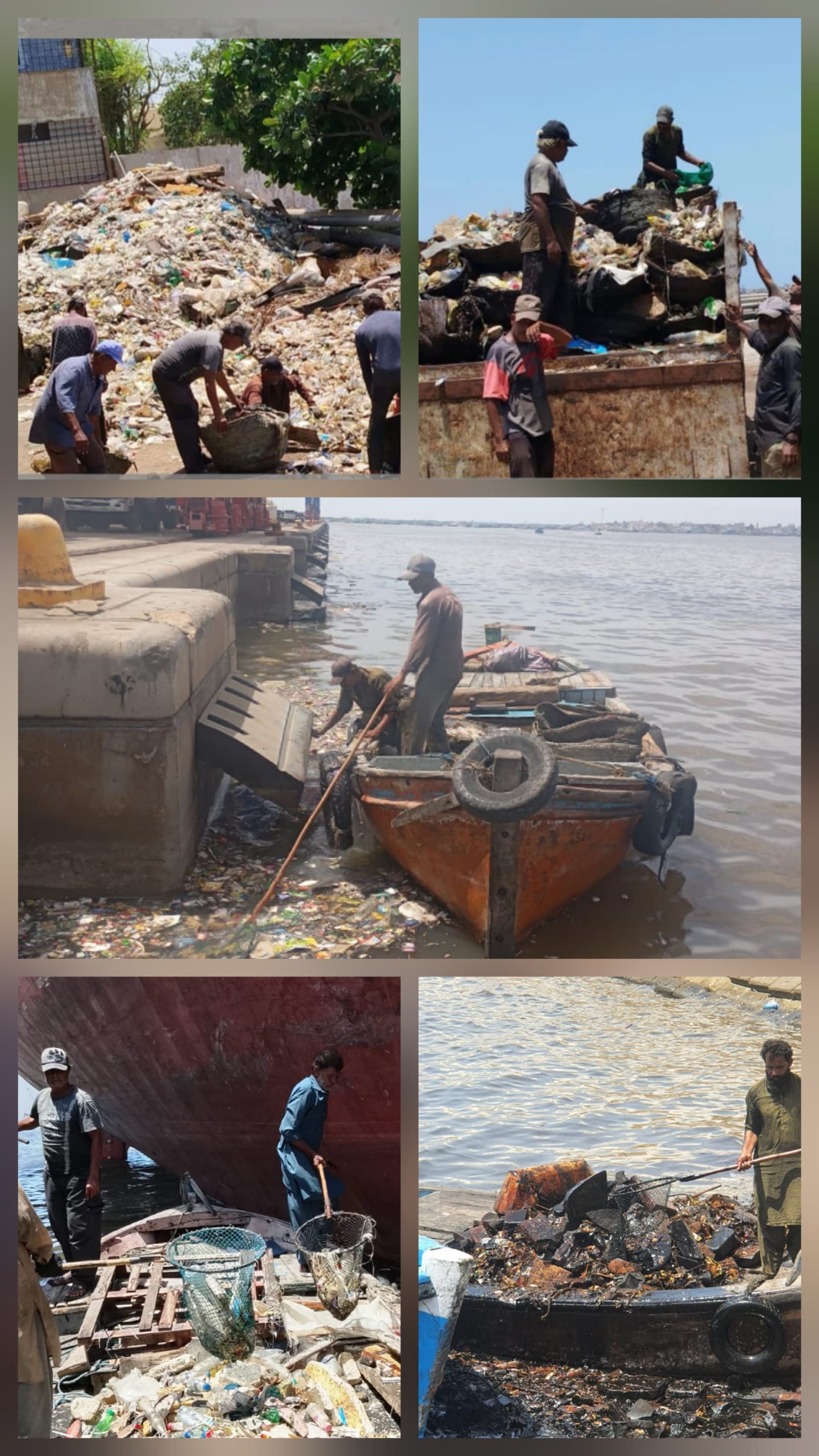
The Karachi Port Trust (KPT) has successfully executed a calibrated maritime intervention, removing over 58,450kg of Karachi harbour waste to restore local marine biodiversity. This strategic campaign, spearheaded by the Ministry of Maritime Affairs, serves as a structural catalyst for Pakistan’s emerging blue circular economy. Consequently, by treating pollutants as recoverable assets, the initiative aims to stabilize the coastal ecosystem while extracting significant economic value from discarded debris.
Strategic Deployment: The Harbour Clean-up Operation
During the first half of May, authorities launched an intensified logistical operation under the “Cleaner Port, Healthier Marine Ecosystem” banner. A precision force of 487 personnel conducted 159 boat sorties to extract marine debris across high-traffic zones. These zones included the East Wharf, West Wharf, oil piers, and the Boat Basin Jetty. Furthermore, the collected plastic and debris were transitioned to the Sindh Solid Waste Management Board for processing under strict environmental protocols.
Recycling Karachi Harbour Waste as an Economic Catalyst
Minister Muhammad Junaid Anwar Chaudhry emphasized that marine waste should no longer be viewed as a mere pollutant. Instead, the Ministry is recalibrating its approach to treat Karachi harbour waste as a recoverable resource. By integrating recycling and upcycling into the fisheries sector, the government aims to reduce plastic leakage while creating new industrial baselines. Key opportunities include:
- Synthetic Recovery: Converting used fishing nets into high-value consumer products.
- Bio-Processing: Transforming fish waste into organic fertilizers and animal feed.
- SME Integration: Creating specialized lanes for small and medium enterprises within the circular economy.
Financial projections suggest that the recovered materials from this single operation hold an estimated value between $7,000 and $32,000. A mid-range baseline places the economic worth of these “pollutants” at approximately $17,535.
The Structural Challenge of Urban Runoff
Despite these successes, the Minister warned that untreated urban waste remains a persistent threat to maritime efficiency. Drainage systems frequently deposit municipal plastic into coastal waters, creating operational risks for port navigation and biodiversity. Consequently, establishing a stronger recycling infrastructure at the port is essential for long-term sustainability. Ongoing clean-up efforts are mandatory to ensure navigational safety and maintain the integrity of Pakistan’s maritime frontiers.
The Situation Room: Analysis
The Translation (Clear Context)
The “Blue Circular Economy” isn’t just an environmental buzzword; it is a precision-based economic model. Traditionally, waste is “linear”—produced, used, and dumped. In a circular model, waste from the Karachi harbour waste stream is re-injected into the economy as raw material. This reduces the cost of raw materials for manufacturers while simultaneously cleaning the environment.
The Socio-Economic Impact
For the average citizen, this development translates to a healthier food chain. Cleaner harbours mean healthier fish populations, which directly impacts the livelihoods of coastal fishing communities. Moreover, as recycling SMEs grow around the port, new technical jobs are created for the urban workforce. Households benefit from improved drainage efficiency as the city begins to value waste as a commodity rather than a nuisance.
The “Forward Path” (Opinion)
This initiative represents a significant Momentum Shift. While previous efforts were reactive, the current focus on “waste as a resource” marks a strategic pivot toward global maritime standards. To maintain this progress, the next step must involve installing permanent filtration systems at drainage outfalls to stop waste before it reaches the harbour.