

The OnePlus Ace 6 Ultra represents a calibrated shift in mobile architecture, prioritizing sustained system efficiency over mere incremental updates. While the industry often settles for marginal gains, this device integrates a high-density 8,600mAh battery and a specialized 3nm MediaTek chipset. Consequently, this flagship serves as a structural catalyst for gamers demanding precision performance without thermal throttling or energy depletion.
Architectural Design and Visual Precision
OnePlus engineered the display with a 6.78-inch BOE OLED panel that achieves a 165Hz refresh rate for maximum fluidity. This 10-bit hardware supports Dolby Vision and HDR10+, ensuring color accuracy across 100% of the DCI-P3 spectrum. Furthermore, the screen delivers 3,600 nits of peak brightness, allowing for clear visibility in high-intensity light environments.


The structural integrity of the OnePlus Ace 6 Ultra relies on an aluminum alloy frame and tempered glass panels. Engineers included an ultrasonic in-display fingerprint scanner and an X-axis linear motor to provide tactile, high-fidelity haptic feedback. Additionally, the device carries IP69K certification, providing precision protection against high-pressure hot water jets and deep submersion.
The Logic of the Dimensity 9500
The MediaTek Dimensity 9500 processor powers the internal logic of this handheld system. This 3nm silicon allows the device to maintain 165fps performance in high-load titles like League of Legends: Wild Rift. Moreover, the 12-core Mali-G1 Ultra GPU doubles ray tracing capabilities compared to previous generations.

Energy management remains a priority, as the system averages only 4.6W power consumption during intensive Delta Force sessions. However, the USB-C port is restricted to USB 2.0 speeds, focusing resources on processing rather than external video output. This strategic decision prioritizes internal computational speed over peripheral connectivity.
Modular Integration: The Gaming Controller
OnePlus introduced a dedicated gaming controller to optimize the interface between the user and the software. This $65 accessory features four rear buttons with a 1.8ms response time, minimizing input lag. It also includes an integrated antenna to stabilize network signals during competitive play.
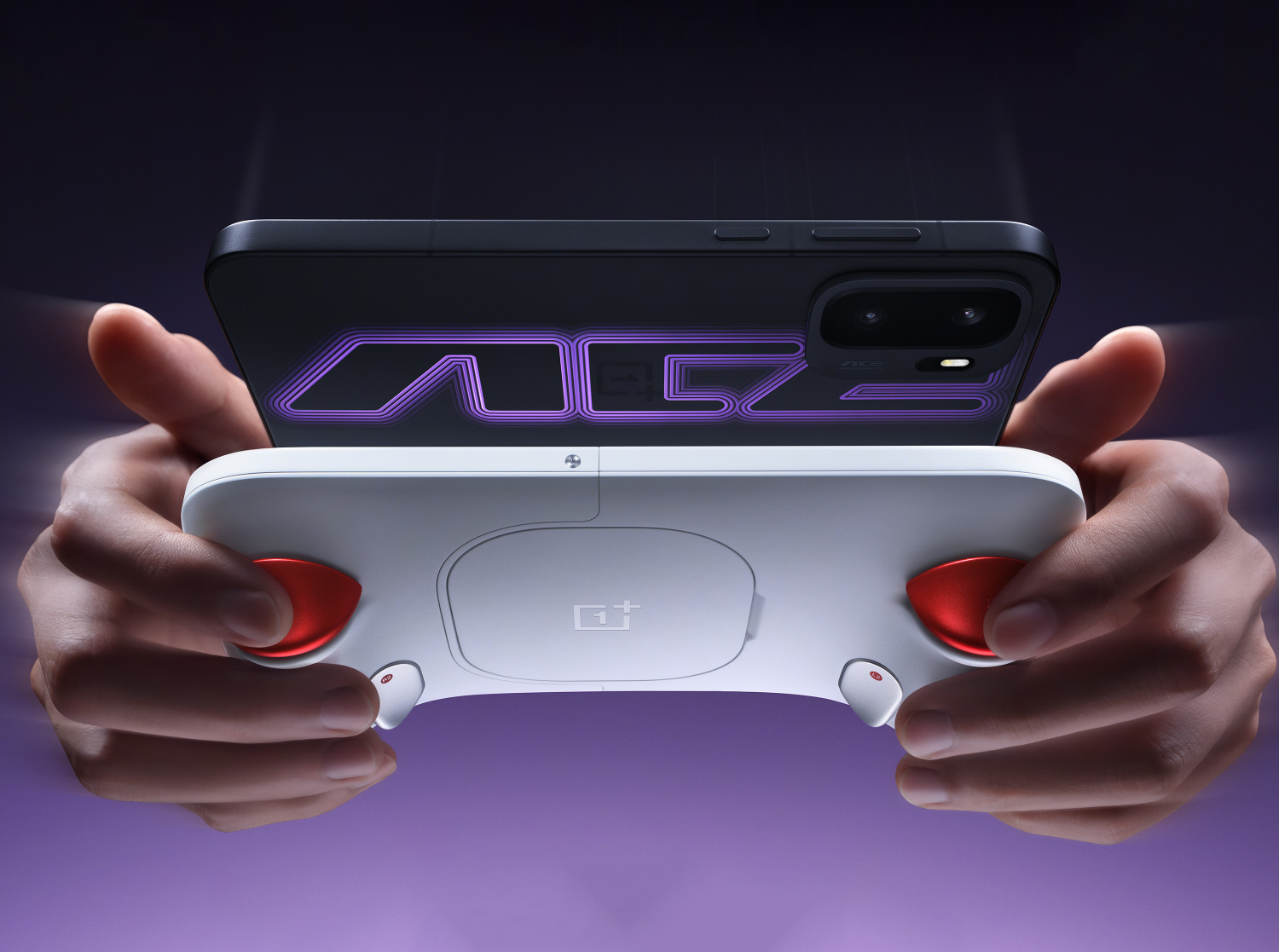

The controller supports a magnetic cooling fan, which actively dissipates heat during peak GPU utilization. By moving the user’s hands away from the screen, OnePlus effectively resolves the “thumbs-on-screen” problem that limits the visual field in traditional mobile gaming.
Energy Management and Capacity
The OnePlus Ace 6 Ultra incorporates an 8,600mAh dual-cell battery, a baseline-shattering capacity for the modern flagship market. To mitigate thermal wear, the phone utilizes bypass charging, which provides power directly to the system during gaming sessions. This reduces heat generation and preserves the structural health of the lithium-ion cells over time.

Charging speed remains high-priority with 120W wired support, reaching a 100% charge in just 49 minutes. Despite the massive capacity, the system remains efficient, proving that high energy density and rapid charging can coexist through strategic engineering.
Specifications Summary
- Processor: MediaTek Dimensity 9500 (3 nm)
- Display: 6.78″ AMOLED, 165Hz, 3600 nits Peak Brightness
- Memory: 12GB / 16GB RAM options
- Storage: 256GB / 512GB / 1TB UFS 4.0
- Camera: 50MP Main (OIS) + 8MP Ultra-wide
- Battery: 8,600mAh with 120W Wired Charging
- Durability: IP66, IP68, and IP69K Ratings
The Situation Room Analysis
The Translation
The “Ultra” designation here isn’t just marketing; it refers to the integration of specialized gaming hardware. By using a magnetic cooling fan and a 1.8ms controller, OnePlus is converting a smartphone into a dedicated handheld console. The move to a MediaTek Dimensity 9500 signifies a strategic shift toward better thermal-to-performance ratios in high-intensity gaming scenarios.
The Socio-Economic Impact
For the Pakistani professional or student, the 8,600mAh battery acts as a critical safeguard against energy instability. In regions where consistent charging is not guaranteed, a device that can last two full days of heavy use provides essential connectivity. This structural reliability supports the growing local “gig economy” and mobile gaming community by reducing downtime.
The Forward Path
This development represents a Momentum Shift. OnePlus is no longer just competing on camera specs; they are building a specialized ecosystem for the STEM-focused power user. By stabilizing the battery and thermal issues that plague high-end phones, they have established a new baseline for what a high-performance mobile tool should achieve in 2026.








