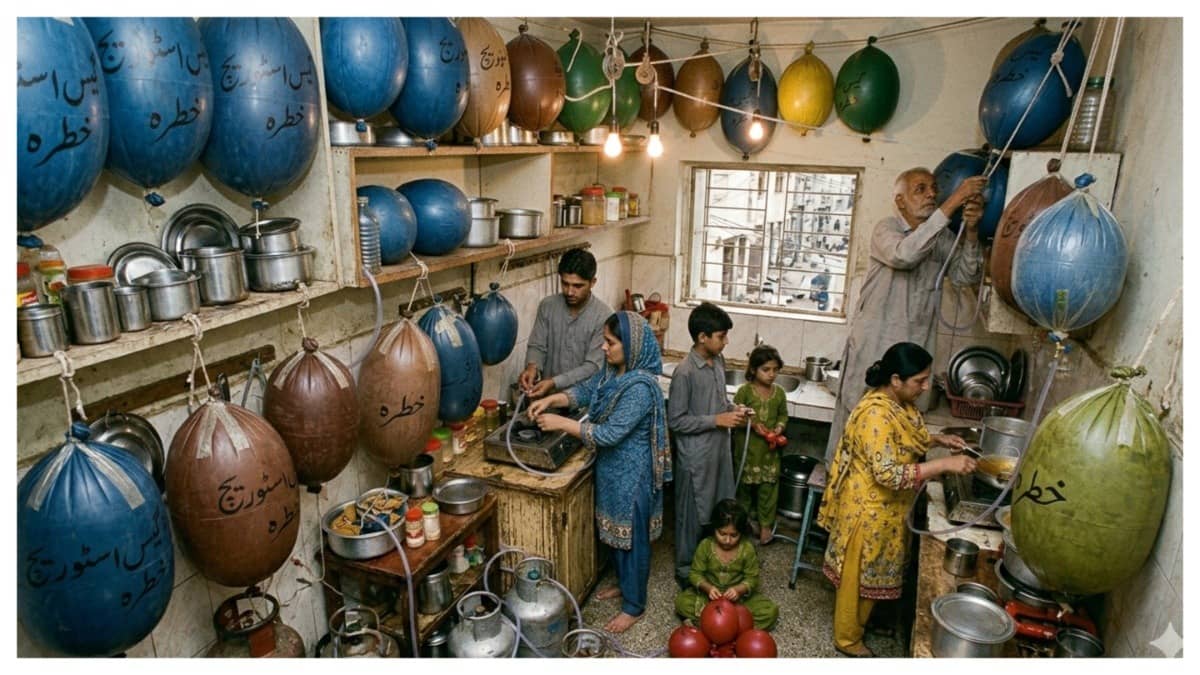
The escalating Karachi gas shortage has triggered a desperate, uncalibrated shift in domestic energy management across Orangi Town and Mominabad. Residents currently utilize large, specially designed plastic balloons as makeshift storage units to combat chronic supply deficits and low pressure. Consequently, this hazardous baseline for survival highlights a severe structural failure in the national energy grid, forcing citizens to adopt life-threatening alternatives.
The Translation: Understanding the Mechanics of Risk
In technical terms, natural gas requires precise containment systems to prevent combustion. These plastic balloons, priced between Rs1,000 and Rs1,500, offer zero structural integrity against pressure changes or external friction. While the logic for residents is simple survival, the engineering reality is terrifying. Consequently, when gas supply resumes briefly, citizens fill these reservoirs, effectively creating unshielded pressure vessels within their living quarters.

Safety experts have calibrated their warnings to reflect the extreme danger of this practice. They describe these balloons as “mobile bombs” because the lack of a regulator or safety valve means a minor spark or domestic accident could trigger a catastrophic explosion. This trend represents a strategic failure in public safety awareness and utility distribution.
The Socio-Economic Impact: Vulnerability in High-Density Zones
The Karachi gas shortage disproportionately affects the most vulnerable demographics in high-density urban areas. For families in Orangi Town, the choice is between hazardous storage or the inability to cook daily meals. This desperation erodes the baseline of urban safety, as one explosion in a crowded neighborhood can catalyze a chain reaction of fires. Furthermore, the financial burden of purchasing these “balloons” adds another layer of economic strain on households already struggling with inflation.
Professional households and students are witnessing a degradation of systemic reliability. When citizens must engineer their own dangerous solutions for basic utilities, the socio-economic friction increases, hindering national productivity. The persistence of this trend signals a critical need for immediate infrastructure intervention to protect the lives of everyday Pakistanis.
The Forward Path: A Dangerous Momentum Shift
This development represents a significant Momentum Shift—but in the wrong direction. It is a transition from regulated utility consumption to an “informal and hazardous” energy economy. Unless gas utility companies implement strategic supply improvements, the proliferation of these balloons will likely increase. This is not a stabilization move; it is a symptom of a system reaching its breaking point.
Authorities must prioritize precision in gas distribution to eliminate the need for such desperate measures. Effective governance requires moving beyond reactive statements and toward structural energy security. We must treat this not just as a local news item, but as a catalyst for a national conversation on energy resilience and safety standards.