

Technological sovereignty requires high-precision tools that are both accessible and efficient. The GLM-5.2 open model, recently deployed by Z.ai, represents a structural catalyst in the artificial intelligence sector. This 753-billion-parameter system outperforms GPT-5.5 Pro in critical engineering benchmarks while operating at approximately 16% of the traditional cost. Consequently, this shift provides a precision baseline for developers seeking sovereign AI infrastructure without the exorbitant fees of closed-source giants.
Calibrated Architecture: The IndexShare Advantage
Z.ai engineered the GLM-5.2 with a focus on resource optimization. The model introduces the “IndexShare” architecture, which strategically reuses a single indexer across four sparse-attention layers. This calibration reduces per-token computing requirements by 2.9 times during full one-million-token context operations. Furthermore, the upgraded Multi-Token Prediction layer enhances speculative decoding efficiency by 20%.
Users can toggle between two specific operational profiles:
- Max Mode: Prioritizes absolute performance with higher token output.
- High Mode: Optimizes for low latency and reduced token consumption with minimal benchmark degradation.
Benchmarking Precision in Autonomous Coding
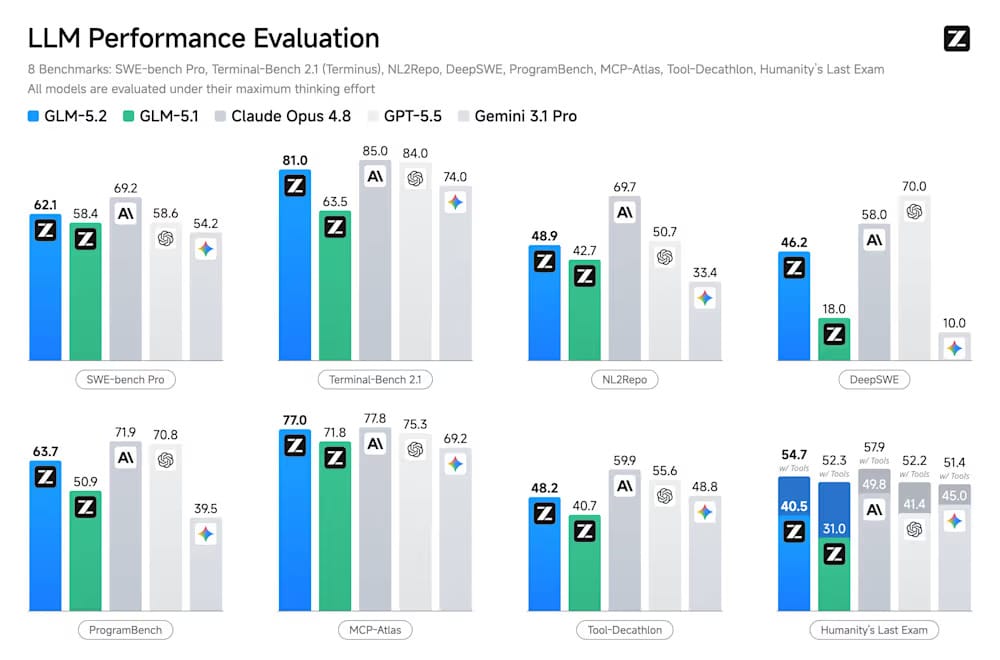
The GLM-5.2 open model demonstrates superior capability in long-running engineering tasks. On the SWE-bench Pro metric, it achieved a score of 62.1, surpassing GPT-5.5’s 58.6. Specifically, the model excels in tool-use scenarios, scoring 76.8 on the MCP-Atlas benchmark. While Claude Opus 4.8 maintains a slight lead in specific “Humanity’s Last Exam” metrics, GLM-5.2 consistently beats GPT-5.5 across most developer-centric categories.
The model also secured the first position on the crowdsourced Design Arena benchmark. Its Elo score of 1,360 confirms its architectural superiority in creative and structural design tasks. Consequently, major coding environments like Kilo Code and Cline have already integrated support for the model’s agentic workflows.
Economic Calibrations: Breaking the API Monopoly
The MIT license allows businesses to modify and commercialize GLM-5.2 without regional restrictions or royalties. This deployment flexibility enables companies to run the model on private infrastructure using frameworks like vLLM or Unsloth. By bypassing external APIs, organizations can ensure data security while maintaining GPT-level performance.

API Pricing Infrastructure
| Model | Input (per 1M) | Output (per 1M) | Total Cost | Source |
|---|---|---|---|---|
| GLM-5.2 | $1.40 | $4.40 | $5.80 | Z.ai |
| GPT-5.5 | $5.00 | $30.00 | $35.00 | OpenAI |
| Claude Opus 4.8 | $5.00 | $25.00 | $30.00 | Anthropic |
The Translation
In simpler terms, Z.ai has built a “brain” for computers that is as smart as the world’s most famous AI (GPT) but costs 84% less to use. They used a clever trick called “IndexShare” to make the AI work less hard to remember long pieces of code, which makes it faster and cheaper. Because the model is “open-weight,” any company can download it and run it on their own servers rather than paying a monthly subscription to a foreign company.
The Socio-Economic Impact
For the Pakistani professional, this is a massive win for scalability. Local software houses can now deploy world-class autonomous coding agents without the prohibitive costs of US-based APIs. This democratizes high-tier AI for students and startups in Karachi, Lahore, and Islamabad, allowing them to compete globally with significantly lower overhead. It represents a shift from “consumers of AI” to “architects of AI.”
The Forward Path
This development represents a Momentum Shift. The era of closed-source dominance is ending as open models like GLM-5.2 reach parity with proprietary giants. For Pakistan, the strategic move is to invest in local GPU clusters to host these open-weight models, ensuring national data remains sovereign while leveraging the highest levels of global computing precision.








