The recent development of a Japan Modular Prayer Space by OM Kiki Co. represents a calibrated advancement in architectural inclusivity, addressing a critical baseline requirement for Muslim travelers. This precision-engineered structure ensures that spiritual obligations do not conflict with urban mobility, effectively removing a significant barrier to international tourism. Consequently, this innovation serves as a catalyst for a more inclusive global travel ecosystem.
Engineering Inclusivity: The Specs of the Japan Modular Prayer Space
OM Kiki Co., a firm specializing in welfare and support equipment, engineered the “Prayer Space” to function as a compact, high-efficiency unit. The wooden structure maintains a streamlined footprint with a 150-centimeter-square floor area and stands 180 centimeters tall. Specifically, the design prioritizes hygiene and orientation, featuring waterproof, easy-to-clean mats for cleansing rituals and a movable qibla marker on the ceiling.
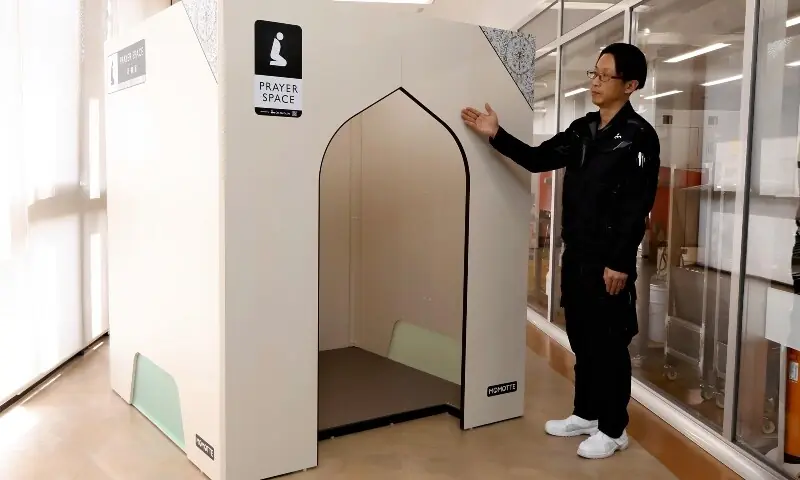
This structural solution emerged from a strategic observation. A staff member noted that Muslim companions often struggled to locate suitable prayer environments during travel. By addressing this friction point, the company has transformed a personal challenge into a scalable product that enhances the functionality of tourist attractions and businesses across Japan.
Data-Driven Design for Global Markets
The market for halal-compliant infrastructure is expanding rapidly. Market research confirms that the availability of prayer facilities significantly dictates travel destinations for Muslim consumers. Data indicates that 72 percent of men and 79 percent of women prioritize destinations that offer dedicated spiritual spaces. Therefore, the Japan Modular Prayer Space is not merely a courtesy; it is a strategic economic asset for the tourism industry.

- Structural Precision: 150cm x 150cm footprint optimized for urban density.
- Ritual Support: Integrated waterproof surfaces for Islamic cleansing.
- Navigation: Strategic qibla markers for accurate orientation.
The Translation: Systemic Optimization for Modern Travelers
Beyond the simple provision of a room, this development translates cultural needs into a systematic framework for hospitality. It replaces “ad-hoc” solutions with a standardized, reliable, and private environment. This structural consistency allows travelers to maintain their daily rhythms without the cognitive load of searching for appropriate facilities, thereby increasing the overall efficiency of their journey.
The Socio-Economic Impact: Empowering the Global Citizen
For the Pakistani professional or student traveling abroad, this innovation represents a significant shift in daily life quality. It facilitates a seamless integration of religious identity and professional mobility. By reducing the stress associated with finding prayer areas, these modular spaces empower individuals to participate more fully in international conferences, global education, and high-level tourism, bridging the gap between faith and global engagement.
The Forward Path: A Catalyst for Universal Accessibility
In our expert assessment, the launch of the Japan Modular Prayer Space represents a Momentum Shift in global travel infrastructure. This is not merely a maintenance move; it is a proactive recalibration of how international spaces accommodate diverse populations. As these units scale from Okayama across the globe, we anticipate a new baseline for inclusive design that other nations must eventually adopt to remain competitive in the global market.