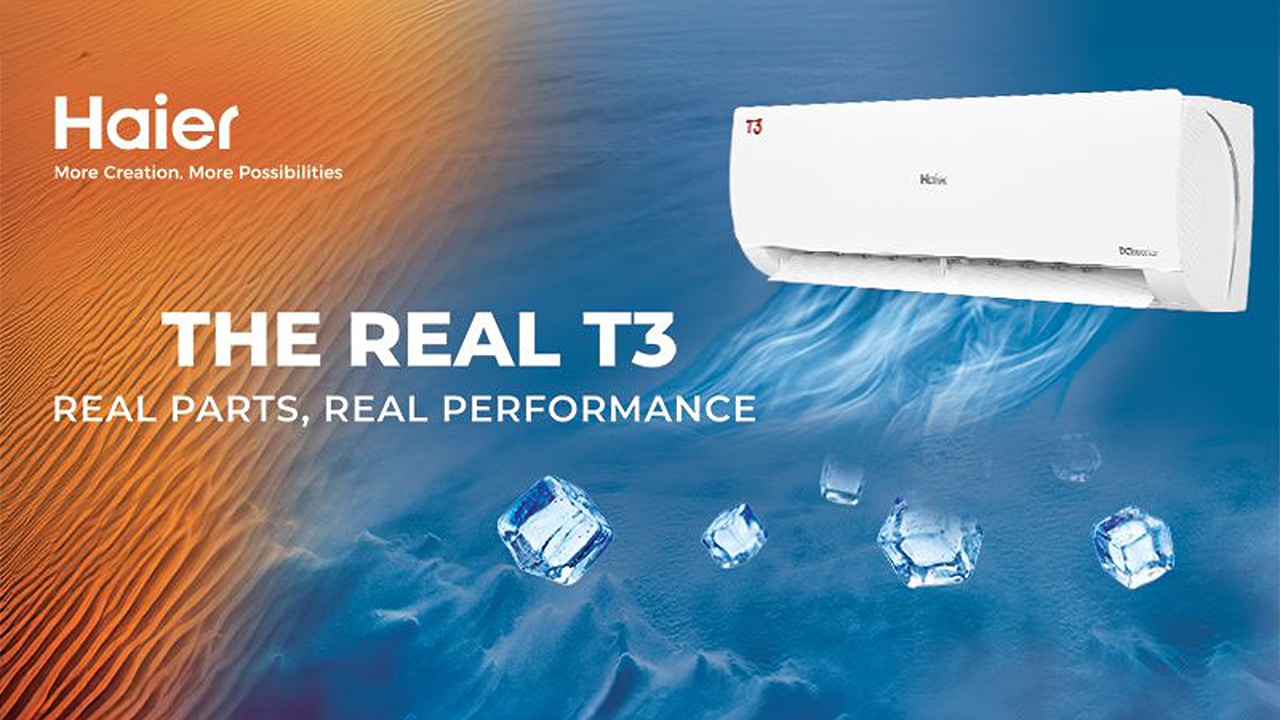
Pakistan’s cooling infrastructure faces a calibrated challenge as urban temperatures frequently exceed standard operating thresholds. The Haier T3 AC emerges as a critical catalyst for climate resilience, engineered to deliver full BTU capacity even when outdoor ambient temperatures hit 53°C. This structural shift in cooling technology ensures that domestic environments remain stable during the most extreme seasonal peaks.
The Engineering of the Haier T3 AC
Ordinary systems often fail because their thermal exchange efficiency drops as heat rises. In contrast, Haier leverages advanced T3 inverter technology to maintain structural cooling integrity. Specifically, this precision engineering allows the unit to continue operating where conventional compressors typically undergo thermal shutdown. Consequently, users in high-heat zones like South Punjab and Sindh experience uninterrupted comfort.
Beyond raw power, the integration of AI Eco Mode optimizes the operational baseline of the unit. Furthermore, the Haismart App allows for granular control over energy consumption. This data-driven approach to cooling enables users to calibrate their indoor climate while monitoring efficiency in real-time. Consequently, the system balances high-output cooling with strategic energy conservation.
The Situation Room: Analysis
The Translation (Clear Context)
Technical specifications often obscure the baseline reality of cooling capacity. In layman’s terms, a “T3” rating identifies a compressor designed for “tropical” climates with extreme heat thresholds. While many units claim T3 compatibility, the Haier T3 AC delivers “Full BTUs.” This means the system does not merely “stay on” during a heatwave; it provides 100% of its rated cooling power without the energy-sapping degradation common in standard models.
The Socio-Economic Impact
The efficiency of the Haier T3 AC directly impacts the daily lives of Pakistani citizens by stabilizing the household economy. As electricity tariffs fluctuate, the AI-driven optimization reduces the financial strain on middle-class families. For professionals and students, reliable cooling prevents the productivity loss typically associated with extreme heatwaves. Consequently, this technology serves as a stabilizer for both physical health and economic output in urban centers.
The Forward Path (Opinion)
This development represents a Momentum Shift for Pakistan’s appliance market. As the region navigates the reality of expanding heat islands, the transition from “standard cooling” to “climate-resilient infrastructure” is no longer optional. Haier’s commitment to 53°C performance sets a new technical baseline, forcing the industry to move toward high-precision, extreme-weather solutions rather than temporary stabilization moves.