

The architectural baseline of mid-range smartphones is shifting as the Redmi Note 17 Pro prepares for its international debut. Recent systemic data from the NBD import and export database reveals a strategic recalibration of hardware specifications for the global market. While the Chinese variant set a high technical ceiling, the global iteration, identified by model number 2607DRA18G, appears to be optimized for different economic parameters.
Global Memory Configurations for the Redmi Note 17 Pro
Analytical records dated May 2026 indicate that shipments destined for Pakistan and Vietnam carry significantly different memory signatures. Unlike the robust 12GB RAM options found in China, the global Redmi Note 17 Pro listings highlight base configurations of 4GB RAM with 64GB storage and 6GB RAM with 128GB storage. This technical adjustment suggests a focus on market accessibility over raw performance peaks.
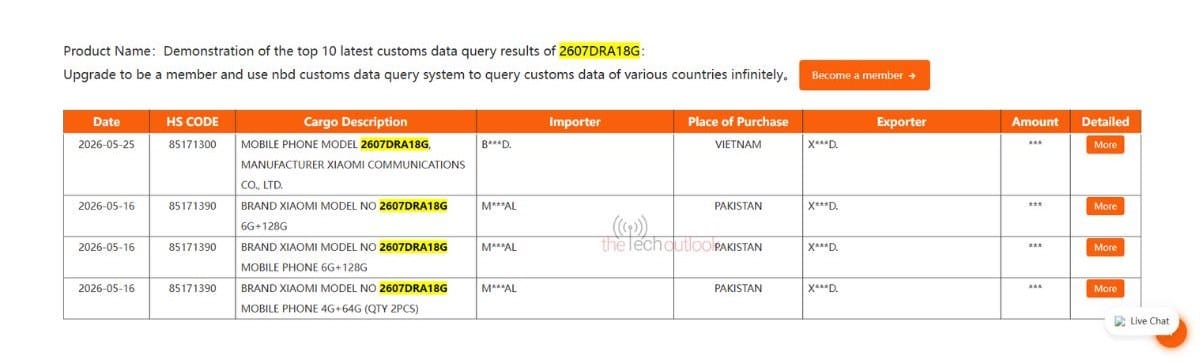
Battery and Regional Variations
The hardware divergence extends to the energy cell. While the Chinese model utilizes a 9,000mAh battery, the global Redmi Note 17 Pro is rumored to house a calibrated 8,340mAh rated battery (marketed as 8,500mAh). Interestingly, reports suggest the Indian market may bypass this downgrade, potentially retaining the original 9,000mAh capacity to meet specific regional competition demands.
The Poco Rebrand Strategy
In addition to the primary Redmi line, the database identifies a parallel device under the model number 2607DPC18G. The “PC” designation strongly implies a Poco-branded rebrand, likely continuing the trend of cross-market hardware sharing. This device, potentially launching as the Poco M8 Power, will likely mirror the adjusted global specs of the Redmi Note 17 Pro to maintain ecosystem synergy.
The Translation (Clear Context)
In the smartphone industry, “G” (Global) models often differ from “C” (China) models due to regional supply chains and purchasing power. Xiaomi is essentially diversifying its product portfolio. By lowering the entry-level RAM and battery capacity, the company can deploy the Redmi Note 17 Pro at a more competitive price point in emerging markets without cannibalizing their premium segments.
The Socio-Economic Impact
For the average Pakistani consumer, this development is a double-edged sword. While a “downgrade” sounds negative, it typically results in a lower retail price, making 5G-ready hardware like the Redmi Note 17 Pro accessible to a wider demographic of students and young professionals. However, heavy users and gamers must carefully evaluate if 4GB of RAM meets their operational precision requirements in 2026.
The Forward Path (Opinion)
This development represents a Stabilization Move. Rather than pushing the absolute limits of hardware in every market, Xiaomi is calibrating its offerings to match the economic realities of global inflation. While tech enthusiasts may lament the loss of the 9,000mAh battery, the move ensures the Redmi series remains a catalyst for digital inclusion by remaining affordable.








