Ferrari recently unveiled the Ferrari Luce EV, a $640,000 grand tourer that signals a pivotal shift in the brand’s engineering trajectory. While the vehicle boasts unprecedented performance metrics, it has sparked a significant decline in market confidence. Within 24 hours of the reveal, Ferrari shares plummeted by 7%, erasing billions in market valuation as enthusiasts and investors questioned the aesthetic direction of the legendary automaker.
Analyzing the Ferrari Luce EV Engineering Paradigm
Designed by former Apple design chief Jony Ive and Marc Newson, the Luce represents a radical departure from the aggressive, aerodynamic silhouettes traditionally associated with the Italian house. Consequently, the online community has scrutinized the vehicle’s minimalist exterior, with some critics drawing unfavorable comparisons to domestic appliances. Despite the visual controversy, the technical baseline of the vehicle remains formidable. The powertrain delivers over 1,000 horsepower, enabling a precision-calibrated acceleration from 0 to 100 km/h in just 2.5 seconds.
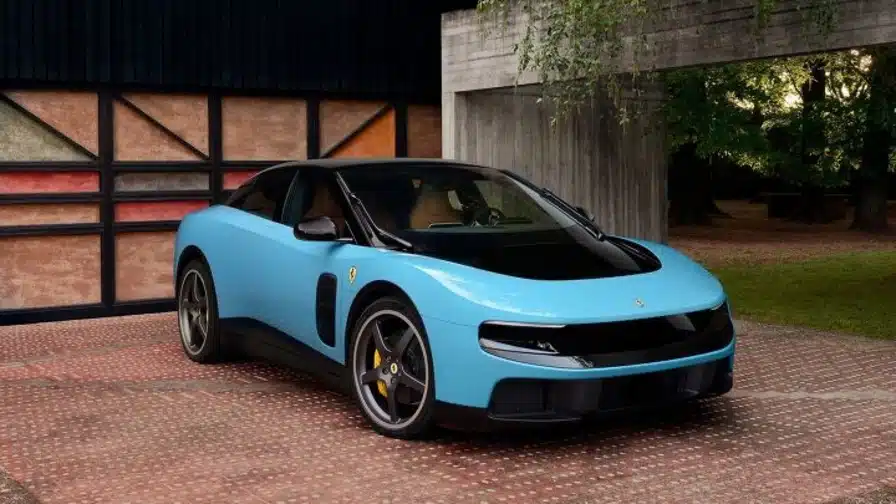
Former Ferrari Chairman Luca Cordero di Montezemolo expressed profound concern regarding this structural shift. He argued that moving toward fully electric platforms risks eroding the brand’s legendary status. Furthermore, he suggested that the company should consider removing the iconic badge from the Ferrari Luce EV to preserve the legacy of its combustion-engine predecessors. Current leadership, however, maintains that this evolution is a necessary catalyst for survival in a cleaner automotive era.
The Translation: Contextualizing the Shift
Technically, Ferrari is attempting to redefine “luxury performance” by decoupling it from the auditory signature of V12 engines. The Luce is not just a car; it is a high-speed computer on wheels. The backlash reflects a structural friction between traditional brand equity and the inevitable transition to electric mobility. While the “fridge” memes dominate social media, the core innovation lies in the 1,000 HP electric architecture, which establishes a new performance ceiling for the grand tourer segment.
The Socio-Economic Impact: What It Means for Pakistan
For the aspiring engineering sector in Pakistan, the Ferrari Luce EV serves as a high-stakes case study in brand evolution and technology adoption. It demonstrates that even the world’s most powerful brands face intense market pressure when transitioning to sustainable tech. As Pakistan looks toward local EV manufacturing and infrastructure development, this situation highlights that performance alone is insufficient; cultural alignment and design precision are critical for consumer acceptance in the luxury tier.
The Forward Path: Architect’s Opinion
This development represents a Stabilization Move rather than a clean momentum shift. While the 1,000 HP output is a technical triumph, the immediate 7% stock decline suggests a failure in strategic communication and design calibration. Ferrari must bridge the gap between their heritage and this new digital frontier. If they cannot convince their core demographic that an EV can carry the soul of the Prancing Horse, they risk a long-term dilution of their market dominance. The Luce is a necessary experiment, but its execution requires further refinement to meet the expectations of the Ferrari mythos.