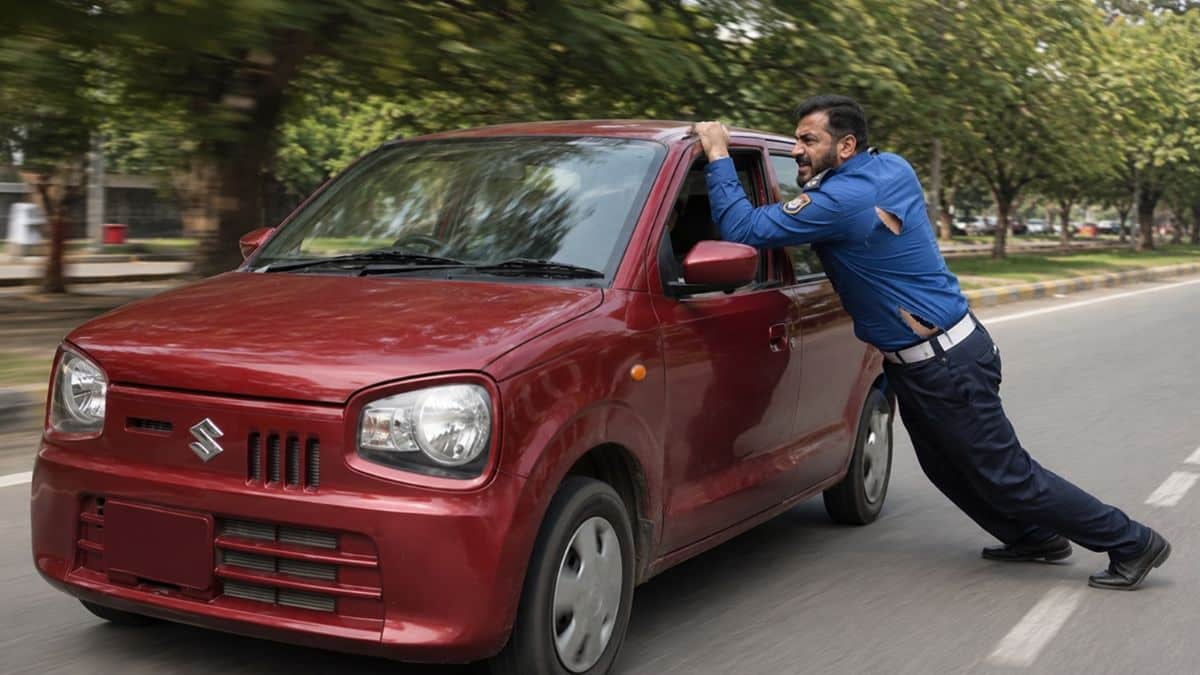
Systemic order in any urban landscape depends on the calibrated interaction between enforcement and civic duty. The recent Faisalabad traffic incident on Canal Road highlights a critical failure in the structural relationship between motorists and law enforcement officers. When a driver allegedly ignored a stop command from traffic warden Inam-ul-Haq, the resulting escalation forced the officer to cling to a moving vehicle for a considerable distance to ensure enforcement.
Decoding the Faisalabad Traffic Incident Dynamics
The incident occurred on the high-traffic Canal Road artery. According to official reports, Warden Inam-ul-Haq signaled the motorist to pull over for a routine traffic ticket. Instead of compliance, the driver accelerated the vehicle, creating an immediate safety vacuum. Consequently, the warden opened the door and gripped the moving car as a last-resort measure to prevent the suspect’s escape.
Visual evidence shows the car maintaining velocity while the officer remains suspended from the open door. This high-risk maneuver resulted in the warden being dragged for several meters, which caused visible damage to his uniform and posed a lethal threat to his physical safety. Specifically, the lack of immediate compliance transformed a minor administrative stop into a dangerous criminal event.

Following the event, traffic authorities located the vehicle. The driver eventually paid the required fine and issued a formal apology. While the warden avoided serious physical injury, the psychological and structural impact on traffic law enforcement protocols remains a subject of intense debate.
The Situation Room: Strategic Analysis
The Translation (Clear Context)
Beyond the viral visuals, this incident represents a “friction point” in urban governance. When citizens perceive traffic stops as negotiable or optional, the entire logic of law enforcement destabilizes. The warden’s decision to hang onto the car was a desperate attempt to maintain the authority of the state in a moment of active defiance. In a digital-first system, this physical risk would be mitigated by automated cameras and immediate plate-tracking.
The Socio-Economic Impact
Incidents like this directly affect the daily lives of Pakistanis by increasing the “risk premium” of public service. When traffic law enforcement becomes physically dangerous, it leads to decreased morale among officers and more aggressive behavior from commuters. For the average citizen, this translates to less orderly roads, higher insurance risks, and a degradation of the social contract that ensures safe transit for families and professionals alike.
The Forward Path (Opinion)
This development represents a Stabilization Move rather than progress. While the resolution involved an apology and a fine, the process was reactive and high-risk. True momentum shift will only occur when Pakistan integrates “e-challan” precision across all metropolitan corridors. We must shift the enforcement burden from physical intervention to digital accountability to ensure that no officer ever has to risk their life for a routine traffic stop again.