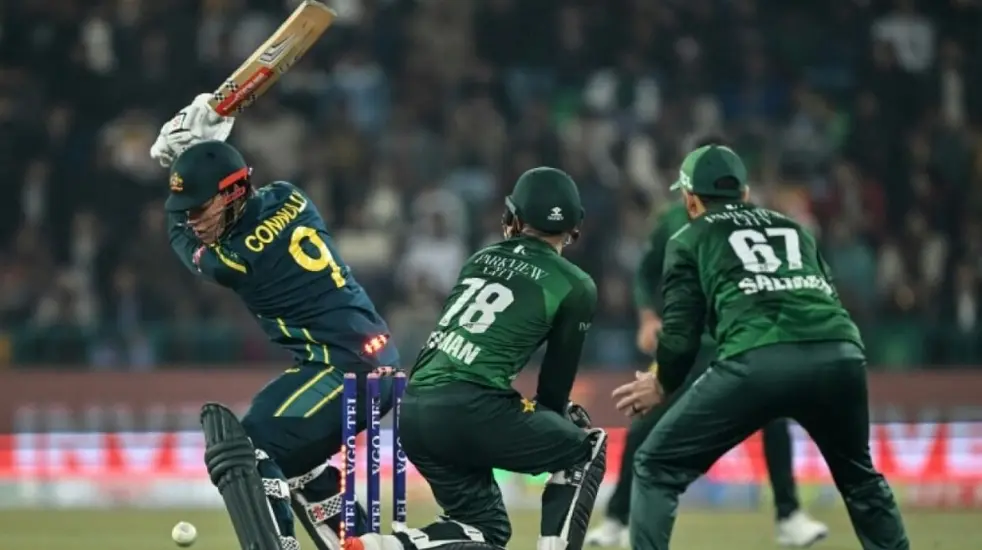
The Pakistan T20 World Cup 2026 campaign initiated with a calibrated, last-over victory against the Netherlands. This strategic three-wicket win at the Sinhalese Sports Club Ground sets a robust baseline for their tournament trajectory. The Men in Green successfully chased 148 runs, concluding at 147 for 7, demonstrating critical resilience under pressure.
Architecting a Chase: Early Momentum and Mid-Innings Calibration
The chase began with assertive intent, as openers Saim Ayub and Sahibzada Farhan established a rapid scoring rate. Saim’s calculated 24 off 13 balls, featuring four fours and a six, provided an immediate burst of energy. Subsequently, spinner Aryan Dutt executed the initial breakthrough, but the momentum was largely sustained.
Farhan maintained the aggressive tempo, collaborating with captain Salman Ali Agha to accelerate Pakistan’s progress. Their partnership yielded a swift 50 runs within the initial five overs. However, Dutt’s return resulted in Salman’s dismissal for 12 off 8, positioning Pakistan at 53-2 in 4.5 overs. This transition phase required immediate strategic adjustment.
Farhan anchored the innings as Babar Azam meticulously settled into his rhythm. Babar advanced significantly, appearing poised for a half-century, before Roelof van der Merwe halted his progress at 47 off 31 deliveries. This critical wicket, followed by Usman Khan’s second-ball duck in the same over, generated a structural challenge for Pakistan at 98-4 in 11.1 overs. Consequently, the scoring rate experienced a necessary calibration.
The Decisive Finish: Pakistan T20 World Cup Strategic Resilience Under Pressure
The chase subsequently decelerated, intensifying the pressure on Pakistan’s middle order. The Netherlands capitalized on this shift, tightening their bowling precision. Later in the innings, Mohammad Nawaz (6) and Shadab Khan (8) were dismissed by Kyle Klein and Logan van Beek respectively, escalating the tension to a critical juncture. This sequence demanded a decisive intervention.
In this high-stakes scenario, Faheem Ashraf and Shaheen Afridi demonstrated exceptional composure. Faheem initiated a powerful momentum shift with consecutive sixes, ultimately remaining unbeaten with a match-winning 29 off 11 balls. His clinical striking, comprising two fours and three sixes, sealed a memorable comeback and secured Pakistan’s initial points in the ICC T20 World Cup 2026.
First Innings Analysis: Netherlands’ Strategic Start and Pakistan’s Counter-Measures
Earlier, the Netherlands exhibited a robust start after being tasked to bat first. Openers Michael Levitt and Max O’Dowd efficiently found boundaries, with Levitt displaying particular aggression. This early offensive posed an initial challenge for Pakistan’s bowling unit.
Pakistan achieved their initial breakthrough in the fourth over. Salman Mirza precisely dismissed O’Dowd for 5 off 7, with Usman Khan securing a clean catch. In the subsequent over, Mohammad Nawaz executed a pivotal dismissal, removing Levitt for 24 off 15. Babar Azam’s sharp boundary effort and relay to Shaheen Afridi for the completion of the catch exemplified tactical precision.
Bas de Leede and Colin Ackermann then initiated a rebuilding phase, ensuring the Netherlands surpassed 50 runs within the powerplay. However, Pakistan responded effectively, as Abrar Ahmed dismissed Ackermann for 20 off 14, setting the Netherlands at 65-3 in the eighth over. This marked a crucial counter-measure to their growing partnership.
The Dutch side reached 100 runs in the 13th over, highlighted by captain Scott Edwards’ six off Nawaz. Nevertheless, Nawaz subsequently secured de Leede’s wicket for 30 off 25, establishing the score at 105-4. Abrar then claimed his second wicket, dismissing Edwards for a resilient 37 off 29. Furthermore, Saim Ayub delivered two decisive blows in the very next over, dispatching Logan van Beek and Zach Lion-Cachet, thereby reducing the Netherlands to 129-7.
Shaheen Afridi efficiently removed van der Merwe for 4. Ultimately, Mirza concluded the innings in the final over by dismissing Aryan Dutt (13) and Paul van Meekeren (0). Mirza led Pakistan’s bowling attack with a structural 3 for 24 in 3.5 overs. Nawaz, Abrar, and Saim each secured two wickets, while Shaheen also contributed one scalp, collectively limiting the Netherlands to 147 runs.
The Translation: Deconstructing the Match Dynamics
This match was a micro-representation of high-stakes tournament cricket. Pakistan’s ability to recover from a mid-innings wobble, particularly after key wickets fell, underscores a developing tactical maturity. The “typical fashion” refers not to an easy win, but to Pakistan’s historical tendency for close finishes, often pushing games to the absolute limit. Here, it signifies a team that can execute under duress, a crucial attribute for deep tournament runs. Furthermore, the collaborative effort of the bowlers to restrict the opposition, despite an aggressive start, indicates a cohesive unit.
The Socio-Economic Impact: Inspiring National Performance Paradigms
For a Pakistani citizen, especially students and young professionals, this victory transcends mere sporting success. It serves as a tangible demonstration of strategic planning, adaptability, and perseverance – qualities directly applicable to professional and academic pursuits. In urban centers, such victories ignite national pride and encourage collective optimism. In rural Pakistan, where access to entertainment is often limited, cricket remains a powerful unifying force, providing aspirational narratives of achievement and teamwork. Consequently, these moments foster a sense of shared national identity and calibrated progress.
The “Forward Path”: Pakistan T20 World Cup Momentum Shift
This opening victory represents a Momentum Shift rather than merely a stabilization move for Pakistan’s T20 World Cup aspirations. While the margin was narrow, the manner of the win – engineered through composure and decisive hitting in the final overs – builds critical confidence and team cohesion. It provides a robust operational baseline for the upcoming, higher-stakes matches. The early tournament pressure often exposes vulnerabilities; Pakistan’s capacity to navigate this challenge effectively signals a readiness for systemic advancement in the tournament. Therefore, this performance serves as a positive catalyst for future challenges.