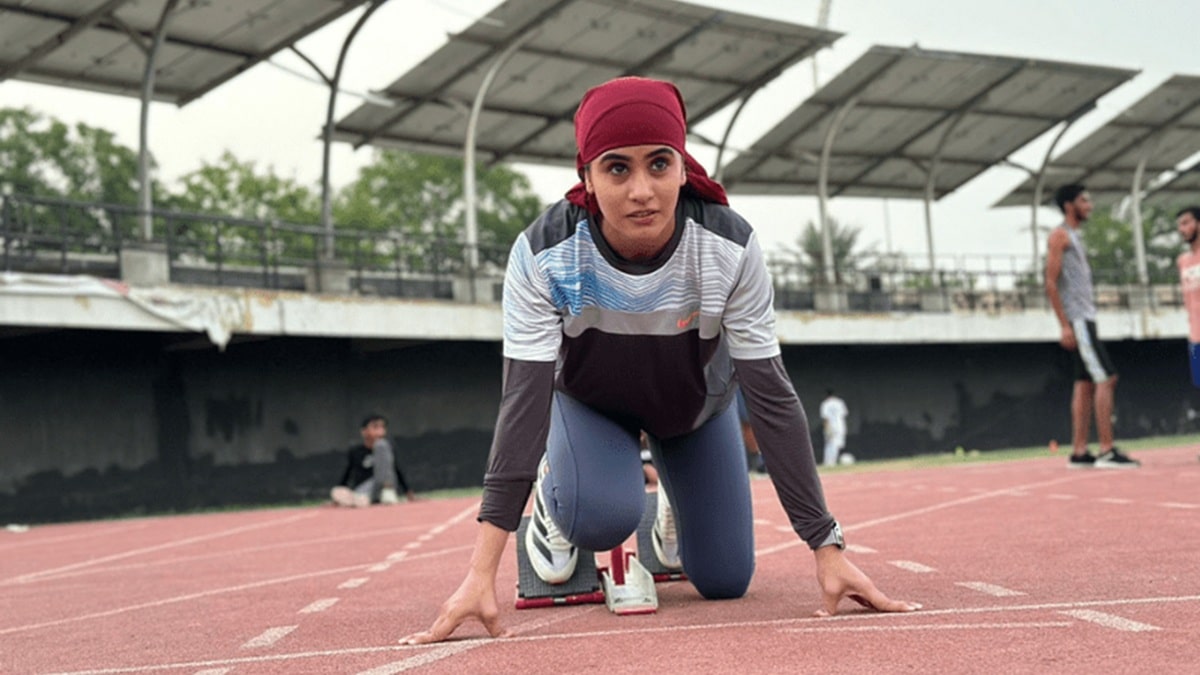
Precision in athletic performance serves as a vital baseline for national development. Recently, Faiqa Riaz established a new national sprinting record during the women’s 100-meter event at the 23rd Commonwealth Games. This achievement represents a strategic leap forward for Pakistan’s track and field contingent, despite her narrow exit before the semi-final rounds.
A New Benchmark: Breaking the National Sprinting Record
Competing in the third heat, Riaz clocked an impressive 11.64 seconds. This calibrated performance effectively shattered the previous national sprinting record of 11.81 seconds. Notably, Olympians Sadaf Siddiqui and Naseem Hameed jointly held that record for years. Riaz ultimately secured 21st place in a competitive field of 52 global athletes.

Consequently, the margin for progression remains razor-thin. Riaz missed the semi-final qualification by a mere 0.12 seconds, as only the top 17 runners advanced. While the exit is premature, the structural improvement in her timing indicates a higher ceiling for Pakistani sprinters on the international circuit.
Analyzing Multi-Disciplinary Results
Beyond the track, other Pakistani athletes faced rigorous challenges in their respective fields. In the long jump, Ansar Abbas recorded a jump of 7.06 meters. This effort placed him 18th out of 20 competitors, falling short of the top-12 requirement for the finals. Similarly, the swimming contingent faced steep competition. Ahmed Durrani and Hamza Asif finished 44th and 47th in the 100-meter freestyle, while Hareem Malik placed 24th in the 50-meter breaststroke.

In combat and precision sports, the results were mixed but determined. Ayub Qureshi secured a victory over Jamaica’s Robert Simpson in lawn bowls with scores of 13-3 and 9-5. However, this was not enough for a semi-final berth. Meanwhile, boxers Sumama Rehman and Mailaika Zahid exited in the round of 16 after hard-fought bouts against opponents from India and Zambia.
The Translation
While the headlines focus on “early exits,” the data reveals a significant narrowing of the performance gap. Breaking a long-standing record by nearly 0.2 seconds in a 100-meter sprint is a massive technical achievement. In the world of high-performance athletics, this level of improvement suggests that Pakistan’s training methodologies are beginning to align with international speed standards.
The Socio-Economic Impact
Faiqa Riaz’s success acts as a catalyst for the “Next Gen” of Pakistani youth. It demonstrates that with calibrated discipline, Pakistani athletes can challenge historical barriers. For households, this shifts the perception of sports from a hobby to a viable professional frontier. Economically, such milestones justify increased investment in high-tech training facilities and sports science infrastructure within urban and rural centers.
The Forward Path
This development represents a clear Momentum Shift. While the absence of medals might seem discouraging, the focus must remain on the precision of the metrics. Establishing a new national record on a global stage provides the psychological and statistical foundation required for future podium finishes. Pakistan is no longer just participating; we are recalibrating our top speeds.