
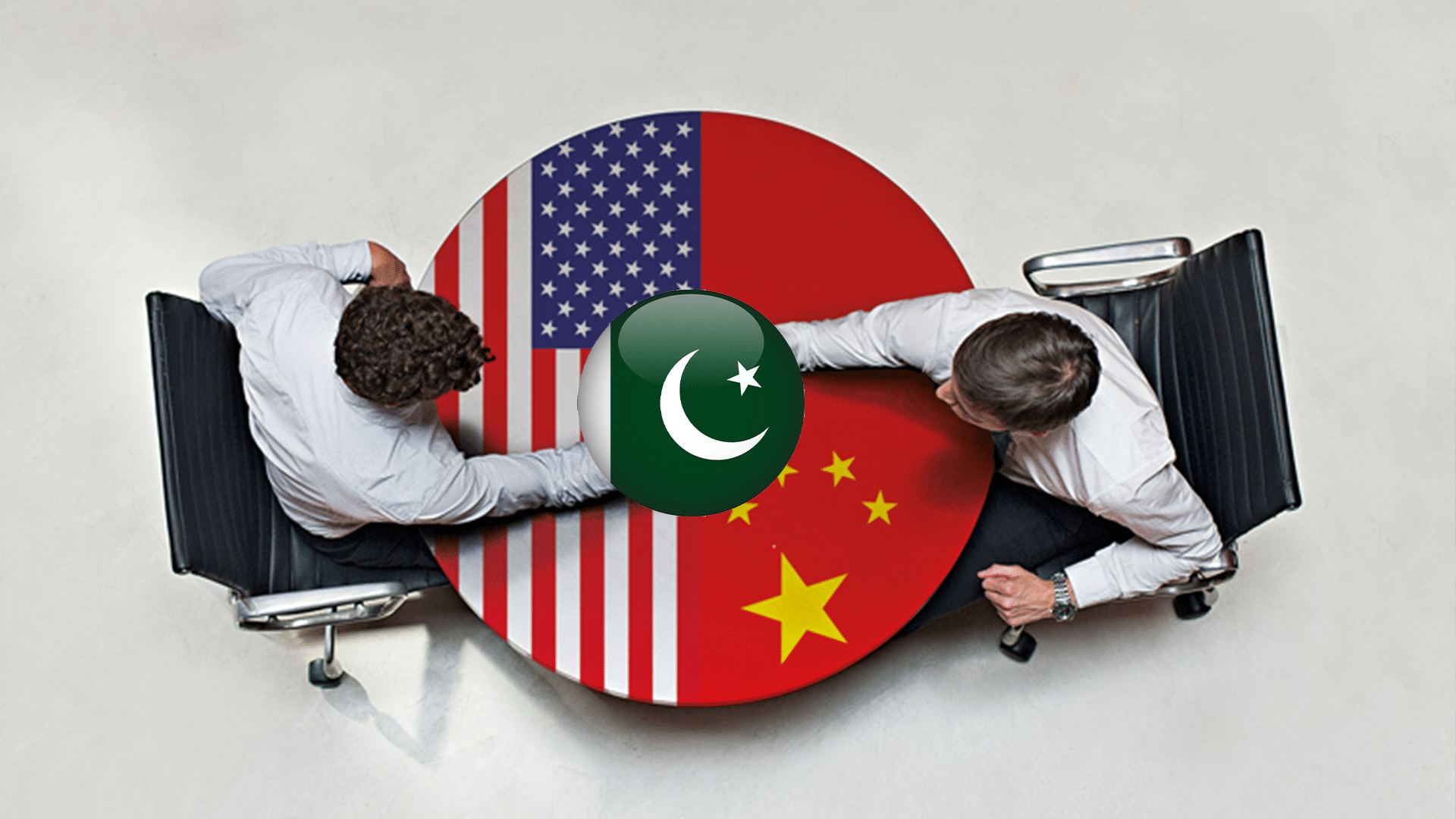
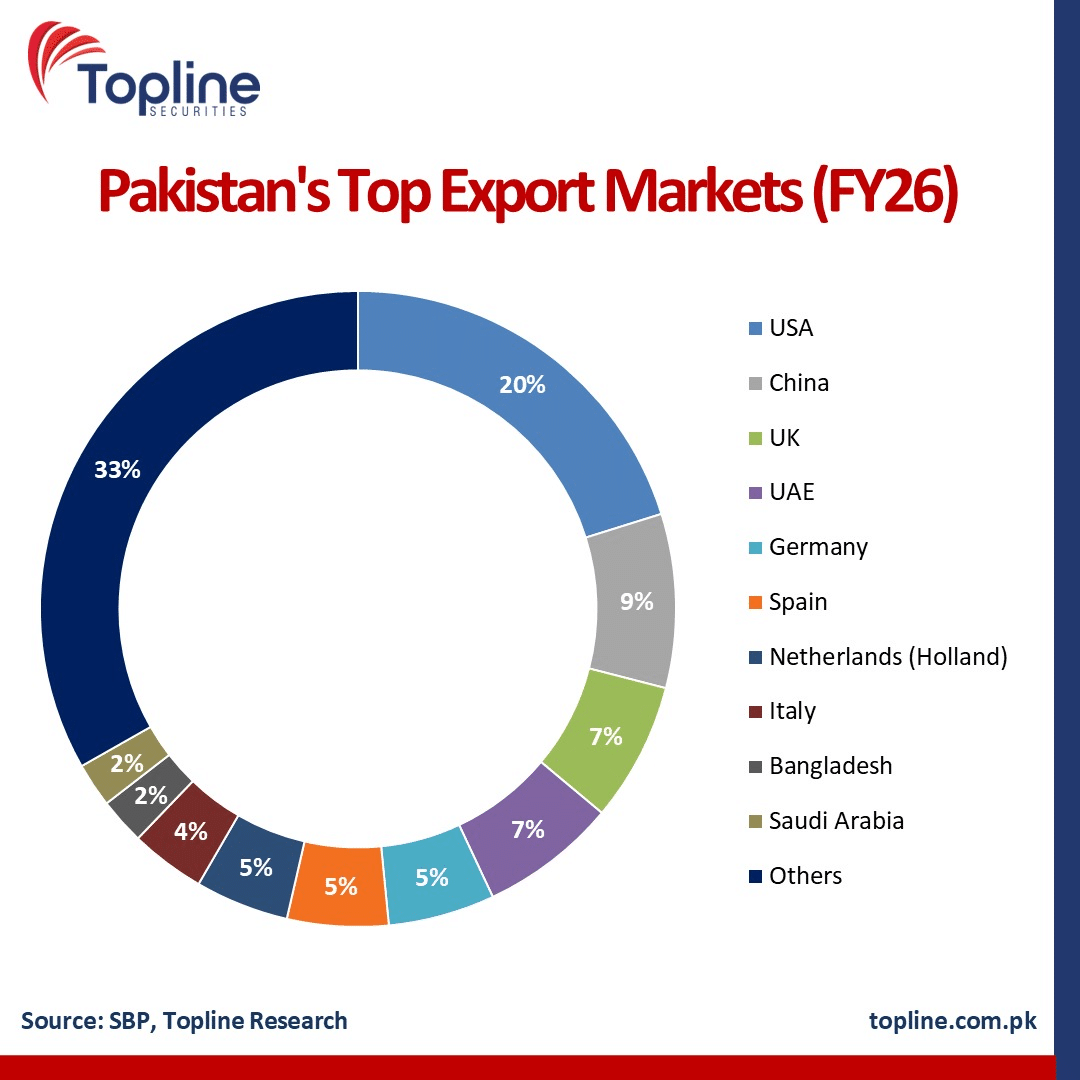
The United States remained the primary Pakistan export destination during FY26, facilitating 20 percent of total outbound trade according to the State Bank of Pakistan. This strategic partnership generated a significant trade surplus, highlighting the Western market’s consistent demand for Pakistani manufacturing. Conversely, China maintained its position as the nation’s most substantial import source, resulting in a complex trade deficit architecture that requires precise policy calibration.
The US as a Strategic Pakistan Export Destination
Data compiled by Topline Securities reveals that Pakistan secured its largest trade surplus with the United States, reaching $2.86 billion in FY26. Furthermore, the United Kingdom and Spain followed as key secondary partners, contributing surpluses of $1.42 billion and $1.35 billion, respectively. These figures demonstrate that high-value markets in the West are the primary catalysts for Pakistan’s foreign exchange earnings.
European nations such as the Netherlands, Germany, and Italy remain vital components of the export framework. Specifically, the Netherlands provided a surplus of $942 million, while Germany added $765 million. Collectively, these markets sustain the core of Pakistan’s industrial output, particularly in the textile and leather sectors.
The Structural Deficit: Managing the China Trade Gap
While the US is the top Pakistan export destination, China represents the largest trade deficit partner. The gap reached $16.85 billion during FY26, driven by a heavy reliance on Chinese machinery and industrial raw materials. Consequently, while China ranks as the second-largest export market with a 9 percent share, the import volume creates a significant structural imbalance.
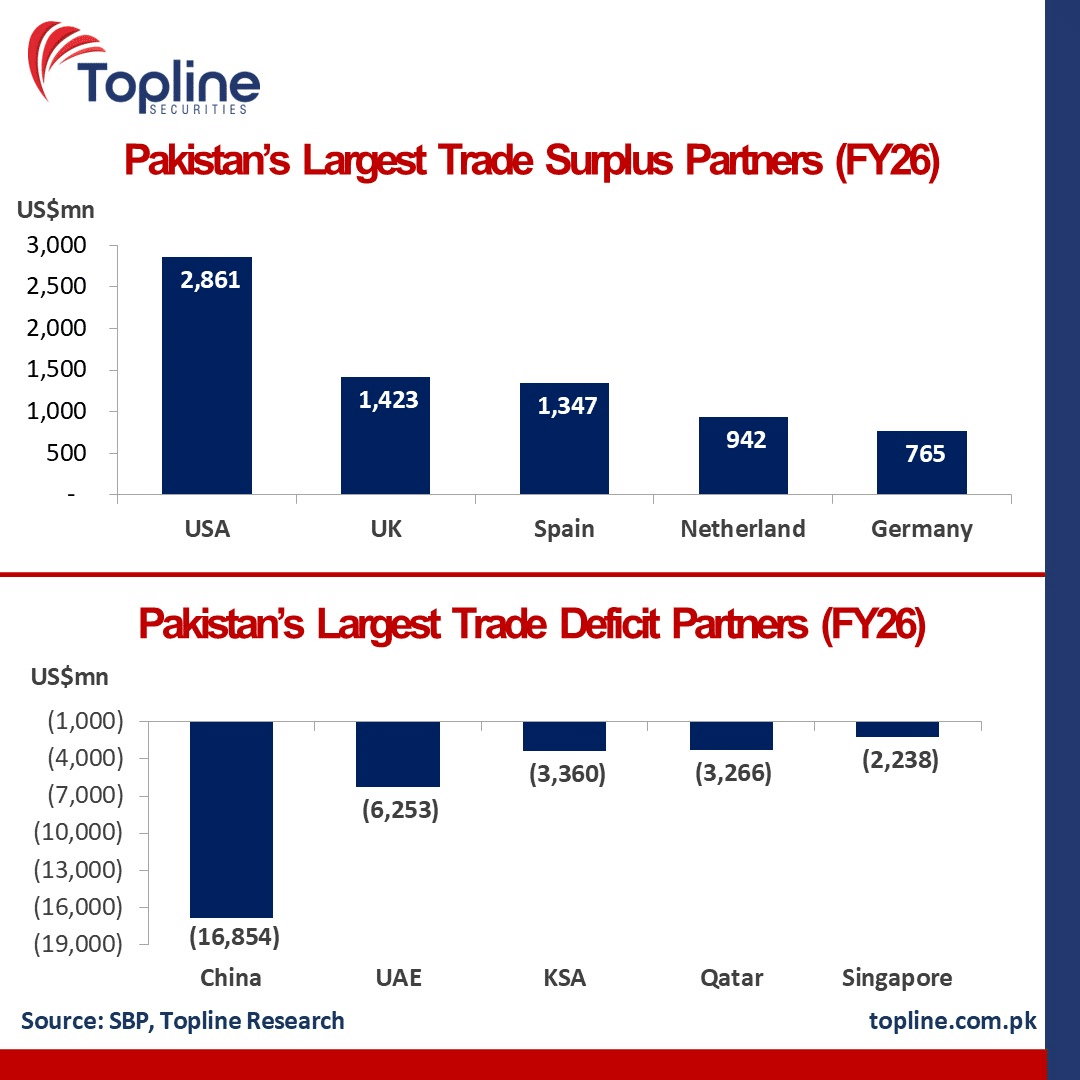
Regional dynamics also show significant deficits with the United Arab Emirates and Saudi Arabia, totaling $6.25 billion and $3.36 billion. These imbalances largely stem from energy product requirements. In contrast, the trade deficits with Qatar and Singapore reflect Pakistan’s ongoing need for specialized electronics and industrial inputs.
The Translation
To understand these figures, we must view trade as a two-way flow of value. A “surplus” means we sell more to a country than we buy, bringing money into Pakistan. A “deficit” means we spend more on their goods than we earn from them. Currently, Pakistan uses the profits earned from the US and Europe to pay for the essential machinery and energy imported from China and the Middle East. This cycle keeps the industrial engine running but highlights a dependence on Western consumption to fund Eastern production needs.
The Socio-Economic Impact
This trade structure directly affects the daily lives of Pakistani citizens through employment and cost of living. The surplus with the US and EU supports millions of jobs in the textile and apparel industries, which are the backbone of the urban working class. However, the massive deficit with China and oil-producing nations means that fluctuations in international energy prices or Chinese manufacturing costs can quickly lead to inflation at home, affecting everything from electricity bills to the price of mobile phones.
The Forward Path
This development represents a Stabilization Move. While maintaining the US as the leading Pakistan export destination ensures a baseline of foreign exchange, the growing deficit with China signals a need for structural reform. Pakistan must pivot toward “Import Substitution”—producing more industrial raw materials locally—to reduce the $16.85 billion drain. True momentum will only shift when we transition from being a consumer of global technology to a precision manufacturer for regional markets.








