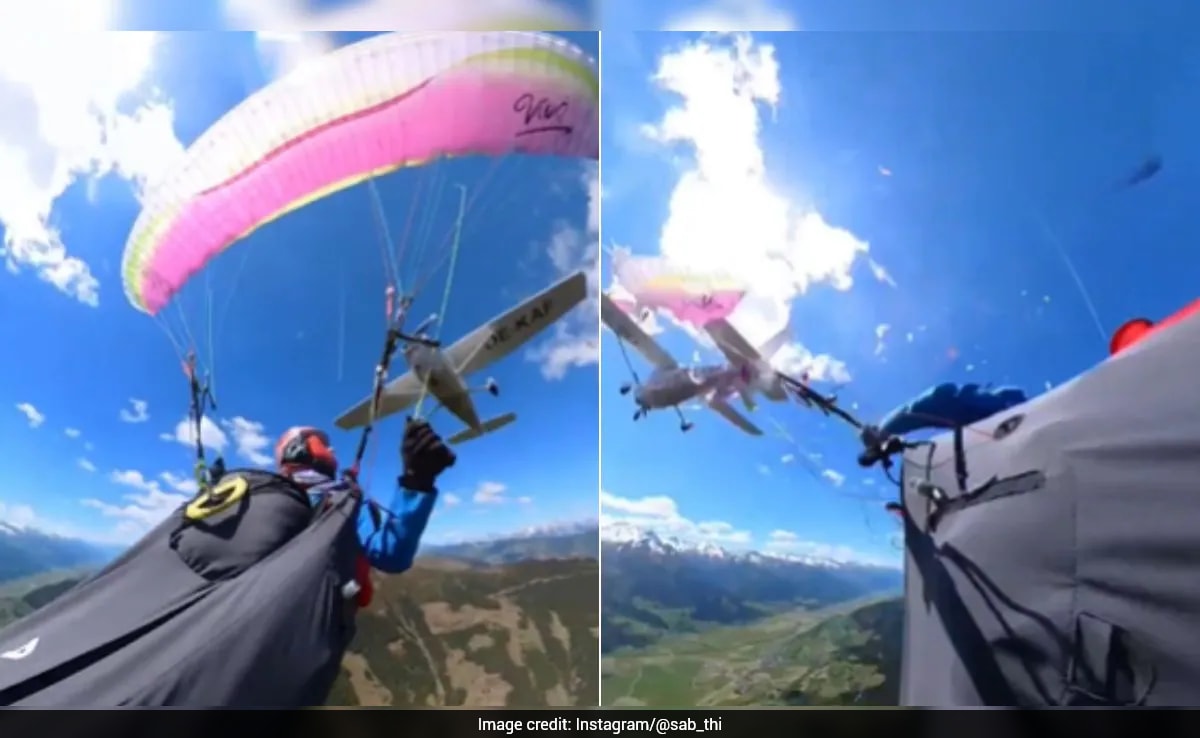
Modern aviation relies on calibrated airspace management to prevent catastrophic failure, yet human error remains a volatile variable in high-altitude environments. A shocking mid-air collision over the Austrian Alps recently tested the structural limits of emergency aviation protocols and individual survival instincts. A 44-year-old Austrian woman narrowly avoided a fatal outcome when a Cessna 172 sightseeing aircraft sliced through her paraglider canopy during a scenic flight near Piesendorf.
Anatomy of a Mid-Air Collision
The incident occurred in the Salzburg region near the Schmittenhöhe mountain, a zone designated as Temporary Reserved Airspace (TRA) specifically for paragliders. Despite the clear visibility, the 28-year-old pilot of the motor plane failed to maintain visual separation. Consequently, the aircraft’s propeller severed the paraglider’s fabric, causing an immediate loss of aerodynamic lift and sending the pilot into an uncontrolled spiral.
Precision Under Pressure
The survivor, identified as Sabrina on social media, demonstrated a disciplined baseline of emergency training. She successfully deployed her reserve parachute while spinning at a high velocity. This strategic redundancy in her gear acted as a catalyst for her survival, allowing her to execute an emergency descent into a forested area. Fortunately, she sustained only minor bruises, and the Cessna pilot landed safely at Zell am See Airport.
Regulatory Failure and Right-of-Way Rules
Aviation regulations provide a precise hierarchy for airspace priority to minimize the risk of a mid-air collision. According to international standards, paragliders hold the right of way over all motorized aircraft. In this instance, the motor plane entered a TRA zone meant to protect non-motorized gliders. Specifically, the pilot’s inability to avoid the collision raises critical questions regarding situational awareness and structural coordination within shared sightseeing corridors.

The Translation: Contextual Logic
While this event appears to be a freak accident, the technical logic reveals a failure in “See and Avoid” protocols. A Temporary Reserved Airspace (TRA) is not a suggestion; it is a calibrated boundary designed to segregate different classes of aircraft. The collision happened because the mechanical speed of the Cessna outpaced the pilot’s spatial processing, leading to a breakdown in the safety baseline that protects slower-moving paragliders.
The Socio-Economic Impact
This incident resonates deeply with the growing adventure tourism sector in Pakistan, from the peaks of Hunza to the plains of Punjab. For the Pakistani citizen, it highlights the urgent need for strict airspace regulation as we expand our local aviation and paragliding infrastructure. Ensuring safety precision directly influences the economic viability of domestic tourism and protects the lives of professionals and enthusiasts who are the catalysts of our outdoor economy.
The Forward Path: Expert Opinion
This development represents a Stabilization Move for global aviation safety discussions rather than a momentum shift. It serves as a stark reminder that technology cannot replace vigilant human oversight. We must advocate for the integration of better transponder technology in small aircraft to ensure every paraglider is visible on a digital baseline, preventing future high-altitude failures before they occur.