
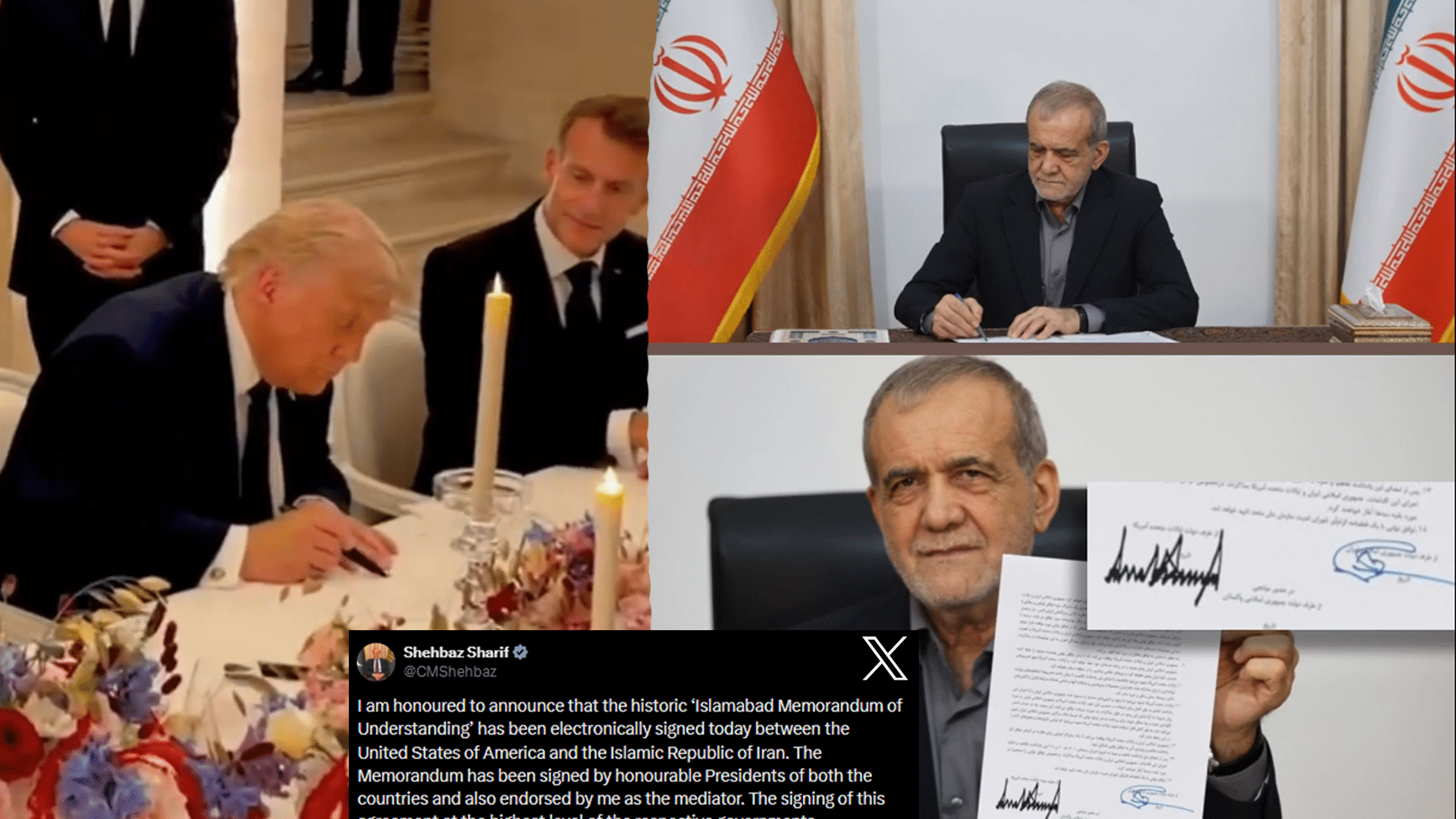
The Islamabad Memorandum was electronically signed today by US President Donald Trump and Iran’s President Masoud Pezeshkian, marking a calibrated end to months of active warfare. This historic peace agreement follows intensive diplomatic mediation by Pakistan, aimed at neutralizing regional volatility. The accord entered force immediately upon signing, initiating a 60-day transition period designed to solidify a permanent geopolitical resolution. Consequently, this development represents a structural pivot in 21st-century diplomacy.
The Strategic Architecture of the Islamabad Memorandum
The signing ceremony utilized secure electronic protocols during a high-profile dinner hosted by French President Emmanuel Macron at the Palace of Versailles. While President Trump endorsed the agreement in France, President Pezeshkian synchronized the signing from Tehran. Prime Minister Shehbaz Sharif confirmed the breakthrough via official channels, highlighting Pakistan’s central role as the primary mediator. Furthermore, the first phase of this deal demands the immediate reopening of the Strait of Hormuz by Iran and the lifting of the naval blockade by the United States.

Precision Diplomacy: The Translation
In technical terms, the Islamabad Memorandum serves as a “De-escalation Framework.” It transitions the conflict from kinetic warfare to a stabilized 60-day negotiation window. By utilizing electronic signatures, both nations bypassed traditional diplomatic delays, reflecting a modern, precision-based approach to international law. Specifically, the agreement establishes a baseline for deep-tier negotiations regarding maritime security and economic sanctions. This mechanism ensures that both parties adhere to verifiable milestones before a final settlement is ratified.
Calibration of Stability: Socio-Economic Impact
How does this historic shift affect the average citizen? The reopening of the Strait of Hormuz acts as a catalyst for global energy price stabilization. For Pakistani households and professionals, this translates to reduced inflationary pressure on fuel and electricity. Increased maritime safety will likely lower freight costs, directly benefiting the manufacturing sector. Moreover, the critical role played by Field Marshal Syed Asim Munir and the diplomatic team reinforces Pakistan’s position as a regional stability hub, potentially attracting foreign direct investment (FDI) into the country’s industrial zones.

The Forward Path: A Momentum Shift
We classify the Islamabad Memorandum as a definitive Momentum Shift. This is not merely a stabilization move; it is a structural redesign of Middle Eastern and South Asian power dynamics. While regional actors attempted to sabotage the deal, the strategic persistence of Pakistan, alongside support from Qatar, Saudi Arabia, and Türkiye, secured the breakthrough. The next 60 days will be critical. If the baseline conditions are met, we are witnessing the dawn of a new era of systematic cooperation that could redefine global trade routes for the next decade.









