

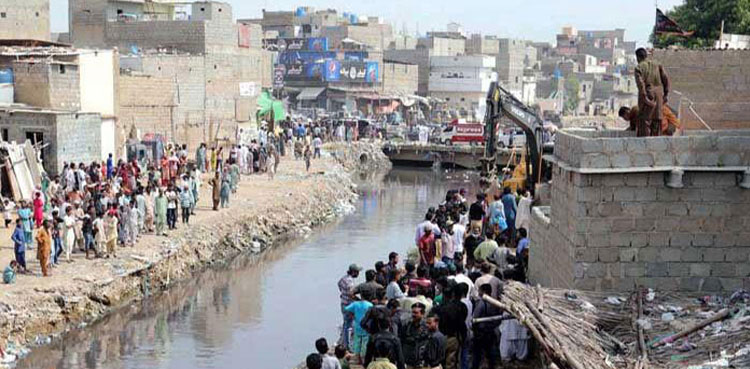
Structural accountability represents the baseline for any functional urban ecosystem. Recently, a local court established TMC Karachi liability by ordering the Town Municipal Corporation (TMC) Orangi Town to pay over Rs. 15 million in compensation to the heirs of a citizen who died due to municipal negligence. This calibrated judicial decision addresses a tragic 2020 incident where a young man lost his life after falling into an uncovered nullah during heavy rainfall.
Establishing Legal Responsibility for Urban Safety
Senior Civil Judge West issued a precise ruling that held TMC Orangi Town solely responsible for the fatal incident. While the court examined the roles of various civic bodies, it strategically cleared the Karachi Metropolitan Corporation (KMC) of direct liability. Consequently, the burden of negligence rests on the local municipal administration for failing to maintain basic safety protocols in the Orangi Town area.
The victim, identified as Arif, was navigating the city during intense rainfall on July 26, 2020. Due to the absence of safety covers on a high-risk nullah, he fell and sustained fatal injuries. Advocate Usman Farooq, representing the family, utilized the Fatal Accidents Act, 1855 to pursue this claim for compensation against the negligent civic bodies.
The Judicial Logic Behind the RS. 15 Million Award
The court’s observation focused on the preventable nature of the tragedy. Since the victim was young, healthy, and the primary support for his family, the court calculated the financial compensation to reflect the profound human and economic loss. Furthermore, the judge emphasized that the “negligent and careless conduct” of the TMC directly caused this loss of life. Despite the TMC’s claims of adequate rain safety arrangements, the evidence demonstrated a critical failure in maintaining hazardous manholes and nullahs.
The Situation Room Analysis
The Translation: Technical Clarity
In legal terms, this ruling utilizes the Fatal Accidents Act of 1855, a foundational law that allows families to seek damages for deaths caused by “wrongful acts, neglect, or default.” By focusing on TMC Karachi liability, the court has clarified the jurisdictional hierarchy. This means that for street-level infrastructure like manholes and small nullahs, the specific Town Municipal Corporation—not just the city-wide KMC—is the entity responsible for citizen safety and legal damages.
The Socio-Economic Impact
This development directly impacts the safety baseline for every Karachi resident. For the average professional or student navigating Karachi’s streets, this ruling creates a “cost for negligence.” When civic bodies are financially penalized for poor maintenance, it incentivizes a shift from reactive repairs to proactive safety measures. For households, this provides a legal precedent to hold local officials accountable for the structural integrity of their neighborhoods.
The Forward Path: Expert Opinion
We classify this ruling as a Momentum Shift. For decades, municipal negligence in Pakistan often went unpunished due to bureaucratic ambiguity. By enforcing a significant financial penalty of Rs. 15 million, the judiciary is signaling a new era of institutional precision. To transform this into a permanent system efficiency, Karachi must now integrate digital mapping of all open nullahs to ensure such “blind spots” in urban safety are eliminated forever.








