

The “Suthra Punjab Program” currently faces a critical structural failure as sanitation workers in Okara and Faisalabad demand Suthra Punjab salaries that have been withheld for over two months. These essential laborers have responded by redirecting urban waste back onto public streets and marketplaces. Consequently, this breakdown in the payment pipeline has transformed a cleanliness initiative into a public health challenge, highlighting the fragility of the current outsourcing model.
The Systemic Delay of Suthra Punjab Salaries
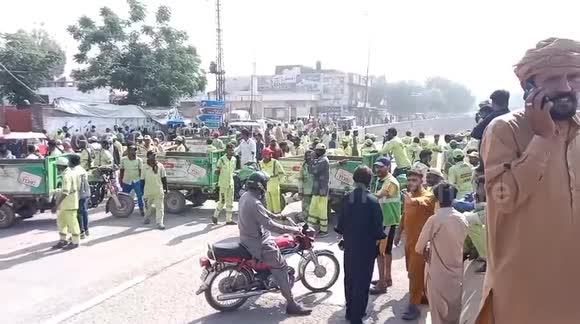
In Okara, workers took the strategic step of dumping garbage across major commercial hubs to signal their financial distress. These employees report 14-hour shifts without compensation, a situation made unbearable by rising national inflation. Furthermore, the protest has spread to Faisalabad, where hundreds of workers marched toward the Deputy Commissioner’s Office. They successfully blocked key roads and deposited waste at official entrances to ensure their grievances were visible to the administration.
Contractual Failures and Labor Insecurity
Labor leaders allege that the outsourcing companies failed to register workers for social security or retirement benefits. This lack of a financial safety net leaves the workforce vulnerable to external economic shocks. Although authorities have now issued formal notices to the contractors, the Suthra Punjab salaries remain a point of intense friction between the state and its service providers.
The Translation (Clear Context)
This crisis represents a “Precision Breakdown” in the provincial administrative architecture. While the “Suthra Punjab” initiative was designed to optimize urban hygiene through outsourcing, it lacked a calibrated mechanism to ensure payment liquidity for the baseline workforce. The logic is simple: when the financial catalyst is removed, the entire logistical system halts. The protest is not merely an act of anger; it is a forced communication from a workforce pushed beyond its economic threshold.
The Socio-Economic Impact
For the average Pakistani citizen, this development creates immediate health hazards and disrupts daily commerce. However, the deeper impact lies in the erosion of institutional trust. When the state’s primary cleanliness program fails to secure Suthra Punjab salaries for its most vital employees, it signals a systemic disregard for labor dignity. For households in Okara and Faisalabad, this means navigating both physical filth and the realization that the systems meant to protect them are fundamentally underfunded or mismanaged.
The “Forward Path” (Opinion)
This development is a Stabilization Move that highlights the need for a structural pivot. Merely issuing notices to contractors is a reactive measure that does not address the core issue of unregulated outsourcing. Next Generation Pakistan views this as a catalyst for reform. To achieve true progress, the government must implement a direct, digital payroll system that bypasses intermediaries. We must ensure that the workers maintaining our national hygiene are the first to be compensated, not the last.








