

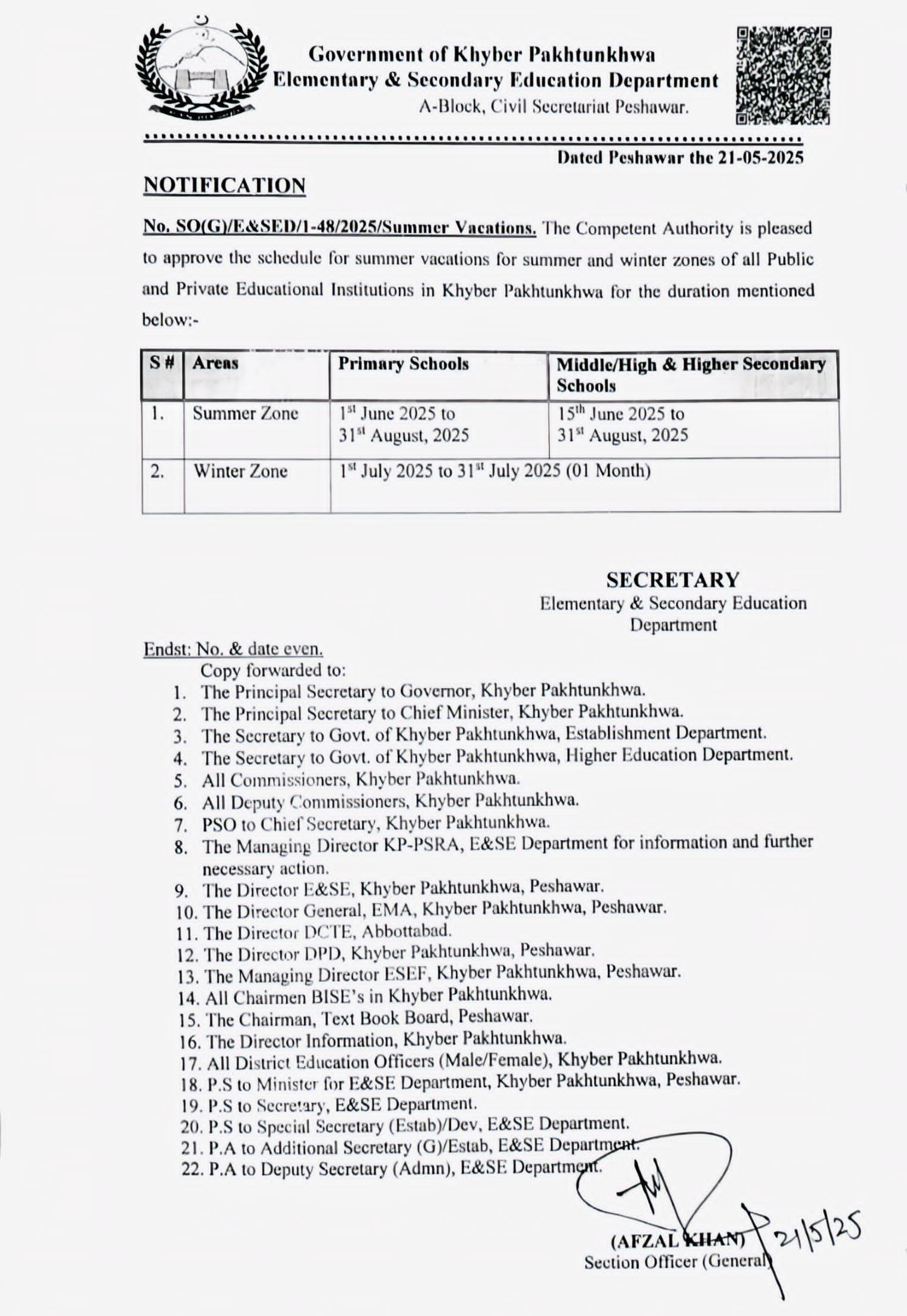
The Khyber Pakhtunkhwa (KP) Elementary and Secondary Education Department recently published the official notification for KP summer vacations, establishing a calibrated operational window for the 2026 academic cycle. This strategic announcement addresses the thermal challenges of the region while maintaining a structural baseline for student progress. Consequently, educational institutions must now align their internal calendars with these province-wide mandates to ensure systemic uniformity.
Calibrated Timelines for KP Summer Vacations
The department has bifurcated the schedule based on regional climate profiles. For the summer zones, primary schools will observe a complete pause from June 1 to August 31. Meanwhile, middle, high, and higher secondary institutions will transition into their recess from June 15 to August 16. In contrast, winter zone schools will follow a condensed thirty-day break, strictly scheduled from July 1 to July 31.
Summer Camp Protocols and Academic Continuity
To prevent learning loss, the department has integrated specialized summer camps for June 2026. These camps will operate under a precision-timed schedule from Monday to Thursday. Primary and middle school students will attend classes between 7:00 AM and 9:00 AM, focusing on core subjects like Mathematics, English, and General Science. Higher secondary students will extend their sessions until 9:40 AM to accommodate Science and Humanities tracks.
- Primary Focus: English, General Science, Mathematics, Urdu, and General Knowledge.
- Secondary Focus: Specialized tracks for Science and Humanities subjects.
- Operational Cap: No academic activity may extend beyond the 10:00 AM threshold.
The Situation Room: Strategic Analysis
The Translation
This update is more than a seasonal break; it is a structural adjustment to the academic clock. By mandating early-morning summer camps, the state is attempting to protect the “Knowledge Retention” phase without exposing students to peak ultraviolet levels. The flexibility granted to school heads to adjust subject durations allows for localized academic precision, ensuring that specific learning gaps are addressed within the restricted operational window.
The Socio-Economic Impact
For the average Pakistani household, this schedule provides a predictable baseline for family planning and child safety. By limiting outdoor exposure to before 10:00 AM, the policy directly mitigates the risk of heat-related illnesses among students. Furthermore, the inclusion of core subjects in summer camps ensures that students in both urban and rural KP remain competitive, preventing the “summer slide” that often affects socio-economically vulnerable districts.
The Forward Path (Opinion)
This development represents a Momentum Shift. Rather than a total shutdown, the KP Education Department is adopting a “Hybrid Continuity” model. This move signals a transition toward a more resilient education system that acknowledges climate realities without compromising on instructional hours. It is a pragmatic step toward building a more adaptable academic infrastructure in Pakistan.








