
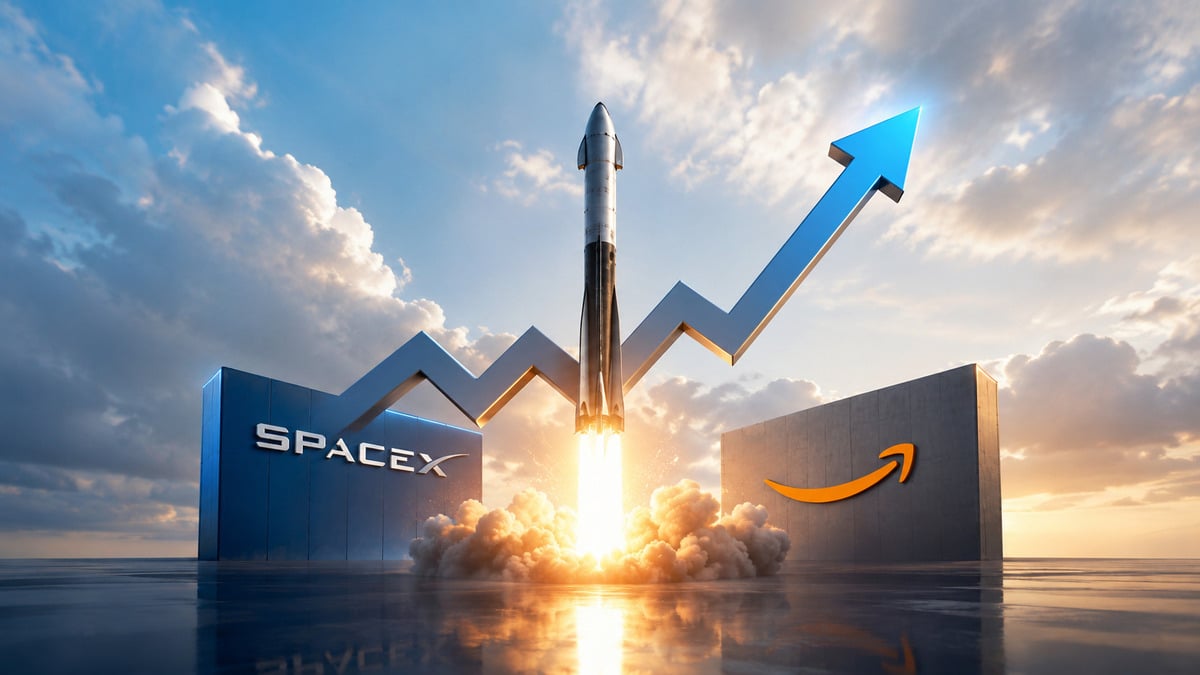
The global financial landscape witnessed a seismic recalibration as the SpaceX market valuation briefly eclipsed Amazon, positioning Elon Musk’s aerospace giant as the fifth-most valuable entity on Earth. This historic surge occurred during a high-intensity post-IPO rally, where shares momentarily pushed the company’s valuation to a staggering $2.9 trillion. While the market later settled, the event signals a structural shift in how investors value multi-planetary infrastructure and integrated AI systems.
Precision Strategy: The Catalyst Behind the Rally
SpaceX shares accelerated by 20% during their first full day of trading, driven by strategic maneuvers that extended beyond traditional aerospace metrics. The momentum intensified following the announcement that SpaceX would acquire Cursor, an AI-driven coding firm, for $60 billion in company shares. This move aligns with Musk’s objective to rebuild the company’s AI division from the foundations up, ensuring a more resilient technical architecture.

Furthermore, the commencement of options trading added significant liquidity and volatility to the SpaceX market valuation. Traders exchanged over 300 million shares in a single day, representing more than half of the total public float. This high-velocity trading environment reflects intense investor appetite for a company that effectively bridged the gap between heavy industry and cutting-edge software automation.
Financial Benchmarks and AI Integration
Despite the rally, the company’s baseline financials show a calibrated risk. SpaceX reported a $4.9 billion loss on $18.7 billion in revenue last year, a sharp contrast to Amazon’s $78 billion profit. However, the market prioritized future scalability over immediate margins. New revenue streams from compute leasing deals with Anthropic and Google have provided a critical catalyst for investor confidence, despite these agreements being currently non-binding.

The Situation Room Analysis
The Translation
In technical terms, SpaceX is no longer being valued as a rocket manufacturer but as a foundational AI and connectivity utility. The market is pricing in the “system efficiency” of owning both the physical transport (rockets) and the digital infrastructure (Starlink/AI). The $60 billion Cursor acquisition is the strategic pivot intended to automate the software layer of this ecosystem, transforming raw hardware into a self-evolving digital frontier.
The Socio-Economic Impact
For the Pakistani professional and student, this development underscores the diminishing gap between software engineering and heavy industry. As SpaceX integrates AI-driven coding via Cursor, the demand for high-precision STEM talent in Pakistan will shift toward multidisciplinary roles. Furthermore, the success of such a capital-intensive IPO suggests that global markets remain ready to fund “hard tech” solutions, potentially opening doors for local startups focused on logistical infrastructure and precision engineering.
The Forward Path
This development represents a Momentum Shift. SpaceX has successfully decoupled its valuation from traditional P/E ratios, moving into the realm of speculative “frontier tech” pricing. While the low public float (4%) makes the stock vulnerable to swings, the massive $86 billion capital injection provides the necessary runway to stabilize its AI ambitions. We are witnessing the birth of a new corporate blueprint: the Integrated Infrastructure-AI Sovereign.









