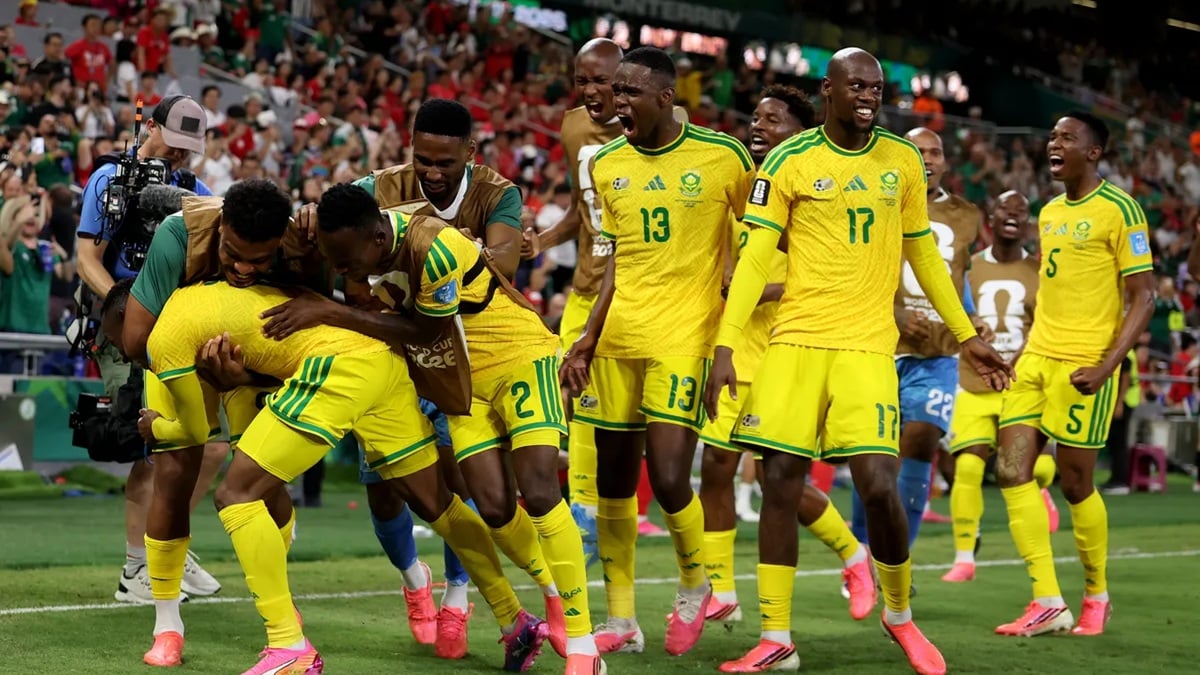
The structural evolution of a national sporting framework often culminates in a single, calibrated moment of breakthrough. South Africa achieved this monumental milestone by securing a position in the FIFA World Cup knockouts for the first time in history. Bafana Bafana defeated South Korea 1-0 at Monterrey Stadium, marking a fundamental shift in the nation\’s athletic trajectory. This victory serves as a precision-engineered response to decades of group-stage exits, finally propelling the squad into the elite Round of 32.
Strategic Execution: Achieving the FIFA World Cup Knockouts
Thapelo Maseko delivered the decisive blow in the 63rd minute of the high-stakes encounter. After receiving a strategic pass from Moremi, Maseko shifted the ball with surgical precision before firing a low shot into the bottom corner. Consequently, South Africa successfully bypassed the limitations that previously stalled their progress in the 1998, 2002, and 2010 tournaments. The team maintained defensive integrity throughout the match, neutralizing a formidable South Korean offense led by Son Heung-min.

The Translation: Tactical Discipline Overcomes Pressure
While the scoreline suggests a narrow victory, the underlying data reveals a masterpiece of structural resilience. South Africa did not merely survive; they calibrated their mid-block to frustrate South Korea\’s creative engines. Early in the match, Aubrey Modiba executed a goal-line clearance that prevented a catastrophic start. This tactical discipline allowed Bafana Bafana to absorb pressure and wait for the precise moment to transition. The match proves that efficiency in the final third outweighs possession statistics when executing a high-stakes tournament strategy.
The Socio-Economic Impact: A Blueprint for Emerging Nations
This historic advancement creates a ripple effect that extends far beyond the pitch. For a nation like Pakistan, observing South Africa\’s ascent provides a baseline for developing a long-term football ecosystem. Furthermore, sporting success at this level acts as a catalyst for national morale and infrastructure investment. The economic benefits of reaching the FIFA World Cup knockouts include increased FIFA funding, higher commercial valuation for players, and a surge in domestic youth participation. It demonstrates that sustained investment in local talent eventually yields global dividends.
The Forward Path: A Momentum Shift
We classify this development as a definitive Momentum Shift. South Africa has transitioned from a participant to a legitimate contender in the global arena. Their upcoming clash against co-host Canada on June 28 will test their newly established baseline. For the first time, Bafana Bafana enters the knockout rounds not just as a guest, but as a strategically viable threat. This is no longer about participation; it is about the precision of progress.