Architectural Calibration of the Urban Grid
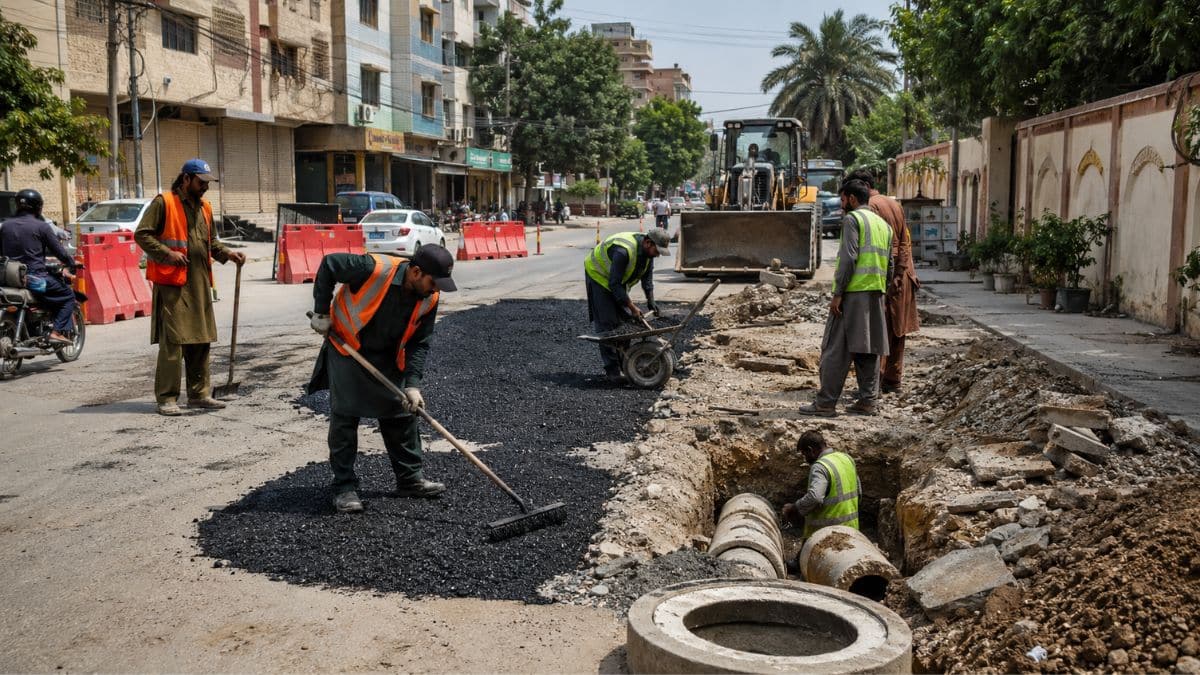
The structural integrity of Karachi’s urban network relies on precise maintenance cycles, a fact underscored by the latest provincial mandate. The Sindh government has officially initiated a baseline recalibration of local infrastructure by ordering immediate Gulistan-e-Jauhar repairs to address failing roads and sewerage systems. Consequently, Chief Minister Murad Ali Shah has mobilized mayoral oversight to ensure these upgrades meet stringent quality benchmarks without further delay.
Strategically, Karachi Mayor Murtaza Wahab has been tasked with conducting an exhaustive review of the area’s primary arteries and internal street networks. This directive encompasses not only surface-level road restoration but also a deep-system audit of drainage lines. Furthermore, the Mayor must submit a comprehensive progress report detailing current development bottlenecks and the precise status of blocked sewerage infrastructure.
Targeted Drainage and Road Network Restoration
The Chief Minister’s approach emphasizes efficiency over traditional bureaucratic timelines. He explicitly stated that poor maintenance and project delays are no longer acceptable metrics for provincial performance. Effectively, the concerned departments must now operate with synchronized urgency to complete the restoration. This calibrated effort aims to mitigate the ongoing challenges faced by commuters and residents who navigate these critical transit corridors daily.
The Situation Room: Analysis
The Translation (Clear Context)
The Sindh government’s directive is a calibrated response to systemic urban decay. By bypassing traditional bureaucratic delays, the provincial leadership is demanding a precision-based restoration of essential utilities. This is not merely a cosmetic road patch; it represents a structural mandate for inter-agency synergy between civic agencies to resolve long-standing sanitation and mobility failures.
The Socio-Economic Impact
For the residents of Gulistan-e-Jauhar, these Gulistan-e-Jauhar repairs catalyze local productivity by reducing vehicle wear and mitigating health hazards associated with stagnant water. Efficient drainage lines act as a baseline for economic stability in high-density residential blocks, protecting property values and enhancing the daily safety of students and professionals. Improved transit efficiency directly correlates with increased economic output for the district.
The Forward Path (Opinion)
This development represents a Momentum Shift. While infrastructure maintenance is the immediate goal, the insistence on high-level mayoral oversight suggests a move toward a more accountable governance model for Karachi’s infrastructure. However, the true test of this catalyst will be the sustainability of the repairs during the next monsoon cycle and the consistency of inter-agency cooperation.