
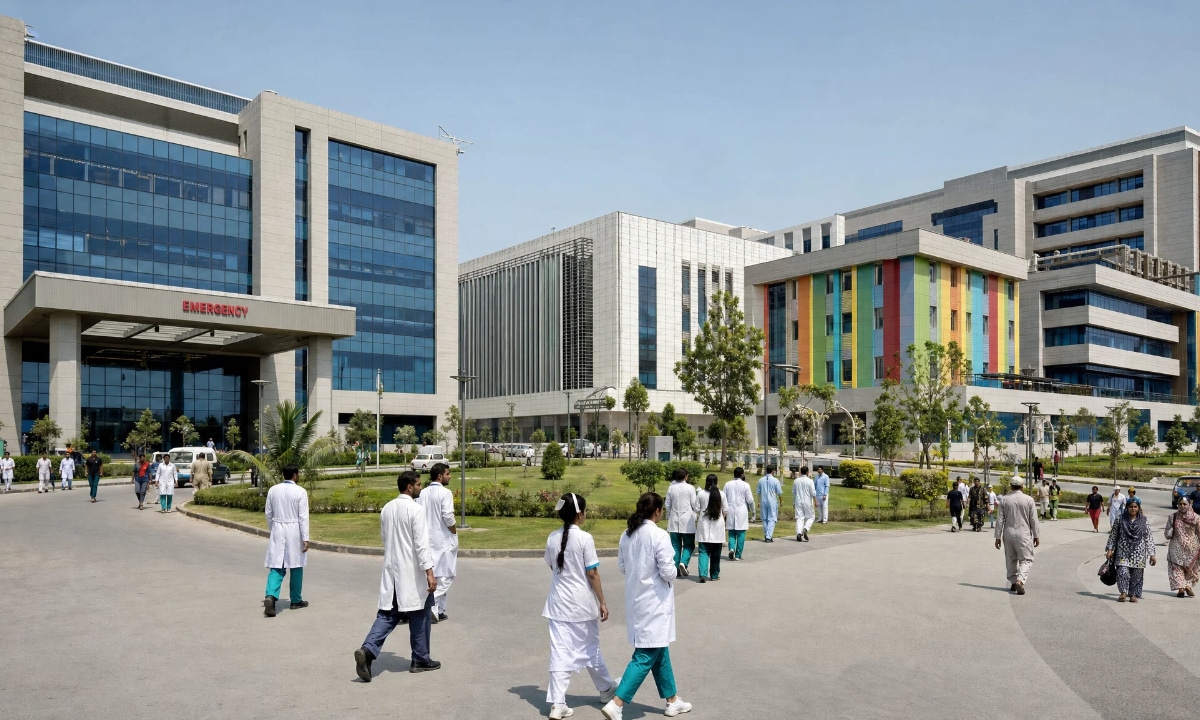
Punjab Chief Minister Maryam Nawaz has officially calibrated the province’s healthcare grid by approving seven major hospitals within the Sharif Medical City. This strategic initiative integrates 1,519 new beds into the provincial system. Consequently, the project will modernize public health delivery through high-precision specialized facilities and structural upgrades to the existing medical framework.
The Strategic Blueprint of Sharif Medical City
The approved expansion includes highly specialized units designed to address critical gaps in Pakistan’s medical landscape. Specifically, the government will establish the Children’s Hospital-IV and the Institute of Surgical Orthopedics. Furthermore, the master plan incorporates a Plastic and Reconstructive Surgery Center, an Institute of Genetic and Blood Diseases, and an Infectious Diseases Hospital.
Officials also confirmed the development of a Center of Excellence for Nursing and Midwifery alongside an Institute of Ophthalmology. These projects represent a phased approach to Punjab healthcare infrastructure development, ensuring that each facility meets international precision standards. In parallel, the meeting reviewed ancillary infrastructure including student hostels, modernized trucking terminals, and strategic food street projects to support the growing Medical District.
The Translation: Breaking Down the Logic
This development signifies a shift toward public-private partnership models to accelerate system efficiency. Rather than relying solely on state resources, the Punjab government is leveraging private sector agility to manage complex healthcare logistics. This approach ensures that sophisticated facilities, such as the FMD production plant and the Mines-to-Metals project in Chiniot, operate with professional precision and sustainable financial baselines.
The Socio-Economic Impact: Citizen-Centric Benefits
For the average Pakistani household, the expansion of Sharif Medical City translates to reduced travel times and lower costs for specialized procedures. Residents in both urban and rural Punjab will now have access to genetic and surgical expertise that previously required expensive private consultations or overseas travel. Moreover, the integrated model creates a localized economic catalyst, providing new employment opportunities for medical professionals and service providers alike.
The Forward Path: Strategic Analysis
This development represents a Momentum Shift for Pakistan’s healthcare sector. By prioritizing specialized institutes over generic wards, the government is moving toward a precision-based healthcare model. This structural upgrade serves as a catalyst for long-term economic growth and social stability, marking a clear departure from maintenance-only governance toward a future-proof health infrastructure.








