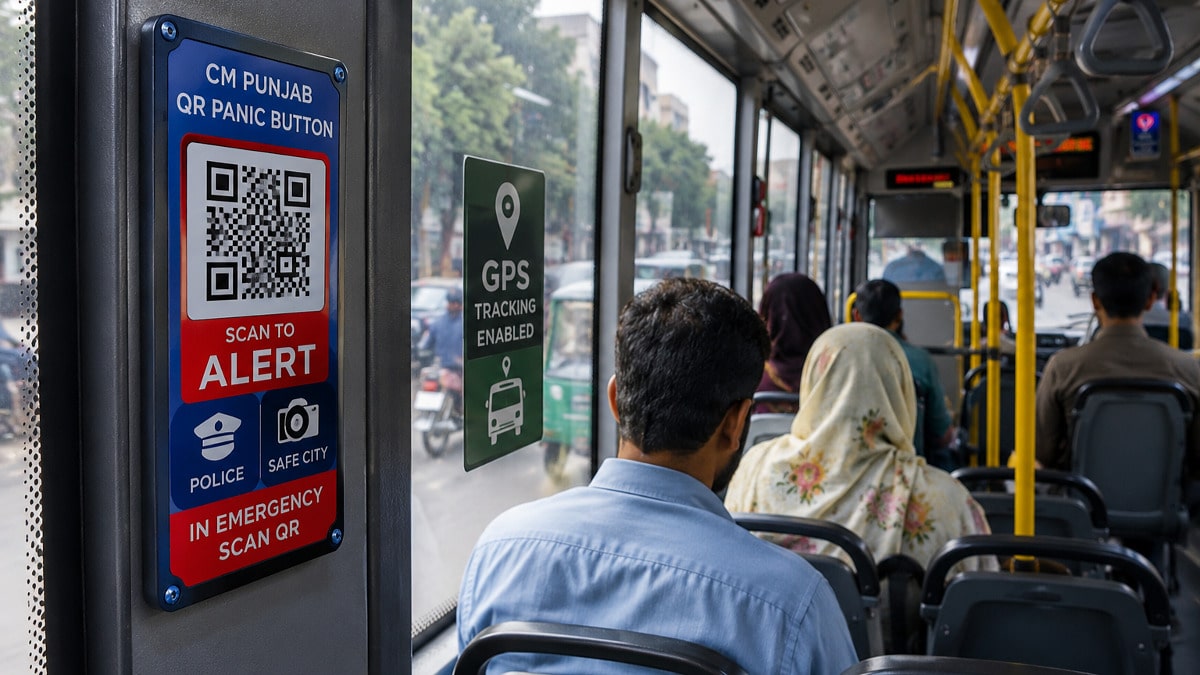
Rawalpindi’s transit infrastructure is undergoing a structural upgrade as authorities integrate QR panic buttons and GPS tracking into the city’s public transport fleet to enhance passenger security and emergency response precision. This calibrated initiative, spearheaded by the Rawalpindi Traffic Police, ensures that safety protocols evolve alongside urban density. By utilizing mobile technology, the department provides a direct link between commuters and law enforcement agencies.
Calibrated Safety via QR Panic Buttons
Chief Traffic Officer (CTO) Farhan Aslam has formally initiated the deployment of the QR panic buttons system across all public transport sectors. Traffic officials are now installing these digital checkpoints in buses, wagons, and rickshaws to create a comprehensive safety mesh. Furthermore, this system allows passengers to bypass traditional reporting delays. Consequently, the immediate nature of a QR-based signal reduces the window for criminal activity or medical emergencies to escalate.
Technical Precision in Emergency Response
Under this new framework, scanning the QR panic buttons instantly transmits live location data and specific vehicle details to Safe City authorities. This level of precision enables law enforcement to execute targeted interventions rather than generalized patrols. Additionally, the integrated GPS tracking provides a structural baseline for monitoring vehicle movement in real-time. Citizens can access these digital lifelines free of charge through the Public Safety App or the Safe City website.
The Situation Room Analysis
The Translation
This initiative represents a shift from voice-dependent emergency calls to data-driven distress signals. By scanning a code, the passenger eliminates the need to describe their location or vehicle details during high-stress situations. The technology automates the identification process, ensuring that the response team receives calibrated data without human error or communication barriers.
The Socio-Economic Impact
For the millions of daily passengers, especially women and students, this deployment serves as a critical catalyst for mobility confidence. When citizens feel secure, labor participation and educational attendance typically increase. Furthermore, the systematic monitoring of public transport reduces the prevalence of harassment and improves the overall quality of life for urban households in Rawalpindi.
The Forward Path
We categorize this development as a Momentum Shift. While GPS tracking is a standard stabilization move in global logistics, integrating a QR-based emergency interface for the general public moves Rawalpindi toward a smarter, more responsive urban ecosystem. It establishes a digital infrastructure that can be scaled across other provinces to unify national public safety standards.