
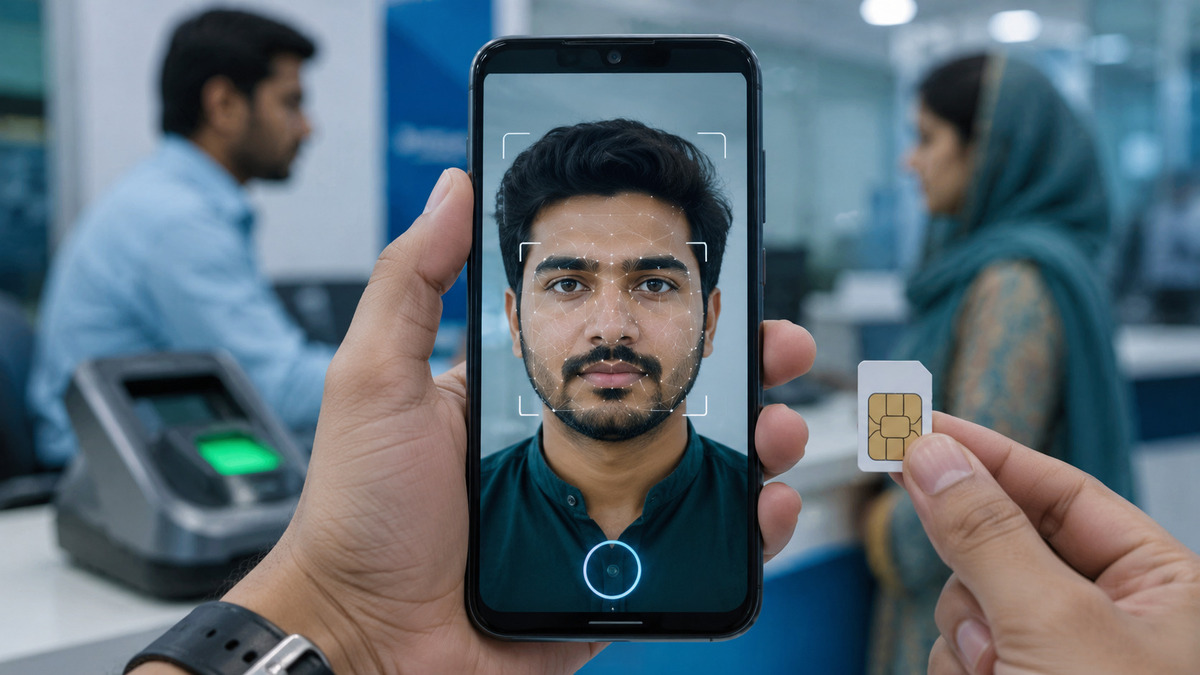
Pakistan’s telecommunications infrastructure is evolving toward a more inclusive, biometrically diverse ecosystem. The Pakistan Telecommunication Authority (PTA) is spearheading this shift by integrating facial verification SIM issuance to overcome traditional fingerprint failures. This strategic move specifically targets senior citizens and laborers who frequently encounter authentication errors during the registration process.
Implementing Facial Verification SIM Technology
The PTA recently submitted a calibrated technical report to the government and Parliament, detailing significant progress on a secure alternative verification system. According to the report, the authority has identified NADRA’s Pak ID app as the primary catalyst for this transition. Consequently, telecom operators will soon offer customer authentication through facial recognition, providing a baseline of accessibility that previously did not exist.
Successful trials of facial verification SIM issuance have already been completed in collaboration with mobile network operators. Furthermore, a “Proof of Concept” demonstrated that the Pak ID app can reliably authenticate users without physical fingerprint scans. PTA has formally requested NADRA to authorize this dual-verification method, allowing customer service centers and franchises to deploy the technology immediately upon final approval.
Overcoming Biometric Hurdles
Data from the report reveals that 70,871 SIMs were issued through alternative mechanisms between January 2025 and the present. Previously, these users relied on medical certificates or NADRA-issued letters to bypass fingerprint failures. While these manual methods provided relief to thousands, the new facial verification system represents a more structural and efficient solution. Mobile operators have already completed the required technical preparations to support this precision-driven update.
The Situation Room Analysis
The Translation
This development simplifies the “Biometric Fail” loop. Currently, if a citizen’s fingerprints are worn or unreadable, they must navigate a bureaucratic path of medical certificates. The new system converts this legal hurdle into a digital one-step process. By utilizing the camera on a smartphone or at a franchise, the Pak ID app verifies identity against NADRA’s database in real-time, removing the need for physical ink or pressure-based sensors.
The Socio-Economic Impact
The impact on the daily lives of Pakistanis is profound, particularly for the working class and the elderly. Laborers involved in manual work often lose their fingerprint ridges, leading to systemic exclusion from digital services. This update ensures that connectivity—a fundamental right in the digital age—is no longer dependent on physical skin condition. For households, this means easier access to communication for elderly relatives without the stress of multiple NADRA visits.
The Forward Path
This development represents a Momentum Shift. Moving beyond singular biometric dependencies is a prerequisite for a mature digital economy. By integrating facial recognition, Pakistan is aligning its telecommunications framework with global security standards. The next phase will likely see SIM issuance directly through mobile operator apps, further decentralizing the process and increasing systemic efficiency across the nation.








