
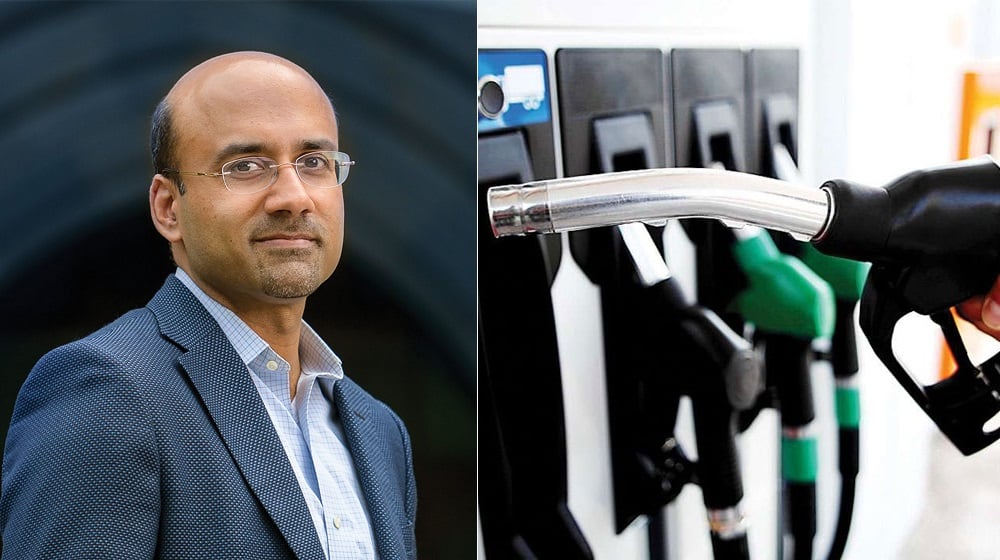
Pakistan’s economic architecture requires a calibrated overhaul to decouple national mobility from volatile international markets. Renowned economist Atif Mian suggests that Pakistan petrol prices are not a reflection of thermodynamic reality but rather a byproduct of inefficient policy structures. Consequently, by transitioning to a decentralized solar-EV ecosystem, the effective cost of travel could plummet to Rs. 30 per litre equivalent.
The Engineering Logic Behind Rs. 30 Travel
The current baseline for mobility relies on inefficient internal combustion engines. Specifically, a standard fuel-efficient motorbike covers approximately 60 kilometers per litre of petrol. In contrast, an electric scooter achieves the same distance using only 2 kWh of energy. Furthermore, Pakistan possesses a strategic advantage in solar generation, where electricity production costs average 5 cents per kWh.
Mathematically, this translates to roughly 10 cents—or Rs. 30—to cover the distance currently costing over Rs. 300 in petrol. Therefore, the discrepancy between current Pakistan petrol prices and the electric equivalent represents a massive loss in national efficiency.
The Translation (Clear Context)
Professor Atif Mian is not arguing that the market price of the liquid fuel will drop. Instead, he is highlighting a “mobility arbitrage.” He argues that we do not consume petrol for its own sake; we consume it for the utility of travel. By switching the energy carrier from imported oil to domestic solar power, we can achieve the same utility at 10% of the cost. The “Rs. 30” figure is a calibrated baseline for energy-equivalent travel.
Addressing the Structural Gap in Energy Policy
The gap between Rs. 300 and Rs. 30 persists due to a historical reliance on dollar-indexed power projects and expensive fuel imports. Moreover, past administrations prioritized traditional automotive sectors over decentralized solar infrastructure. This strategy has inadvertently penalized the Pakistani consumer with higher electricity costs and slower technological adoption.
Strategic investment in EV charging networks and battery swapping systems could serve as a catalyst for local investment. Consequently, billions of dollars currently leaving the country for fuel could instead circulate within the domestic economy, creating a robust ecosystem for small businesses and modular energy producers.
The Socio-Economic Impact
This structural shift would revolutionize the daily life of Pakistani citizens, particularly students and middle-income professionals. A 90% reduction in transport costs provides immediate relief to household budgets, allowing that capital to flow into education, healthcare, or personal savings. Additionally, the proliferation of battery swapping stations creates a new domestic industry, offering scalable job opportunities in both urban and rural centers.
The “Forward Path” (Opinion)
This development represents a Momentum Shift. Moving toward a solar-EV framework is no longer a luxury; it is a precision requirement for national survival. While the transition demands a stabilization move in the short term to manage existing IPP contracts, the long-term architectural goal must be total energy independence through decentralized technology. We must stop subsidizing the past and start engineering the future.








