
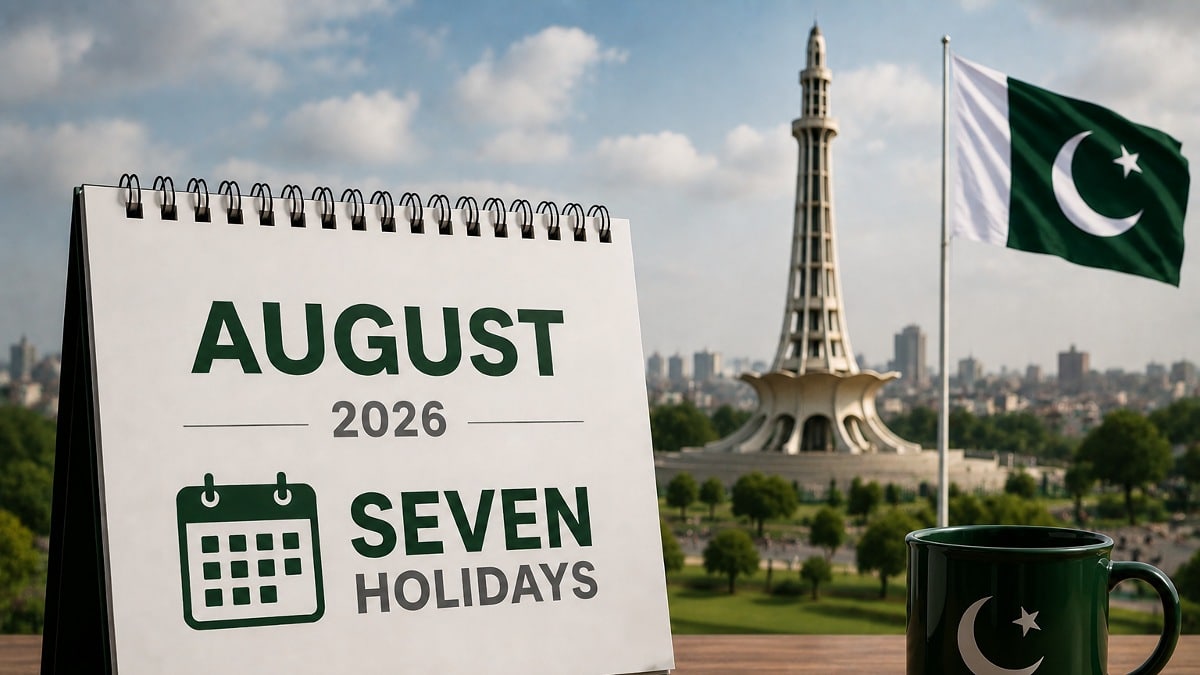
National productivity requires calibrated intervals of rest to sustain systemic efficiency. For August 2026, the August holidays Pakistan schedule identifies seven specific dates for citizen recharge and national observance. This alignment includes five standard weekends and two high-priority public holidays sanctioned by the federal government. Consequently, both the public and private sectors must adjust their operational baselines to accommodate this structural shift in the working month.
Mapping the August 2026 Holiday Grid
The Cabinet Division has finalized the 2026 calendar, highlighting a unique clustering of downtime. The five Sundays occur on August 2, 9, 16, 23, and 30. Furthermore, the state has designated August 14 for Independence Day and August 25 for Eid Milad-un-Nabi (12th Rabi-ul-Awwal 1448 AH). While government offices will follow this strictly, private-sector execution remains contingent on individual corporate policy frameworks.

The Translation: System Logic Explained
In technical terms, the August 2026 calendar represents a “High-Density Rest Phase.” The overlap of religious observances and national milestones creates a rare 22.5% non-operational ratio for the month. By aligning the August holidays Pakistan notification early, the government allows industrial sectors to recalibrate their supply chain expectations. This transparency ensures that technical milestones and project deadlines remain realistic despite the reduced number of active business days.
The Socio-Economic Impact: Daily Life and Utility
For the average Pakistani citizen, these seven holidays act as a catalyst for domestic economic stimulation. Households often utilize these clusters to increase local consumption, benefiting the retail and tourism sectors. However, for daily wage earners, these breaks require precise financial management. The structured gap between August 14 and August 25 allows for significant social cohesion without causing a complete halt to the urban economic engine.
The Forward Path: Strategic Momentum
From an architectural standpoint, this development represents a Stabilization Move. While seven holidays might seem to interrupt momentum, they actually prevent burnout within the national workforce. We view this as a necessary pause to maintain long-term precision in our economic output. Organizations should leverage this foresight to implement “Sprint Cycles” in the early weeks of the month, ensuring that the Independence Day break does not stall critical national projects.








