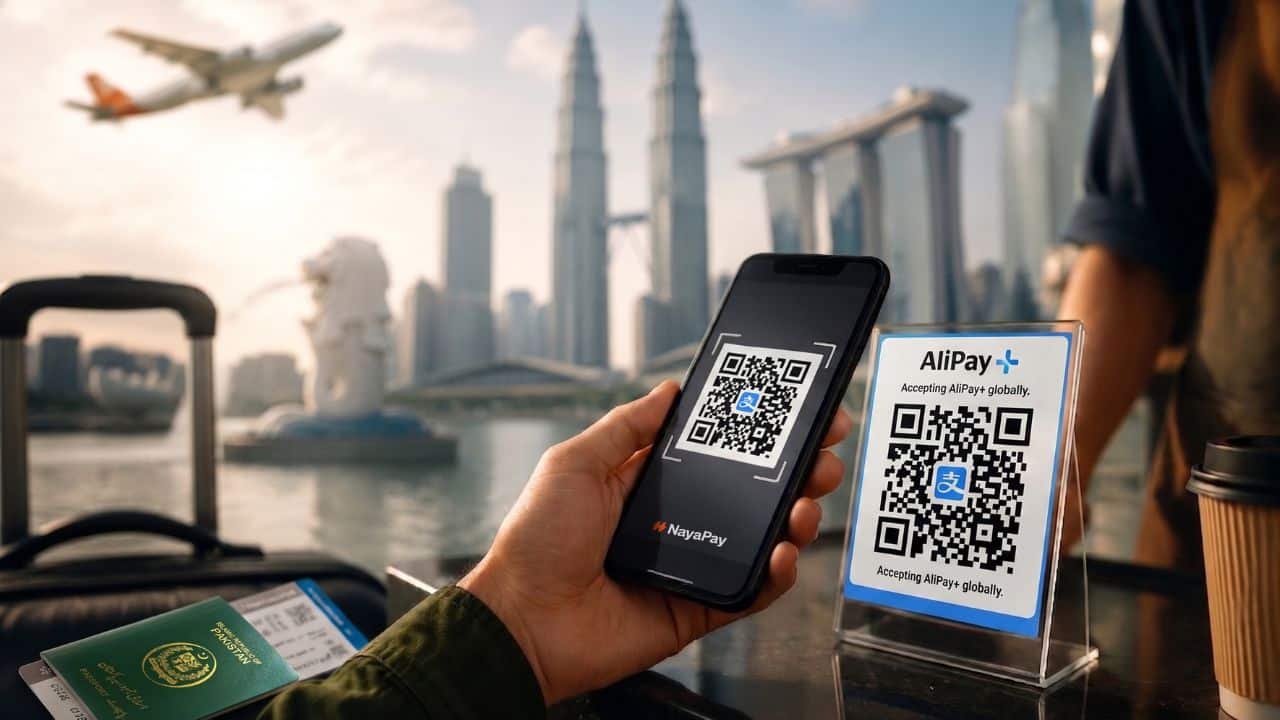
The global financial architecture is undergoing a structural recalibration. Historically, Pakistani citizens faced significant friction when transacting abroad, forced to choose between predatory currency exchange rates or excessive bank card fees. However, a transition is occurring as citizens adopt QR payment networks to achieve a higher baseline of financial efficiency during international travel.
The Structural Rise of QR Payment Networks
Across the Asian landscape, QR-based payment ecosystems have effectively bypassed traditional card schemes. Systems like Alipay+ have stitched together a cross-border digital framework. Consequently, this allows a traveler from Karachi to execute a precision transaction in Kuala Lumpur using their domestic wallet. This infrastructure eliminates the need for local SIM cards, foreign bank accounts, or physical currency reserves.
Pakistani-issued cards frequently suffer from weak international acceptance and high markup percentages. In contrast, QR payment networks provide a calibrated solution that operates outside these traditional limitations. Currently, NayaPay stands as the primary catalyst in the local EMI space, offering direct integration with the Alipay+ network.
The Translation: Understanding the Logic
To understand this shift, we must look at the underlying technology. Rather than relying on the legacy “swipe and verify” card system, these networks use a unified QR standard that communicates directly between digital wallets. This means your Pakistani rupees are converted at a more transparent rate the moment you scan. It simplifies the transaction flow into a single, mobile-first action that mirrors the domestic digital habits we have already mastered.
The Socio-Economic Impact
This development significantly reduces the “travel tax” paid by Pakistani students, professionals, and families. For an Umrah pilgrim or a student in China, the ability to avoid physical cash reduces the risk of loss or theft. Furthermore, the removal of heavy transaction fees keeps more capital in the hands of the traveler. This efficiency is a critical step toward integrating the Pakistani middle class into the global digital economy.
The Forward Path: A Momentum Shift
This integration represents a definitive Momentum Shift. We are witnessing the first signs of Pakistan’s domestic payment rails connecting to a global grid. While the current network covers key destinations like Dubai, Thailand, and Singapore, the strategic potential is much larger. For the system to reach maximum velocity, more local banks must follow this blueprint, moving away from legacy card models toward app-based global interoperability.