National industrialization reached a calibrated benchmark today as the Nishat Group achieved a significant Nishat Group automotive milestone by rolling off 5,000 units of Omoda & Jaecoo vehicles. This achievement, finalized at the state-of-the-art Faisalabad facility, underscores a rapid structural expansion in Pakistan’s premium mobility sector. By integrating global manufacturing standards with local labor, the group has successfully scaled production to meet the surging domestic demand for advanced hybrid technology.
Strategic Production and Global Trajectory
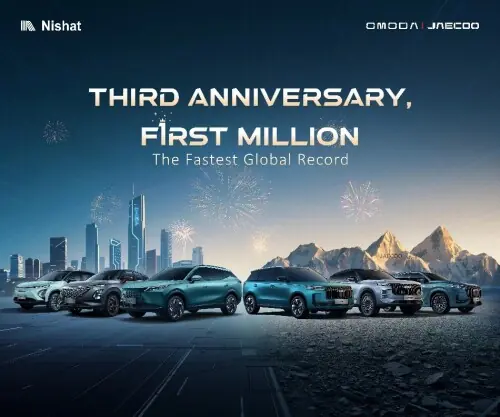
Omoda & Jaecoo currently operates as the fastest-growing automotive brand globally, securing nearly 1 million sales within its first three years. Consequently, the localization of this momentum within Pakistan represents a strategic alignment with international market trends. The production milestone specifically highlights the success of the Jaecoo J5 SHS HEV and the Jaecoo J7 SHS PHEV models. These vehicles have established a new baseline for consumer adoption, driven by their reputation for innovation and precision engineering.

The Faisalabad plant serves as the catalyst for this growth. By maintaining high operational excellence, Nishat Group has demonstrated that Pakistan’s industrial infrastructure can support sophisticated automotive assembly. Furthermore, the strong booking numbers across the country indicate a profound shift in consumer trust toward premium, locally-manufactured solutions.

The Translation: Breaking Down the Nishat Group Automotive Milestone
To understand the technical gravity of this event, one must look at the “Line Off” terminology. This signifies the moment a vehicle is fully assembled and passes final inspection, ready for the consumer. The SHS (Smart Hybrid System) technology used in the J5 and J7 models integrates electric and internal combustion power with precision. This ensures maximum fuel efficiency without sacrificing performance. Essentially, Nishat Group is not just building cars; they are deploying a sophisticated energy-management ecosystem on four wheels.
The Socio-Economic Impact: What This Means for Citizens
This development directly impacts the Pakistani citizen through two primary channels: economic stability and technological accessibility. Localized production at this scale generates specialized technical jobs, fostering a workforce capable of maintaining next-generation systems. For the average household, the increased availability of Hybrid Electric Vehicles (HEV) and Plug-in Hybrids (PHEV) provides a strategic hedge against volatile fuel prices. As more units hit the road, the cost of maintenance and parts typically decreases, making premium technology more sustainable for the professional class.
The Forward Path: Architect’s Opinion
The achievement of 5,000 units in such a compressed timeframe represents a definitive Momentum Shift for Pakistan’s automotive landscape. While many manufacturers are currently in a stabilization phase due to economic headwinds, Nishat Group’s aggressive scaling of Omoda & Jaecoo suggests a high-conviction bet on the country’s long-term industrial potential. This move transitions Pakistan from a mere consumer of foreign technology to a regional hub for precision hybrid assembly.