
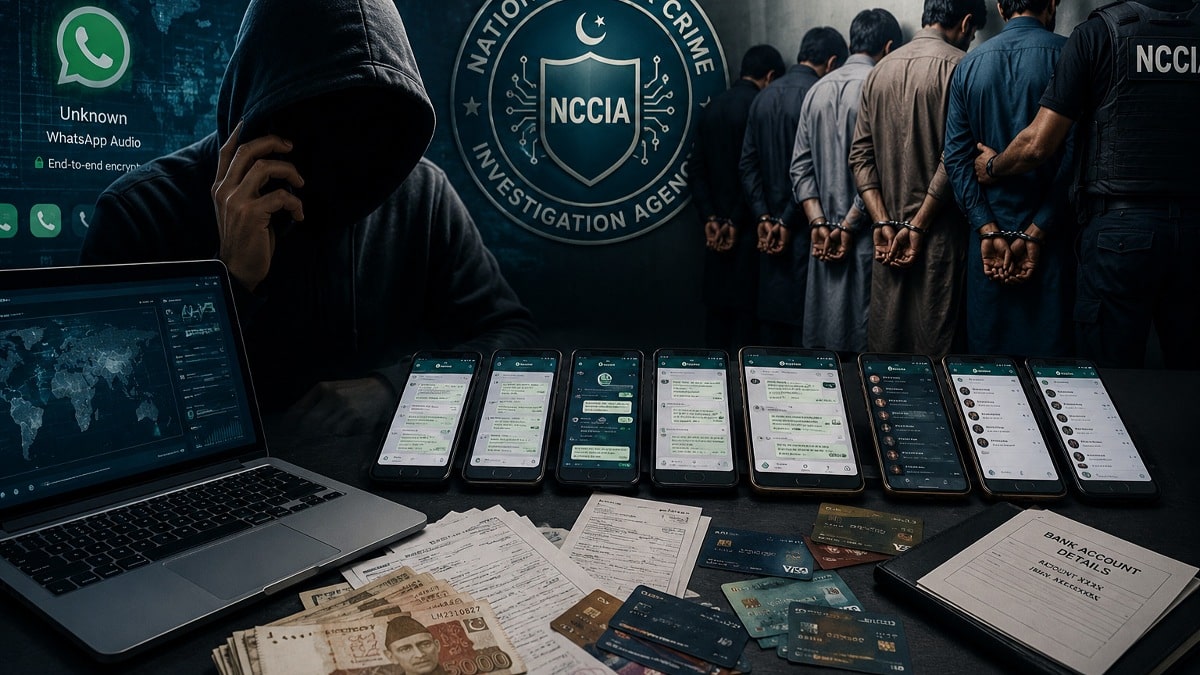
The National Cyber Crime Investigation Agency (NCCIA) recently executed a calibrated operation resulting in a major NCCIA scam arrest of a 10-member inter-provincial syndicate. This gang specialized in precision social engineering, impersonating relatives of overseas Pakistanis to extract funds through fabricated emergency scenarios. Architecturally, the group leveraged advanced technology to manipulate domestic trust for illicit financial gain.
The Tactical Neutralization of a Fraud Syndicate
According to official statements, the suspects utilized foreign WhatsApp numbers and specialized caller-masking software to obfuscate their true identities. They constructed credible narratives by posing as close relatives facing urgent visa or immigration crises abroad. Consequently, victims were coerced into transferring significant sums under the guise of family assistance.
The operational logic of the gang involved sending forged digital receipts and fake bank transaction slips to validate their claims. This layer of deception ensured a high conversion rate for their fraudulent requests. Specifically, investigators confirmed that the syndicate successfully defrauded at least one citizen of Rs. 1.02 million before the NCCIA scam arrest occurred during a tactical raid in Sohan Garden, Islamabad.
Digital Forensics and Evidence Retrieval
During the precision raid, the NCCIA apprehended ten suspects, all originating from Sindh, identified as Mohsin Braro, Muhammad Adil, Asadullah, Mashooq Ali, Arz Muhammad, Dilbar Ali, Daud, Fahad, Imtiaz Ali, and Ibtisam. Furthermore, investigators recovered 10 mobile devices containing incriminating WhatsApp logs, forged financial documents, and stolen banking data.

The Situation Room: Strategic Analysis
The Translation
In “Next Gen” terms, this case highlights the “Impersonation-as-a-Service” model of cybercrime. By using caller-masking, the gang bypassed the standard biological and social verification protocols humans use to identify family members. They essentially hacked the “Trust Layer” of social communication rather than the technical layer of the bank itself.
The Socio-Economic Impact
This development directly impacts the security of the Pakistani household’s digital wallet. When inter-provincial gangs target the emotional bonds between overseas workers and their families, it creates a “Trust Deficit” that slows down the adoption of digital financial services. For the average citizen, this NCCIA scam arrest provides a necessary baseline of security, ensuring that digital connectivity remains a tool for progress rather than a liability.
The Forward Path
We categorize this development as a Momentum Shift. While fraud is persistent, the NCCIA’s ability to track masked foreign numbers to a physical location in Sohan Garden demonstrates a significant upgrade in Pakistan’s signal intelligence and inter-provincial coordination. This is a catalyst for a more robust digital infrastructure where perpetrators can no longer hide behind software obfuscation.








