

Precision-engineered public transit systems must operate with zero-margin error to ensure urban efficiency. On Saturday, a Metro bus fire erupted near Sixth Road in Rawalpindi, triggering an immediate suspension of operations and highlighting a critical baseline vulnerability in our mass transit infrastructure. While authorities successfully evacuated all passengers, the incident underscores the urgent need for calibrated safety protocols within the Rawalpindi-Islamabad metro network.
The Sixth Road Incident: Analysis of the Metro Bus Fire
The fire ignited suddenly as the vehicle traversed the dedicated track from Islamabad toward Saddar, Rawalpindi. Consequently, panic spread among the commuters, who resorted to breaking windows to exit the cabin before the arrival of emergency services. More than 12 rescue personnel and four specialized emergency vehicles arrived on the scene to execute a high-precision firefighting operation. Furthermore, officials confirmed that the blaze completely destroyed the vehicle before they could contain the flames.
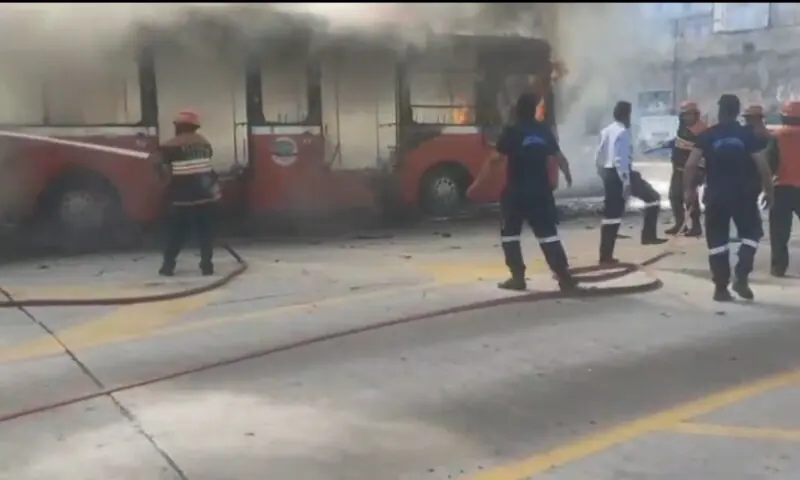
Preliminary diagnostic investigations by rescue authorities suggest a short circuit within the vehicle’s electrical matrix as the primary catalyst. Consequently, the administration suspended all metro operations and closed ticket counters across several stations to conduct comprehensive safety audits. This strategic pause ensures that the track remains clear of debris and secondary hazards before service restoration.
The Translation: Deconstructing Technical Risks
Essentially, the “short circuit” mentioned by officials indicates a failure in the electrical insulation or a surge within the bus’s internal wiring. In a high-capacity transit vehicle, such failures can lead to rapid thermal runaway. Because the fire erupted in a confined track area, the evacuation logic required passengers to bypass standard exits. The breakage of windows was not merely an act of panic but a necessary survival response to a structural failure of the primary egress systems.
Socio-Economic Impact: The Daily Pulse of the Twin Cities
This disruption directly affects the precision of daily life for thousands of Pakistani citizens. Specifically, students and professionals who rely on the metro for affordable, time-sensitive commuting faced immediate logistical hurdles. For the average household, the suspension of the metro translates to increased expenditures on private transport and significant loss of productive hours. Furthermore, such incidents diminish public confidence in state-managed infrastructure, which is a vital catalyst for urban development.
The Forward Path: A Catalyst for Systematic Upgrades
We categorize this development as a Momentum Shift requiring immediate structural intervention rather than a simple stabilization move. To prevent future occurrences of a Metro bus fire, the management must implement a rigorous, data-driven maintenance schedule. Specifically, the aging fleet requires a calibrated overhaul of electrical systems. Ultimately, Pakistan’s path to modernization depends on the reliability of its systems; yesterday’s fire must serve as the catalyst for a more resilient and precise public transport framework.








