
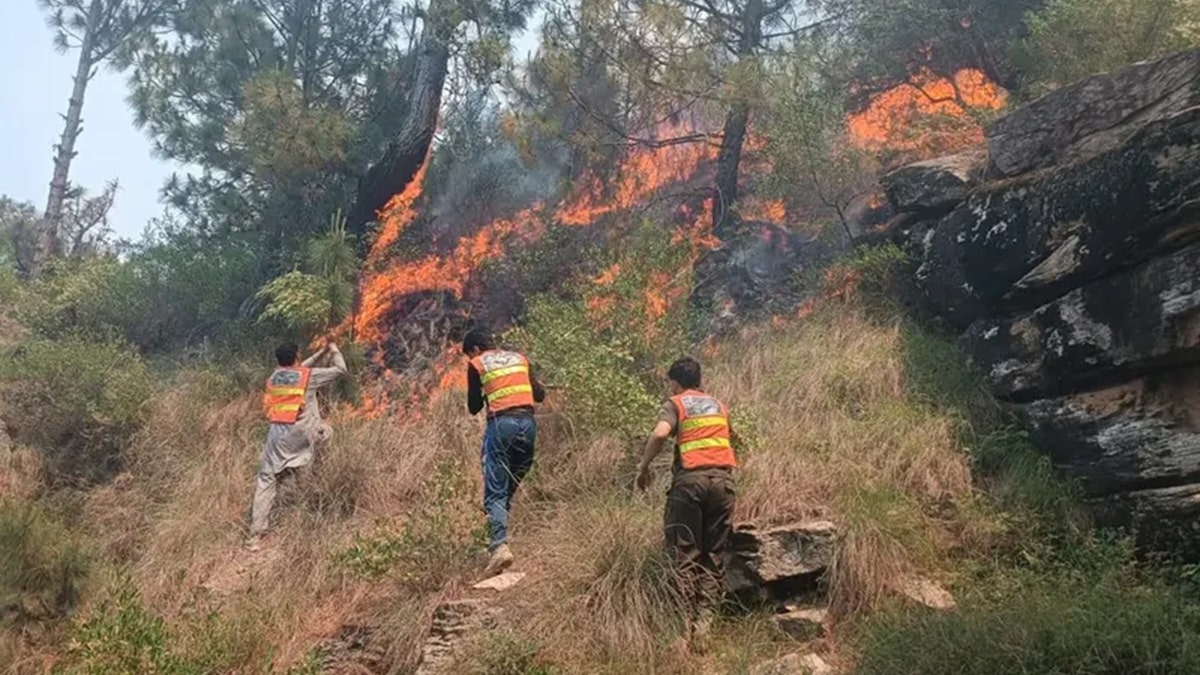
A massive wildfire recently impacted the Saleem Bagh forest in the Mansehra mountain range, triggering a calibrated emergency response to safeguard local biodiversity and residential infrastructure. District Emergency Officer Ibrar Ali confirmed that rescue teams neutralized the blaze through a combination of mechanized and traditional firefighting tactics. While the incident caused significant damage to indigenous flora and fauna, the swift deployment of resources prevented a wider structural disaster in the adjacent urban areas.
Analyzing the Saleem Bagh Forest Incident
The fire spread with dangerous precision due to high concentrations of dry grass and pine needles, which acted as a natural catalyst for the flames. Consequently, firefighters faced a dual-front challenge: high-altitude terrain and rapid horizontal expansion. Specifically, teams utilized fire tenders in accessible regions while employing manual suppression methods in steep, high-altitude zones where machinery could not penetrate. This multi-layered strategy eventually restricted the fire to the forested perimeter, effectively creating a barrier for nearby households.
The Translation: Technical Context
In environmental terms, pine needles (conifer litter) possess high resin content, making them exceptionally flammable during dry seasons. When these materials accumulate, they create a “fuel bed” that allows fire to leap across the forest floor at accelerated speeds. The rescue operation’s success relied on “structural containment,” which focuses on cutting off the fire’s path rather than just cooling the flames. This maneuver saved the Saleem Bagh forest from becoming a total ecological loss.
The Socio-Economic Impact
This incident directly impacts the local economy and public health in several ways. Primarily, the destruction of herbs and shrubs disrupts the local supply chain for traditional medicine and botanical research. Furthermore, the loss of wildlife reduces the regional biodiversity index, which is a baseline for ecological health in Northern Pakistan. For the residents of Mansehra, the fire represented a looming threat to property values and air quality, highlighting the urgent need for modernized fire-break infrastructure in mountain ranges.
The Forward Path: Architectural Opinion
This development represents a Stabilization Move rather than a momentum shift. While the emergency response was technically proficient and disciplined, the occurrence of the fire itself reveals a lack of preventative structural baseline. To advance, Pakistan must transition from reactive firefighting to predictive forest management. Implementing sensor-based early warning systems and strategic controlled burns would represent a calibrated approach to environmental security. Ultimately, protecting the Saleem Bagh forest requires a shift toward system efficiency in disaster mitigation.








